|
Getting your Trinity Audio player ready...
|
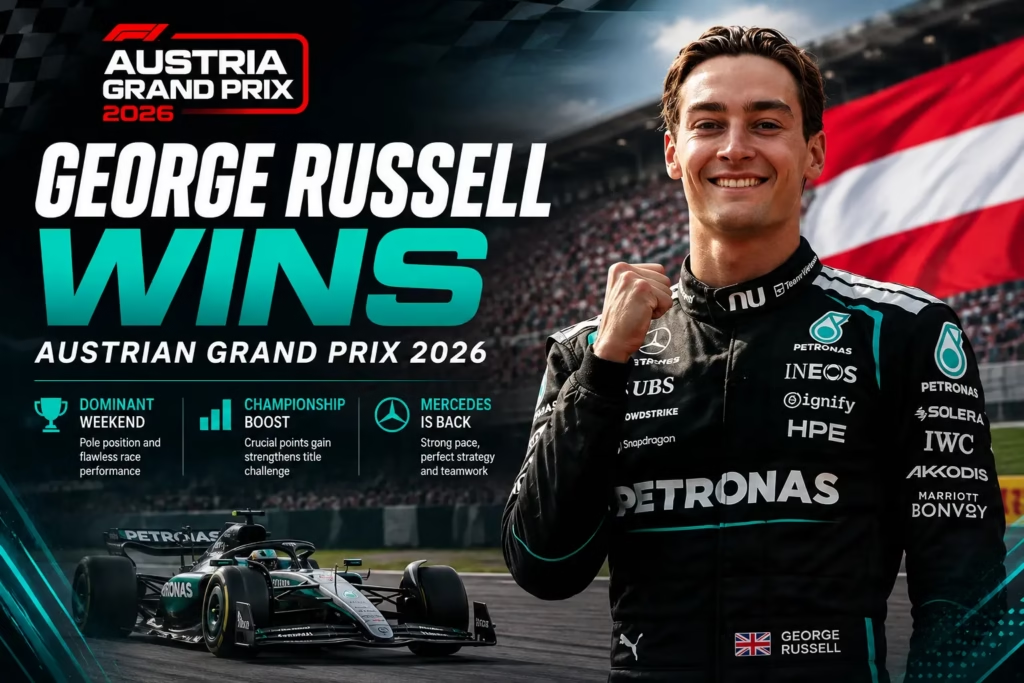
Formula 1 is a sport where success is measured in fractions of a second, and championships are often decided by a handful of moments across a long and demanding season. On a dramatic weekend at Austria’s iconic Red Bull Ring, George Russell delivered one of those defining moments. The Mercedes driver produced a near-flawless performance to secure victory at the Austrian Grand Prix 2026, a result that not only strengthened his own championship ambitions but also sent a clear message to the rest of the Formula 1 grid: Mercedes is firmly back in the fight.
The Austrian Grand Prix has always been one of the most exciting races on the Formula 1 calendar. With its fast straights, technical corners, elevation changes, and passionate fan base, the Red Bull Ring consistently produces action-packed racing. This year’s edition was no different. However, while fans expected another fierce battle between Formula 1’s leading teams, few predicted the level of dominance and composure George Russell would display throughout the weekend.
His victory was more than just another race win. It represented years of development, patience, and hard work. For Mercedes, it validated months of engineering improvements and strategic planning. For Formula 1 fans, it added another fascinating chapter to what is becoming one of the most competitive championship battles in recent memory.
George Russell’s Journey to the Top
George Russell’s rise through the ranks of motorsport has been one of determination and consistent excellence. Long before he became a Formula 1 race winner, Russell was already considered one of the brightest young talents in motorsport. Success in karting was followed by championship victories in Formula 3 and Formula 2, where he showcased the speed, intelligence, and racecraft that would later define his Formula 1 career.
His Formula 1 debut with Williams came during a difficult period for the historic British team. Despite driving a car that struggled for competitiveness, Russell consistently outperformed expectations. Week after week, he extracted maximum performance from the machinery available to him, earning widespread respect throughout the paddock.
When Mercedes eventually promoted him to their works team, expectations were enormous. Replacing one of the sport’s greatest line-ups is never easy, but Russell embraced the challenge. Over subsequent seasons, he matured into a genuine team leader capable of fighting at the front against Formula 1’s elite drivers.
The Austrian Grand Prix victory was not simply a product of speed. It was the culmination of years of experience, learning, and development as a driver capable of managing pressure at the highest level of motorsport.
Qualifying Performance Set the Tone
The foundation for Russell’s victory was established during qualifying. The Red Bull Ring is one of the shortest circuits on the Formula 1 calendar, meaning lap times are incredibly close. A minor mistake can cost multiple positions, while a perfect lap can deliver pole position.
Russell delivered precisely when it mattered most.
Throughout the qualifying sessions, the Mercedes driver looked comfortable and confident. His car demonstrated excellent balance through Austria’s high-speed sections while maintaining strong traction exiting corners. As the final qualifying session unfolded, Russell produced an exceptional lap that secured pole position against intense competition from Red Bull, Ferrari, and McLaren.
Securing pole position at a circuit where overtaking opportunities can sometimes be limited provided a significant strategic advantage. More importantly, it demonstrated that Mercedes had found genuine pace capable of challenging the strongest teams on the grid.
The result also boosted confidence within the Mercedes garage. Pole position wasn’t achieved through luck or changing weather conditions. It was earned through outright performance, reinforcing the belief that Mercedes had made meaningful progress during the season.
Race Day: A Masterclass in Control
When the lights went out on race day, the pressure immediately intensified. Starting from pole position brings advantages, but it also creates enormous responsibility. Every rival behind is focused on finding a way past, and every strategic decision becomes critical.
Russell handled the challenge perfectly.
His launch from the starting grid was clean and decisive, allowing him to maintain the lead into the opening corners. Behind him, multiple battles unfolded as drivers fought for track position, but Russell remained calm and focused on controlling the pace at the front.
Throughout the opening stint, he demonstrated excellent tyre management. Modern Formula 1 races are often decided not only by speed but by how effectively drivers preserve tyre performance over long distances. Russell balanced aggression and conservation expertly, ensuring he maintained competitive pace without excessively degrading his tyres.
As the race progressed, several strategic scenarios emerged. Teams evaluated whether to pursue aggressive undercut strategies, extend stints, or respond to changing track conditions. Mercedes executed their race plan with precision, making pit stop decisions that kept Russell in control of the event.
Even when rivals attempted to close the gap, Russell consistently responded with strong lap times. Every challenge was met with composure and professionalism.
Mercedes’ Strategy Played a Crucial Role
Formula 1 victories are rarely achieved by drivers alone. Behind every successful race is a team of engineers, strategists, analysts, and mechanics working together to maximize performance.
Mercedes’ Austrian Grand Prix strategy was close to perfect.
The team entered the weekend with a clear understanding of tyre degradation patterns and race pace expectations. Their strategic planning allowed Russell to remain in favourable track positions throughout the event while minimizing risks.
Pit stops were executed efficiently, helping prevent competitors from gaining valuable time. Communication between the pit wall and Russell remained smooth, ensuring that race decisions were implemented quickly and effectively.
Perhaps most importantly, Mercedes showed confidence in their pace. Rather than reacting nervously to every move from rivals, they trusted their preparation and allowed Russell to manage the race according to plan.
The victory highlighted how far Mercedes has progressed compared to previous seasons, where strategy execution occasionally undermined strong on-track performances.
What the Win Means for Mercedes
For Mercedes, the Austrian Grand Prix victory carries significance far beyond a single race result.
The team has spent recent years attempting to close the gap to Red Bull and regain its status as Formula 1’s dominant force. While progress has been visible, consistent race-winning pace has sometimes proved elusive.
Austria provided evidence that Mercedes is moving in the right direction.
The car demonstrated competitiveness across different phases of the weekend, from qualifying to race pace. Engineers will be encouraged by the performance data, while team management can view the victory as validation of their development strategy.
Momentum is incredibly important in Formula 1. A successful weekend often boosts confidence throughout an organization, from drivers and engineers to factory staff working behind the scenes. The Austrian Grand Prix may ultimately prove to be a turning point in Mercedes’ 2026 campaign.
Impact on the Drivers’ Championship
One of the most important consequences of Russell’s victory is its effect on the championship standings.
Formula 1 championships are built through consistency, and every victory carries substantial value. By securing maximum points in Austria, Russell strengthened his position among the leading title contenders and increased pressure on his rivals.
The championship battle remains incredibly competitive, with multiple drivers capable of winning races. However, victories such as Austria provide both mathematical and psychological advantages.
For Russell, the result reinforces his credentials as a genuine championship challenger. It demonstrates that he can convert strong qualifying performances into race victories and maintain composure under intense pressure.
For rival drivers, Austria serves as a warning that Mercedes and Russell cannot be underestimated during the remainder of the season.
Why Austria Is One of Formula 1’s Most Important Circuits
The Red Bull Ring occupies a unique place in Formula 1. Located in the picturesque Styrian mountains, the circuit combines breathtaking scenery with demanding racing conditions.
Despite its relatively short lap length, the track presents numerous challenges. Long straights reward power and aerodynamic efficiency, while technical corners test braking performance and driver precision.
These characteristics make the Austrian Grand Prix an excellent benchmark for evaluating a car’s overall competitiveness. Success at the Red Bull Ring often indicates strength across multiple performance areas.
Russell’s ability to excel on such a demanding circuit further enhances the significance of his victory.
George Russell’s Growing Legacy
At 28 years old, George Russell is entering what many consider the prime years of a Formula 1 driver’s career.
His Austrian Grand Prix triumph adds another important achievement to an already impressive resume. More importantly, it reflects his evolution from a promising young talent into a mature and complete racing driver.
The qualities displayed in Austria—speed, consistency, strategic awareness, tyre management, and mental resilience—are characteristics commonly associated with world champions.
While the championship battle remains far from decided, performances like this strengthen the belief that Russell possesses everything required to compete for Formula 1’s biggest prize.
What Comes Next?
The Formula 1 season continues with several crucial races still to come. Rival teams will undoubtedly respond with upgrades and strategic adjustments as the championship battle intensifies.
Mercedes will seek to build on the momentum generated in Austria, while competitors will aim to prevent Russell from gaining further ground.
The coming races will reveal whether Austria was a standalone success or the beginning of a sustained championship challenge. Either way, the Austrian Grand Prix has significantly altered the narrative of the 2026 Formula 1 season.
Conclusion
George Russell’s victory at the Austrian Grand Prix 2026 will be remembered as one of the standout performances of the season. It showcased not only his exceptional driving ability but also Mercedes’ growing competitiveness in a fiercely contested championship battle.
From a brilliant qualifying lap to a perfectly managed race, Russell delivered a complete performance that highlighted why he is regarded as one of Formula 1’s elite drivers. The win provides momentum, confidence, and valuable championship points as the season enters its decisive stages.
For Mercedes, it signals progress. For rivals, it represents a serious warning. And for Formula 1 fans, it adds another exciting chapter to an increasingly fascinating title fight.
If the Austrian Grand Prix is any indication of what lies ahead, the remainder of the 2026 Formula 1 season promises to be unforgettable.
FAQs
Who won the Austrian Grand Prix 2026?
George Russell secured victory for Mercedes at the Austrian Grand Prix 2026 after starting from pole position.
Where is the Austrian Grand Prix held?
The Austrian Grand Prix takes place at the Red Bull Ring in Spielberg, Austria.
Why was George Russell’s victory important?
The win strengthened his championship challenge and highlighted Mercedes’ return to race-winning form.
What team does George Russell drive for?
George Russell competes for the Mercedes Formula 1 Team.
How does the Austrian Grand Prix affect the championship?
The result awarded valuable points to Russell and Mercedes, increasing pressure on rival title contenders.