|
Getting your Trinity Audio player ready...
|
Artificial intelligence is changing how businesses communicate with customers, manage daily operations and improve productivity. From answering customer questions to qualifying sales leads and automating repetitive tasks, AI-powered solutions are becoming increasingly useful for businesses of different sizes. Two technologies attracting particular attention are AI agents and AI chatbots.
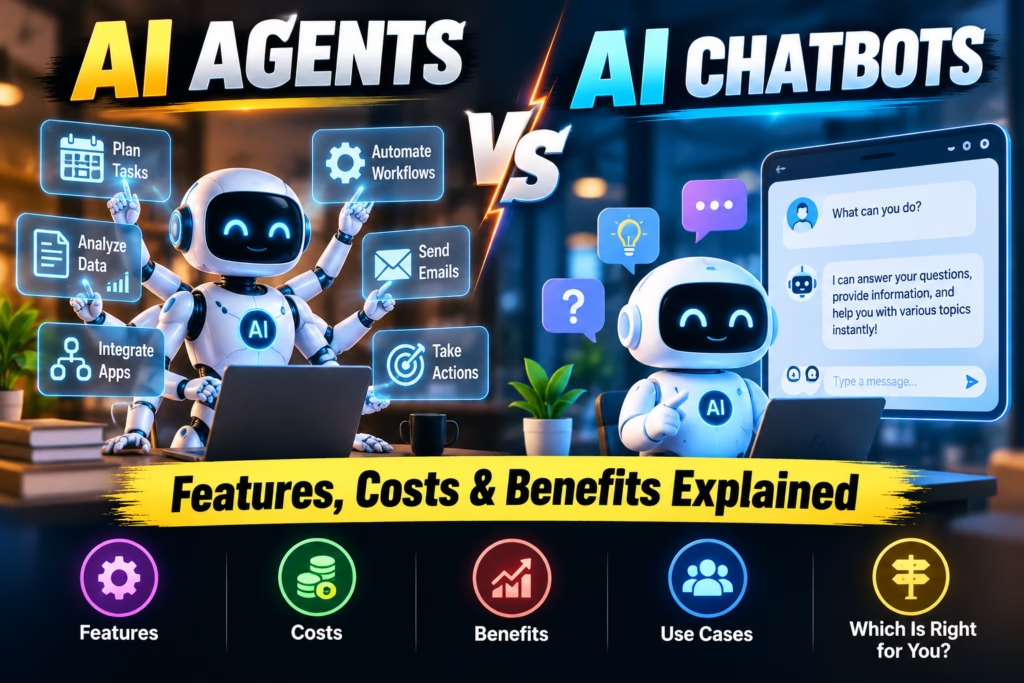
Although people often use these terms interchangeably, AI agents and AI chatbots do not always perform the same functions. Traditional chatbots primarily respond to user questions based on predefined rules, scripts or available knowledge. AI-powered chatbots can understand natural language and generate more flexible responses. AI agents, on the other hand, can go a step further by planning tasks, using connected tools, gathering information and taking actions to achieve a specific goal.
For example, a chatbot can explain a company’s refund policy, while an AI agent might check an order’s status, verify whether it meets the refund conditions and prepare a refund request for approval. The actual capabilities depend on the system’s integrations, permissions and design.
Understanding AI agents vs AI chatbots can help business owners choose the right technology for customer service, marketing, sales, operations and internal support. However, the best solution is not necessarily the most advanced one. Businesses should consider their requirements, budget, security needs and expected return on investment before making a decision.
What Is an AI Chatbot?
An AI chatbot is a software application that communicates with users through text or voice. It uses artificial intelligence, natural language processing and, in many modern systems, large language models to understand questions and generate relevant responses.
Businesses commonly use AI chatbots on websites, messaging platforms, mobile applications and customer support channels. They can answer frequently asked questions, explain products, collect contact details and help customers navigate services.
Older chatbots generally follow predefined rules. For instance, when a user selects a particular option, the chatbot displays a corresponding response. Modern AI chatbots can understand different ways of asking the same question and respond in more natural language.
A customer might ask, “Do you deliver to Ahmedabad?”, “Can I get this product in Ahmedabad?” or “Is Ahmedabad covered by your delivery service?” An AI chatbot connected to suitable information can recognise that these questions have a similar meaning.
However, a chatbot does not automatically have permission or the ability to perform actions in external systems. Its capabilities depend on the tools, integrations and workflows provided by its developers.
Key Features of AI Chatbots
Natural language conversations: AI chatbots can understand and respond to questions written in everyday language rather than requiring users to follow rigid menus.
24/7 availability: They can handle customer queries outside normal business hours, although technical issues, usage limits or service outages may affect availability.
Frequently asked questions: Businesses can use chatbots to answer common questions about products, pricing, policies, opening hours and services.
Lead collection: A chatbot can ask visitors for their names, contact details, requirements and preferred services before forwarding qualified enquiries to a sales team.
Multilingual support: Depending on the model and configuration, chatbots can communicate in multiple languages, making them useful for businesses serving different regions of India.
Website and messaging integration: Chatbots can be deployed on websites, mobile applications and supported messaging platforms. More advanced systems can also connect to customer relationship management software and other business tools.
What Is an AI Agent?
An AI agent is a system designed to work towards a goal by selecting steps, using available tools and responding to the results of its actions. Depending on its design, it can break a task into smaller steps, retrieve information, call APIs, update records and decide what to do next within defined boundaries.
Unlike a system that only generates a conversational response, an AI agent may carry out a workflow from beginning to end. It can also request human assistance when it encounters an exception, lacks sufficient information or needs approval.
Consider a business that receives enquiries through its website. An AI agent could collect a prospect’s requirements, check whether the enquiry matches the company’s target customer profile, look up available appointment slots and schedule a meeting. It could then update the CRM and prepare a summary for the sales representative.
These actions require appropriate integrations, access permissions and reliable workflow design. An AI agent cannot automatically access every application or perform every task simply because it uses artificial intelligence.
Key Features of AI Agents
Goal-oriented execution: An AI agent works towards a defined outcome, such as preparing a report, qualifying a lead or processing an eligible service request.
Task planning: It can divide a larger task into smaller steps and select an appropriate sequence based on the information available.
Tool usage: Agents can use connected APIs, databases, search systems, calendars, CRMs and other approved tools to complete tasks.
Multi-step workflows: Instead of stopping after answering one question, an agent can continue through several stages of a process.
Context awareness: Depending on its memory and system design, an agent can use information from earlier steps to make subsequent actions more relevant.
Monitoring and escalation: Well-designed agents can identify errors, follow predefined limits and send difficult or sensitive cases to a human employee.
AI Agents vs AI Chatbots: Key Differences
The main difference between an AI agent and an AI chatbot is their role in a workflow. A chatbot primarily provides a conversational interface, while an agent is designed to pursue goals and execute actions using available tools. However, the categories overlap: a chatbot can include agent capabilities, and an AI agent can communicate through a chat interface.
| Feature | AI Chatbot | AI Agent |
|---|---|---|
| Primary purpose | Answer questions and communicate | Complete tasks and achieve goals |
| Main operation | Responds to user input | Plans and executes a sequence of steps |
| Task complexity | Often handles individual queries | Can manage multi-step workflows |
| External tools | Optional integrations | Often central to its task execution |
| Decision-making | Usually limited to responses or defined flows | Can select actions within configured boundaries |
| Automation | FAQs, basic support and lead collection | Scheduling, record updates and workflow execution |
| Human involvement | Often needed for complex requests | Can escalate exceptions or approval requests |
| Setup complexity | Usually lower for simple use cases | Often higher because of tools and safeguards |
| Testing requirements | Focus on response quality and accuracy | Also test actions, permissions and workflow outcomes |
| Best suited for | Information and conversational support | Action-oriented business processes |
For example, a chatbot might tell a customer that an appointment is available on Friday. An agent connected to the company’s calendar could check availability, reserve the slot and send a confirmation, provided it has the required permissions.
Nevertheless, a well-integrated chatbot can also complete these actions. Therefore, businesses should evaluate actual capabilities instead of relying only on product labels.
How Much Do AI Agents and AI Chatbots Cost?
The cost of AI agents vs AI chatbots depends on the platform, number of conversations, AI model, integrations, complexity and ongoing maintenance. There is no single price that applies to every business.
A simple FAQ chatbot can be inexpensive to launch, while a chatbot that uses a premium language model and integrates with several business systems may require a larger budget. Similarly, an AI agent that performs a single internal task may cost relatively little compared with a multi-agent workflow that handles sensitive customer transactions.
The following figures are illustrative planning estimates in Indian rupees, not verified vendor quotations or current subscription prices.
| Solution type | Illustrative cost | Typical requirements |
|---|---|---|
| Basic rule-based chatbot | Free to ₹5,000 per month | FAQs, basic menus and simple enquiries |
| AI chatbot for a small business | ₹2,000–₹20,000 per month | AI responses, knowledge base and basic integrations |
| Custom AI chatbot | ₹25,000–₹2 lakh or more for initial development | Custom workflows, design and business integrations |
| Simple AI agent workflow | ₹5,000–₹30,000 per month | Limited task automation and connected tools |
| Custom AI agent system | ₹50,000 to several lakh rupees or more for development | Multi-step processes, APIs, security and testing |
Actual prices can fall outside these ranges. Some platforms charge per seat, conversation, task, execution or AI token, while others combine subscription fees with usage-based charges.
What Affects the Cost of an AI Chatbot?
The price of an AI chatbot depends on the number of users, monthly conversations, language model and level of customisation. A basic website chatbot that answers questions from a small knowledge base requires fewer resources than a system that handles thousands of conversations and connects to a CRM.
Businesses should also account for implementation, content preparation, maintenance and human support. A low-cost chatbot may not deliver good results if its knowledge base is outdated or its responses do not match customer requirements.
What Affects the Cost of an AI Agent?
AI agent costs depend heavily on the number and complexity of actions it performs. A system that creates a daily report from one database is generally simpler than an agent that researches prospects, verifies details, updates a CRM, sends approved communications and schedules follow-ups.
Additional costs can include API usage, cloud infrastructure, third-party software, monitoring, security controls and ongoing testing. Agents that run repeatedly without appropriate limits can also generate unexpected usage charges.
Businesses should compare the total cost of ownership rather than looking only at the monthly subscription fee.
Benefits of AI Chatbots
AI chatbots are valuable because they make information accessible without requiring an employee to answer every routine question.
1. Faster Customer Support
Customers can receive immediate responses to common questions about pricing, services, delivery, appointments and company policies. This reduces waiting time and allows support teams to concentrate on issues that require human judgement.
2. Lower Workload for Support Teams
A chatbot can handle repetitive enquiries and collect the information employees need to resolve a problem. As a result, staff may spend less time answering the same questions and more time helping customers with complex needs.
3. Better Lead Collection
Businesses can use chatbots to ask visitors about their requirements, budget, location and preferred contact method. The chatbot can then forward these details to a sales team for follow-up.
4. Consistent Information
A chatbot connected to an approved knowledge base can provide consistent answers about company services and policies. Businesses must still review its responses and update the underlying information regularly.
5. Easy Deployment for Common Use Cases
Many chatbot platforms provide templates, visual builders and ready-made integrations. This allows small businesses to launch basic customer support without developing an entire system from scratch.
Benefits of AI Agents
AI agents offer additional opportunities when businesses need software to do more than provide information.
1. Automating Repetitive Workflows
An agent can complete several connected tasks, such as collecting form data, validating information, updating records and preparing a report. This reduces manual handovers between different tools.
2. Improving Operational Efficiency
Employees often spend time switching between applications and copying information from one system to another. An appropriately designed agent can automate parts of these processes and reduce repetitive work.
3. Supporting Sales Teams
An AI agent can research potential customers using approved data sources, organise prospect information, identify missing details and prepare personalised draft messages. Any outreach should follow applicable privacy, consent and communication rules.
4. Connecting Business Applications
Agents can coordinate actions across connected systems. For example, an agent may retrieve an order from an e-commerce platform, check its delivery status and prepare a customer response using the latest available information.
5. Handling Multi-Step Tasks
An agent can continue working through a sequence of steps rather than waiting for the user to provide a new instruction after every action. This can be especially useful for internal reporting, administrative processes and structured customer requests.
Limitations of AI Chatbots
Despite their advantages, chatbots have several limitations that businesses should consider.
Incorrect answers: AI chatbots can produce inaccurate or misleading responses, especially when they lack reliable information or encounter ambiguous questions.
Limited action capabilities: A chatbot without appropriate integrations cannot independently update a CRM, issue a refund or schedule an appointment.
Dependence on knowledge quality: If a business provides incomplete or outdated information, the chatbot may give unsuitable answers.
Difficulty with unusual cases: Complex complaints, sensitive situations and exceptions to company policies often require human judgement.
Privacy and security concerns: Businesses must protect personal information, restrict access to sensitive data and review how vendors store and process conversations.
A chatbot should therefore be tested against realistic customer questions and provide a clear route to human assistance when it cannot resolve a request confidently.
Limitations of AI Agents
AI agents can perform more complex tasks, but their greater capabilities also introduce additional risks.
Unintended actions: An agent may select an incorrect action or misunderstand a goal. If it has permission to modify records or communicate externally, mistakes can affect real business operations.
Higher implementation complexity: Agents may require APIs, authentication, permissions, workflow orchestration and monitoring. These requirements can increase development and maintenance costs.
Unpredictable execution costs: Multi-step workflows can use more model calls and external services than expected, especially when the agent repeatedly attempts to solve a problem.
Security risks: Poorly configured agents may expose confidential information, misuse permissions or respond incorrectly to malicious instructions embedded in external content.
Difficult testing: Businesses must test not only the quality of an agent’s answers but also its decisions, tool calls, data handling and final actions.
Need for human oversight: Important financial, legal, employment and customer-facing decisions should have appropriate approval controls. An agent should not receive unrestricted authority simply because it can perform a task automatically.
To reduce these risks, businesses should start with limited permissions, use approval checkpoints for consequential actions, maintain audit logs and define clear conditions for stopping or escalating a workflow.
Real-World Business Examples: When Should You Use Each?
The right choice depends on the problem a business wants to solve. A chatbot is often sufficient when customers mainly need information, while an agent becomes more useful when a process involves several actions across connected systems.
Example 1: E-Commerce Business
An online store receives questions about delivery, returns, product availability and payment methods. An AI chatbot can answer these questions using the store’s policies and product information.
An AI agent could go further by checking an order’s current status, identifying whether a return request meets the configured conditions and preparing a return workflow. If the process involves issuing a refund, the business can require human approval before payment is reversed.
Example 2: Digital Marketing Agency
A digital marketing agency can use a chatbot to explain its SEO, website development and advertising services. It can also collect a visitor’s business details and arrange for a salesperson to follow up.
An AI agent could qualify incoming leads against predefined criteria, check for duplicate CRM records, assign leads to the appropriate team and schedule a follow-up task. The agency should verify important prospect information and monitor the agent’s decisions.
Example 3: Hotel or Resort
A hotel chatbot can answer questions about room types, check-in timings, amenities, meal plans and cancellation policies.
An integrated AI agent could check room availability, prepare a booking request, update the reservation system and send confirmation after the booking is successfully completed. Availability and pricing must come from the hotel’s actual reservation system rather than the AI’s assumptions.
Example 4: Internal Business Operations
A company can use a chatbot to answer employees’ questions about leave policies, expense rules and internal procedures.
An AI agent could help prepare an expense report, check whether required documents are present and route the submission to the appropriate manager. The agent should not approve expenses beyond its authorised limits.
These examples demonstrate that both technologies can work together. A chatbot can serve as the communication layer, while an agent handles specific actions behind the scenes.
AI Agent vs AI Chatbot: Which Is Better for Your Business?
There is no universal winner in the AI agents vs AI chatbots comparison. The better option depends on the complexity of your business requirements, the systems you already use and the consequences of making an incorrect decision.
Choose an AI chatbot if your primary goal is to answer customer questions, provide basic support, collect leads or make company information easier to access. It is often the more practical starting point for small businesses because a simple implementation can be easier to test and maintain.
Choose an AI agent if your business needs to automate multi-step workflows, interact with external applications or complete tasks using connected data. Before implementation, identify the exact tasks the agent may perform, the permissions it needs and the conditions under which a human must intervene.
For many businesses, a combination works best. A chatbot can handle the conversation and understand the customer’s request, while an agent performs approved actions when necessary. This approach allows businesses to introduce automation gradually instead of giving an AI system broad control from day one.
Before investing, identify one repetitive business problem and measure the time or cost it currently consumes. Run a small pilot, compare its results with the existing process and expand only when the benefits justify the cost and risk.
How to Calculate the ROI of AI Automation
Businesses should evaluate AI solutions using measurable outcomes rather than relying on claims about productivity or automation.
For example, suppose a support team handles 1,000 routine enquiries every month. Each enquiry currently takes an average of five minutes to handle, and the business estimates that an AI system can safely resolve 60% of those enquiries without employee intervention.
The potential time saved would be:
1,000 enquiries × 60% × 5 minutes = 3,000 minutes
That equals 50 employee hours per month. However, this is a hypothetical estimate, not a guarantee. The actual savings will depend on the chatbot’s resolution rate, review requirements, failed conversations and the time employees spend handling escalations.
To calculate the financial benefit, multiply the productive hours saved by the relevant hourly labour cost. Then subtract the software, implementation, maintenance and human oversight costs.
Businesses should also track customer satisfaction, response accuracy, successful task completion, error rates and the number of conversations requiring human intervention. An AI solution that saves time but creates costly mistakes may not provide a positive return.
Future of AI Agents and AI Chatbots
AI chatbots and AI agents are increasingly becoming parts of connected business systems rather than isolated tools. Modern assistants can combine natural-language conversations with knowledge retrieval, external tools and workflow automation.
This development is making the distinction between the two categories less rigid. Some products marketed as chatbots now include agent-like capabilities, while many AI agents use chat interfaces to receive instructions and report results.
For businesses, the important question is not whether a product uses the label “agent” or “chatbot.” Instead, decision-makers should examine what it can actually do, which applications it can access, how reliably it completes tasks and what safeguards are available.
As these systems become more capable, organisations will need clear data policies, permission controls, testing procedures and human accountability. Businesses that adopt AI gradually and measure real outcomes will be better positioned to gain value without introducing unnecessary complexity.
FAQs
What is the main difference between an AI agent and an AI chatbot?
An AI chatbot primarily communicates with users and answers questions. An AI agent can also plan and execute tasks using connected tools to achieve a defined goal. However, advanced chatbots can include agent capabilities, so the actual functionality matters more than the product label.
Are AI agents more expensive than AI chatbots?
AI agents can cost more when they require complex workflows, external integrations, monitoring and additional security controls. However, a simple agent may be inexpensive, while a sophisticated chatbot can also have significant implementation and usage costs. Compare the total cost of ownership for the specific solution.
Can an AI chatbot become an AI agent?
Yes. A chatbot can be extended with tools, APIs, workflow execution and controlled decision-making capabilities. Once it can use these capabilities to pursue goals and perform actions, it may function as an AI agent or an agent-enabled chatbot.
Which is better for small businesses in India?
A chatbot is often a suitable starting point for small businesses that need website support, FAQ automation or lead collection. An AI agent may be more appropriate when the business needs to automate tasks across a CRM, calendar, booking system or other applications. The decision should reflect the business’s budget and requirements.
Can AI agents replace human employees?
AI agents can automate selected tasks, but they do not reliably replace every responsibility of a human employee. Businesses still need people to handle exceptions, exercise judgement, review sensitive decisions and maintain accountability. The practical goal is often to reduce repetitive work and help employees become more productive.
Are AI agents safe to use for business automation?
AI agents can be used safely when businesses implement suitable controls, but they are not risk-free. Organisations should limit permissions, protect sensitive data, test realistic scenarios, log important actions and require approval for consequential transactions. Regular monitoring is essential even after deployment.
Conclusion
AI agents vs AI chatbots is not simply a comparison between old and new technology. Chatbots help businesses communicate efficiently, while AI agents can extend that communication into task execution and workflow automation. Both have useful applications, but their effectiveness depends on the quality of their implementation.
For most businesses, the sensible approach is to start with a clearly defined problem, choose the simplest solution that addresses it and measure the results. A chatbot may be enough for customer questions, while an agent may provide greater value when a process requires multiple actions. By balancing cost, capability, security and human oversight, businesses can use AI to improve efficiency without adding unnecessary risk.