
Grip strength has a bit of a gym-bro reputation. Climbers care about it, so do deadlifters, and so does that one colleague who nearly breaks your fingers during a handshake. But doctors have been measuring it for years, and not because they’re interested in handshakes. How hard you can squeeze turns out to say a lot about the rest of you.
So let’s go through what it is, why anyone bothers measuring it, and how to get a reading you can actually trust.
It isn’t just your hand
When you squeeze something, most of the work comes from your forearm, with the small muscles in your palm helping out and your nervous system telling everything when to fire. If something in that chain is off, the number drops. That’s partly why it’s so useful as a check.
There are a few kinds, too. Crush grip is the one you use on a dynamometer or a stress ball. Pinch grip is thumb against fingers, like lifting a flat plate. Support grip is just hanging on, which is what you’re doing when you carry heavy bags or dangle from a bar. When studies say “grip strength”, they usually mean crush grip, simply because it’s the easiest to test the same way every time.
Why researchers are so keen on it
The study everyone mentions is called PURE, published in The Lancet in 2015. Researchers followed around 140,000 adults, aged 35 to 70, across 17 countries for roughly four years. For every 5 kg lower someone’s grip was, their risk of dying from any cause was about 16% higher, and their risk of dying from cardiovascular causes was about 17% higher. In that data, grip strength predicted those outcomes better than systolic blood pressure did.
Before anyone panics, though: that’s a link, not a cause. Weak hands don’t kill people. Grip is more likely a stand-in for general muscle health and how well someone is ageing overall. Squeezing a gripper won’t automatically fix your heart. What it does give you is a quick, cheap reading that clinicians use to spot frailty, low muscle mass and slow recovery after surgery or injury.
So what’s a good number?
Honestly, it depends. Age, sex, body size and even the brand of device all change the answer, so I’d be wary of any chart that claims to be definitive. One reference point from assessment guidance is under 27 kg for men and under 16 kg for women, which is the range where clinicians start to worry. It’s a screening line, not a goal, and plenty of regular gym-goers sit far above it.
For most of us the more useful comparison is with ourselves. A reading of 40 kg isn’t good or bad on its own. Is it climbing, steady or slipping over a few months? That’s the interesting part. And check both hands. A small gap between your dominant and weaker side is normal. If one hand is pulling well ahead, or the gap keeps growing, mention it to a physio.
Measuring it properly
You’ll want a hand dynamometer. The Jamar is the one most often cited in clinics. A decent digital model is fine for tracking yourself, as long as you always use the same one, because different brands don’t always agree with each other.
Here’s the usual clinical method. Sit in a chair with a back and keep your feet flat on the floor. Tuck your upper arm in against your body, bend your elbow to about 90 degrees, and keep your forearm neutral with the wrist slightly extended. Don’t rest the arm on anything. Hold the device upright, in line with your forearm, then squeeze as hard as you can for around three seconds and let go.
Do that three times with each hand, with about a minute’s rest in between so you’re not testing a tired muscle. Write down the best reading for each hand, not the average.
Honestly, consistency beats perfection. Test at roughly the same time of day, before training instead of after it, and in the same position each time. If you stand one week and sit the next, you’re comparing two different things.
Where a strengthener comes in
Measuring and training aren’t the same job. The dynamometer shows you where you’re at. A strengthener is what you use to move that number. So once you’ve got a baseline, the best grip strengthener for you is the one that matches your level and leaves room to grow. Go for adjustable resistance, because a fixed spring that feels tough now will feel easy in a couple of months. Also check the handle span. If it’s too wide or narrow for your hand, the exercise feels awkward and your readings can get skewed.
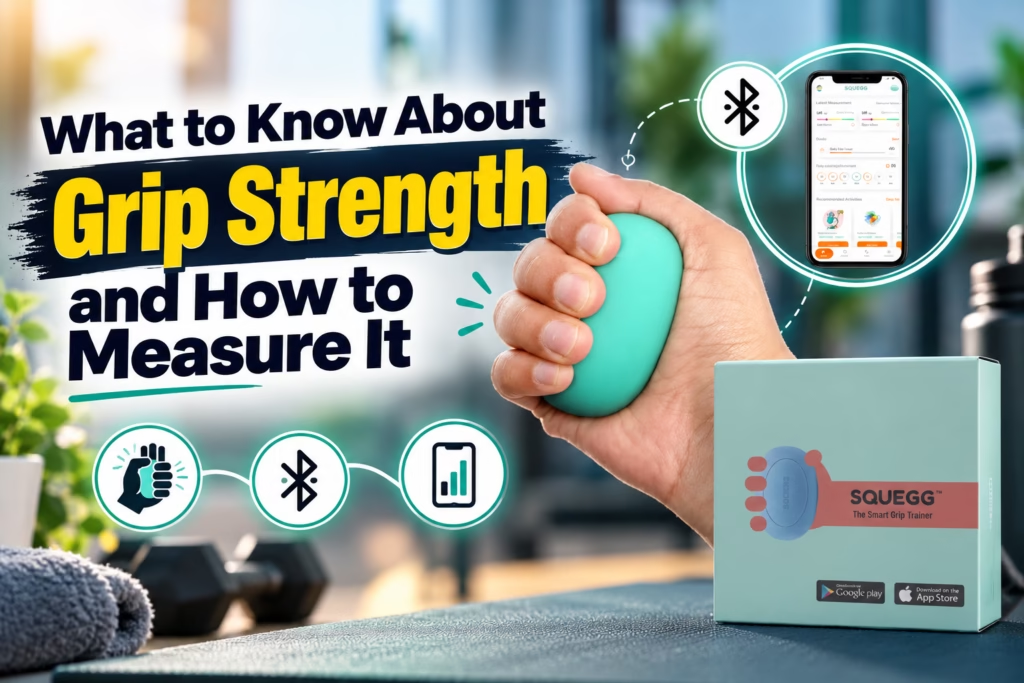
Some people like digital models that log every squeeze, since the app does the record keeping. Others do perfectly well with a plain gripper and a notebook. If tracking is your priority, a digital one is probably the best grip strengthener for you. If you just want to build strength cheaply, a basic adjustable spring does the job. Whichever you choose, the idea’s the same: raise the challenge slowly, give your tendons time to catch up, and don’t squeeze to failure every single day.
And mix it up a bit. Crush grip is only one piece of the puzzle. Dead hangs, farmer’s carries and plate pinches cover the others, and a little work for the muscles on the back of your forearm helps keep things balanced.
A few cautions
Don’t test every day. Maximal squeezes tire you out and muddy the numbers, so once a week or every other week is plenty. If something hurts, stop. Sharp pain in the wrist, elbow or fingers isn’t normal soreness. And if your grip drops suddenly, or the weakness comes with numbness, tingling or swelling, get it checked. That kind of change can have causes that have nothing to do with training.
Finally, one number isn’t a diagnosis. It’s a useful indicator, nothing more.
The short version
Grip strength is cheap to measure, easy to track, and linked in big studies to general health and longevity. Test it the same way every time, judge yourself against your own history, and pick a strengthener you’ll actually use. The best grip strengthener isn’t the priciest one. It’s the one that fits your hand, offers the right resistance and gets used consistently.