|
Getting your Trinity Audio player ready...
|
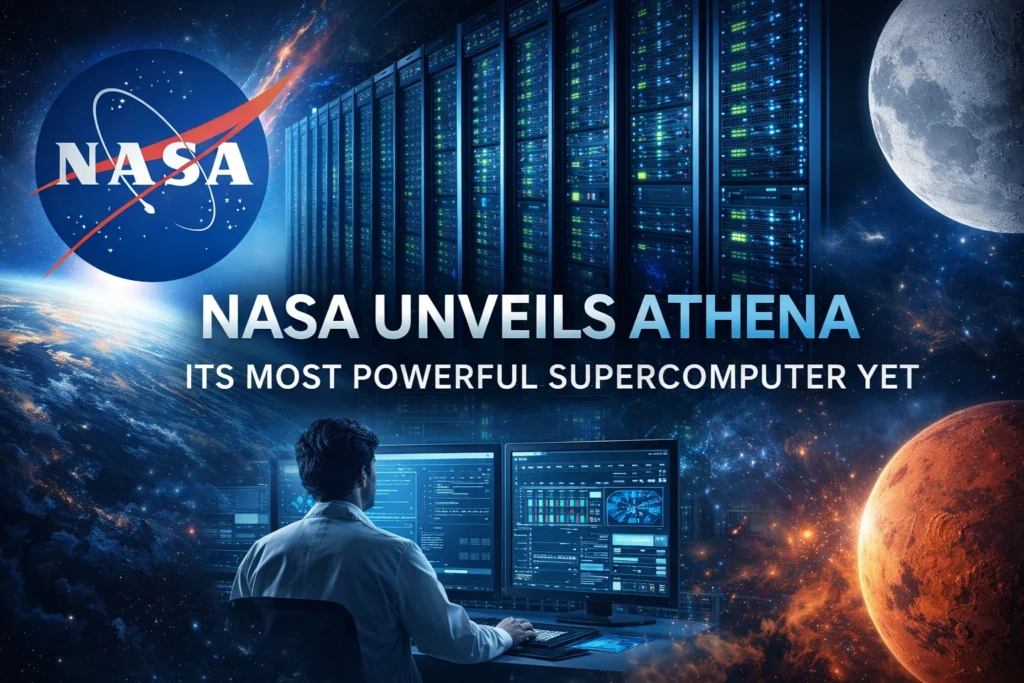
NASA has taken a massive technological leap forward with the unveiling of NASA’s most powerful supercomputer yet—Athena. Designed to accelerate scientific discovery, mission planning, and space exploration, Athena represents a new era of high-performance computing that could reshape how humanity explores the Moon, Mars, and beyond.
Unlike conventional systems, Athena is not just about raw power. Instead, it focuses on speed, efficiency, and real-world mission impact, enabling NASA to compress decades of computational work into days—or even hours.
What Is Athena and Why It Matters
Athena is NASA’s latest flagship supercomputer, built to handle some of the most complex scientific and engineering challenges ever attempted. From simulating spacecraft aerodynamics to modeling planetary climates, Athena allows NASA scientists to solve problems that were previously too time-consuming or computationally expensive.
Most importantly, Athena can reportedly perform calculations in one day that would take a standard personal computer hundreds of years. As a result, mission timelines shrink dramatically, and decision-making becomes faster and more precise.
Built for the Next Phase of Space Exploration
NASA’s current focus is not limited to Earth orbit. Instead, the agency is preparing for long-term human presence on the Moon and eventual crewed missions to Mars. Consequently, Athena plays a critical role in supporting these ambitions.
With Athena, NASA can:
- Simulate Moon and Mars landing conditions in extreme detail
- Test spacecraft designs virtually before physical construction
- Predict system failures long before they happen
- Optimize fuel efficiency and mission safety
Because space missions allow no margin for error, Athena’s predictive power significantly reduces risk while improving reliability.
Compressing 500 Years of Computing Into a Single Day
One of the most striking claims about Athena is its ability to compress nearly 500 years of traditional computing into just 24 hours. This capability is not marketing hype—it reflects the scale of modern scientific challenges NASA faces.
For example, calculating atmospheric entry dynamics for Mars landers once required weeks of supercomputer time. Now, Athena can deliver higher-resolution results within hours. Therefore, engineers can run multiple simulations, compare outcomes, and refine designs far more efficiently.
Energy Efficiency Meets Extreme Performance
While Athena is NASA’s most powerful system, it is also designed to be one of the most energy-efficient. This balance is crucial, especially as sustainability becomes a priority even in high-performance computing.
Rather than consuming massive energy indiscriminately, Athena uses optimized architectures that deliver more calculations per watt. As a result, NASA reduces operational costs while maintaining top-tier performance.
This approach also sets a benchmark for future government and scientific supercomputers worldwide.
How Athena Supports Moon and Mars Missions
Athena directly supports NASA’s upcoming and ongoing missions by acting as the brain behind the scenes.
For Moon missions, Athena helps:
- Model lunar terrain and landing zones
- Analyze radiation exposure for astronauts
- Plan surface mobility and habitat placement
For Mars missions, it goes even further:
- Simulating long-duration space travel effects
- Predicting Martian weather and dust storms
- Testing autonomous navigation systems
Because Mars missions operate with communication delays, Athena’s simulations help build systems that can make intelligent decisions without real-time human input.
Accelerating Scientific Discovery Beyond Spaceflight
Although space missions are Athena’s primary focus, its impact extends far beyond rockets and spacecraft.
Athena also supports:
- Climate modeling and Earth observation
- Astrophysics simulations
- Materials science research
- AI-driven data analysis
By processing massive datasets quickly, Athena enables scientists to identify patterns and insights that were previously hidden due to computational limitations.
Why Athena Is a Strategic Advantage for NASA
In today’s world, space exploration is no longer limited to a few nations. Therefore, computational power has become a strategic advantage. Athena gives NASA a decisive edge by allowing faster innovation cycles and deeper scientific insight.
Moreover, Athena strengthens collaboration. Scientists can now share results faster, test hypotheses more frequently, and respond quickly to unexpected discoveries.
In short, Athena transforms computing from a bottleneck into a launchpad for innovation.
The Bigger Picture: A New Computing Era
Athena is not just a machine—it is a signal. It shows how future scientific progress will depend on the fusion of advanced hardware, intelligent software, and mission-driven design.
As missions grow more complex and data-heavy, traditional computing models will no longer suffice. Athena represents the blueprint for how institutions can scale responsibly while maintaining performance excellence.
Final Thoughts
NASA’s Athena supercomputer marks a defining moment in modern space exploration. By delivering unprecedented speed, efficiency, and analytical power, Athena enables NASA to move faster, think deeper, and explore further than ever before.
As humanity prepares to return to the Moon and take its first steps toward Mars, Athena will quietly power the decisions that make those giant leaps possible. In many ways, while rockets carry astronauts into space, Athena carries the intelligence that gets them there safely.