|
Getting your Trinity Audio player ready...
|
AI has shifted from an innovative technology into a strategic national resource. Many governments see AI as vital for boosting economic innovation, boosting science, enabling health care, enhancing manufacturing, improving education, and upgrading public services. With more powerful AI models and faster adoption, nations are vying to attract researchers, develop computing capacity, invest in new companies, and set the global standards for this technology.
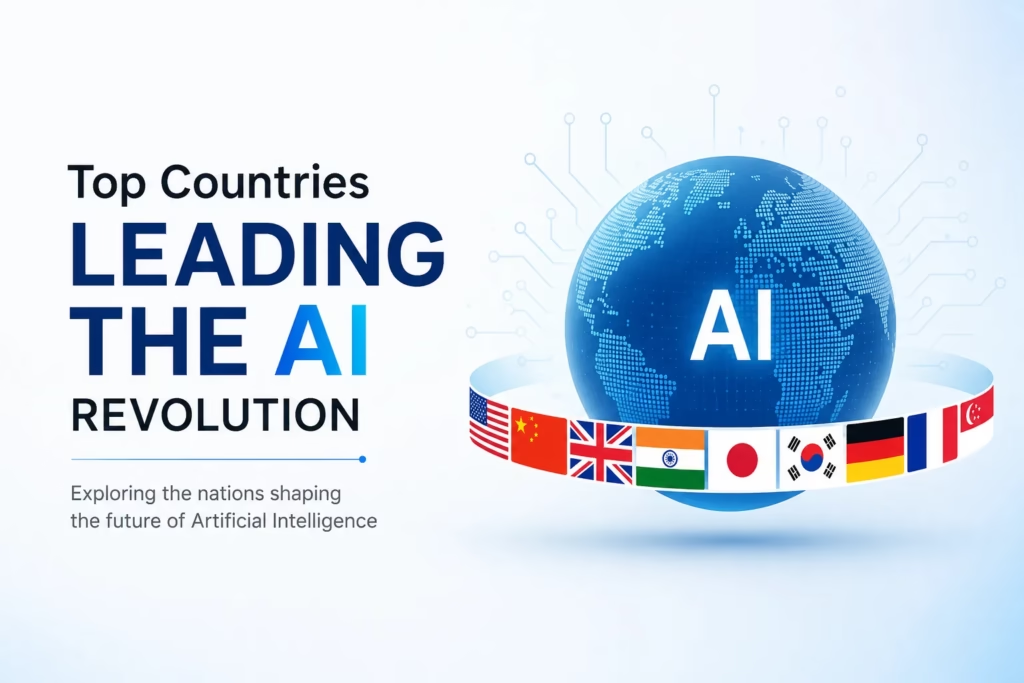
The top countries driving the AI revolution are not all kings across all indicators. The US dominates private investment and frontier-model development; China looks very strong across a number of research and patent indicators, while the UK, Canada, France, India, Japan, South Korea, Singapore and the UAE have built particular areas of comparative advantage. Thus there is no one size fits all ranking of AI superpowers; it really depends on whether you are looking at research, investment, talent, infrastructure, innovation or adoption.
Why AI Leadership Matters
AI is also obviously a gateway to economic and geopolitical influence. Countries with mature AI ecosystems will be able to derive technologies of great value internally, gain productivity improvements, secure investments and reduce reliance on foreign technology.
The level of competition is already high. Corporate AI investment worldwide more than doubled in 2025, and 88% of organizations reported having adopted AI in Stanford University’s 2026 AI Index survey. Concurrently, training and running large models demands an ever-growing level of computational power, electricity, data, and specialized talent.
What this brings to us is that the AI race is a layered one, with the participation of universities, tech giants, the semiconductor supply chain, clouds, governance, the startups, and the skilled employees.
Top Countries Leading the AI Revolution
United States: The Global AI Powerhouse
The United States remains the strongest overall AI ecosystem, particularly in frontier models, private capital, startups, cloud computing, and commercial deployment. Companies including OpenAI, Google, Microsoft, Anthropic, Meta, Amazon, and xAI have helped establish the country at the center of generative AI.
Stanford’s 2026 AI Index reports that U.S. private AI investment reached $285.9 billion in 2025, more than 23 times China’s private investment. The U.S. also produced 59 notable AI models in 2025, compared with 35 from China.
Leading research institutions include Stanford, MIT, Carnegie Mellon, UC Berkeley, and major corporate research labs. The country’s biggest advantage is the combination of world-class research, venture capital, hyperscale computing infrastructure, and entrepreneurial culture.
Its challenges include rising infrastructure costs and a sharp decline in the rate at which international AI researchers and developers move to the country.
China: America’s Closest AI Rival
China has emerged as the other major AI superpower. Its strengths include enormous industrial scale, a large technology market, extensive research activity, and strong government coordination.
Companies such as Alibaba, Baidu, Tencent, Huawei, and DeepSeek are major participants in China’s AI ecosystem. Chinese AI models have also rapidly narrowed the performance gap with leading U.S. systems. Stanford reports that U.S. and Chinese models have repeatedly traded positions at the top of performance rankings since early 2025.
China leads the United States in publication volume, citations, and AI patent output, while its industrial deployment is particularly strong in robotics and manufacturing. Government-backed investment also supplements private funding, making simple comparisons of private investment potentially misleading.
United Kingdom: A Research and AI Safety Leader
The United Kingdom has built an influential AI ecosystem around universities, startups, financial services, and research organizations. DeepMind, now part of Google, originated in the UK, while institutions such as Oxford and Cambridge remain important research centers.
The UK government has emphasized AI infrastructure, public-sector adoption, AI skills, and safety research. Its AI Opportunities Action Plan has supported AI Growth Zones, expanded national computing resources, opened priority public datasets, and delivered AI upskilling initiatives.
The UK’s challenge is scale: it does not match the United States or China in private capital or computing infrastructure. Its opportunity lies in translating research excellence into globally competitive companies and trusted AI systems.
Canada: Deep Research and Talent
Canada played an outsized role in the development of modern machine learning through researchers such as Geoffrey Hinton and Yoshua Bengio. Its AI ecosystem includes Mila in Montreal, the Vector Institute in Toronto, and Amii in Edmonton.
The country continues to emphasize research talent, commercialization, and responsible AI. Its emerging national AI strategy proposes expanding the Canada CIFAR AI Chairs program to nearly 200 researchers while improving pathways for international AI specialists.
Canada’s limitation is comparatively smaller access to capital and computing than the largest AI economies, but its research institutions remain a major competitive advantage.
India: A Fast-Rising AI Power
India is increasingly important in the global AI race because of its huge developer base, STEM workforce, digital infrastructure, startups, and enormous potential market.
The government’s IndiaAI Mission, approved with a five-year outlay of ₹10,371.92 crore, focuses on compute capacity, foundation models, datasets, applications, skills, startup financing, and safe and trusted AI.
India had reached more than 38,000 GPUs under the mission and announced an additional 20,000 GPUs in February 2026. Indigenous efforts such as BharatGen and models from Sarvam AI are also targeting India’s multilingual and local-use requirements.
India’s strongest advantage may be AI application at population scale—from healthcare and agriculture to education, financial services, government, and multilingual technology. The key challenge is converting its enormous talent and developer base into more frontier research, proprietary models, and globally scaled AI companies.
France and Germany: Europe’s Industrial AI Engines
France has become one of Europe’s most ambitious AI hubs, supported by research institutions, startups such as Mistral AI, and strong government backing. At the 2025 AI Action Summit, more than €109 billion in AI-related infrastructure investment announcements were made for France. Its low-carbon electricity supply is also an advantage for energy-intensive data centers.
Germany brings different strengths: advanced manufacturing, automotive engineering, industrial automation, and research institutions such as the Max Planck Society and Fraunhofer network. Its AI opportunity lies particularly in applying AI technology to manufacturing, robotics, mobility, and industrial systems.
Together, France and Germany represent an important European strategy: combine scientific research with industrial strength while operating within the EU’s regulatory framework.
Japan and South Korea: AI Meets Robotics and Semiconductors
Japan has had an edge in robotics, electronics, automotive and industrial automation for many years. Toyota, Sony and SoftBank are well placed to translate AI into robotics, mobility, healthcare and consumer electronics.
Combining cutting edge semiconductor fabrication with large technology enterprises such as the Samsung and SK hynix. According to Stanford’s 2026 AI Index South Korea has the most AI patents per capita meaning it has a higher than normal innovation density.
Consequently, both also occupy an important position in the world of the physical AI economy, where software intelligence meets robots, chips, factories and connected devices.
Singapore and the UAE: Smaller Countries With Big AI Ambitions
Singapore has established a reputation as a land of robust digital infrastructure, government coordination, research and fast track technology adoption. The UAE has likewise painted itself as an AI-based technology hub, leveraging government adoption, investment, infrastructure and international talent to fast track its strategy.
The UAE’s National Strategy for AI 2031 has set AI as a priority and aims to be a leader in it, emphasizing on fields of energy, logistics, healthcare, cyber security and government services.
Show us that you don’t always have to be the size of China or the US to be a leader in AI:
How These Countries Are Competing in the Global AI Race
The leading AI countries compete across several interconnected dimensions:
- Research: Universities and corporate labs create new algorithms, models, and scientific applications.
- Investment: Venture capital and corporate spending determine which technologies can scale.
- Talent: Researchers, engineers, entrepreneurs, and AI specialists remain scarce and highly mobile.
- Compute: Data centers, GPUs, cloud platforms, and reliable energy are becoming strategic assets.
- Startups: New companies can commercialize breakthroughs faster than traditional institutions.
- Policy: Governments influence AI through funding, regulation, education, procurement, and infrastructure.
- Adoption: Countries that successfully deploy AI across businesses and public services can turn technological capability into economic value.
The global artificial intelligence landscape is consequently becoming more distributed. The U.S. and China remain dominant in frontier development, but other countries can establish leadership in specialized areas such as robotics, industrial AI, AI safety, multilingual systems, chips, healthcare, or public-sector deployment.
India’s Growing Role in AI
India deserves particular attention because it combines scale with rapidly improving national infrastructure. Its developer community is among the world’s largest, while AI adoption in the workplace is already high. Stanford’s 2026 research found that more than 80% of workers in India reported using AI regularly or semi-regularly in 2025.
The 2026 India AI Impact Summit further strengthened India’s position as a convening power. More than 100 countries and international organizations participated, while investment commitments across the AI value chain announced around the summit exceeded $250 billion, according to the Indian government.
India’s next challenge is moving from being primarily a large-scale AI adopter and services hub toward becoming a stronger producer of frontier research, foundational models, AI infrastructure, and globally competitive products.
Future of Global AI Leadership
The next phase of the global AI race is unlikely to produce one permanent winner. The technology is advancing too quickly, and different countries possess different advantages.
The United States has unmatched private capital and frontier-company depth. China has enormous research and industrial scale. Europe is building sovereign infrastructure and regulatory influence. India has exceptional developer and market scale. Japan and South Korea have powerful industrial and semiconductor ecosystems, while Canada and the UK retain major research strengths.
Another important shift is AI sovereignty: governments increasingly want domestic control over compute, data, models, and critical technology. Stanford’s 2026 AI Index reports that state-backed AI supercomputing capacity has expanded substantially, particularly across Europe and Central Asia.
Conclusion
The Top Countries Leading the AI Revolution are defined not simply by who has the most advanced chatbot. True AI leadership requires a durable ecosystem spanning research, investment, talent, computing infrastructure, startups, policy, and real-world adoption.
For now, the United States and China remain the two central AI superpowers, but the wider field is becoming increasingly competitive. Countries such as India, the UK, Canada, France, Germany, Japan, South Korea, Singapore, and the UAE are building distinctive advantages that could become increasingly valuable.
As AI technology becomes embedded in economies and national infrastructure, leadership will increasingly belong to countries that can combine innovation with affordable compute, skilled talent, responsible governance, and large-scale adoption. The global AI race is therefore only entering its next chapter—and the balance of power could look very different by the end of the decade.
FAQs
1. Which country is leading the AI revolution?
The United States currently leads in frontier AI models, private investment, startups, and computing infrastructure.
2. Is China a global AI superpower?
Yes. China is a major AI superpower, particularly in research output, patents, industrial applications, and large-scale AI deployment.
3. Is India becoming a leader in AI?
Yes. India is rapidly expanding its AI infrastructure, talent pool, startups, and government-backed initiatives such as the IndiaAI Mission.
4. What makes a country an AI leader?
AI leadership depends on research, investment, talent, computing infrastructure, startups, government policy, patents, and real-world adoption.
5. Which countries are investing heavily in AI?
The United States, China, India, the UK, France, Germany, Japan, South Korea, Singapore, and the UAE are among the countries making significant investments in AI.