
|
Getting your Trinity Audio player ready...
|
The future of luxury cars is becoming increasingly electric. Leading automakers are investing heavily in battery technology, intelligent software, high-performance electric motors and premium cabin experiences to attract customers who want luxury without traditional fuel-powered engines.
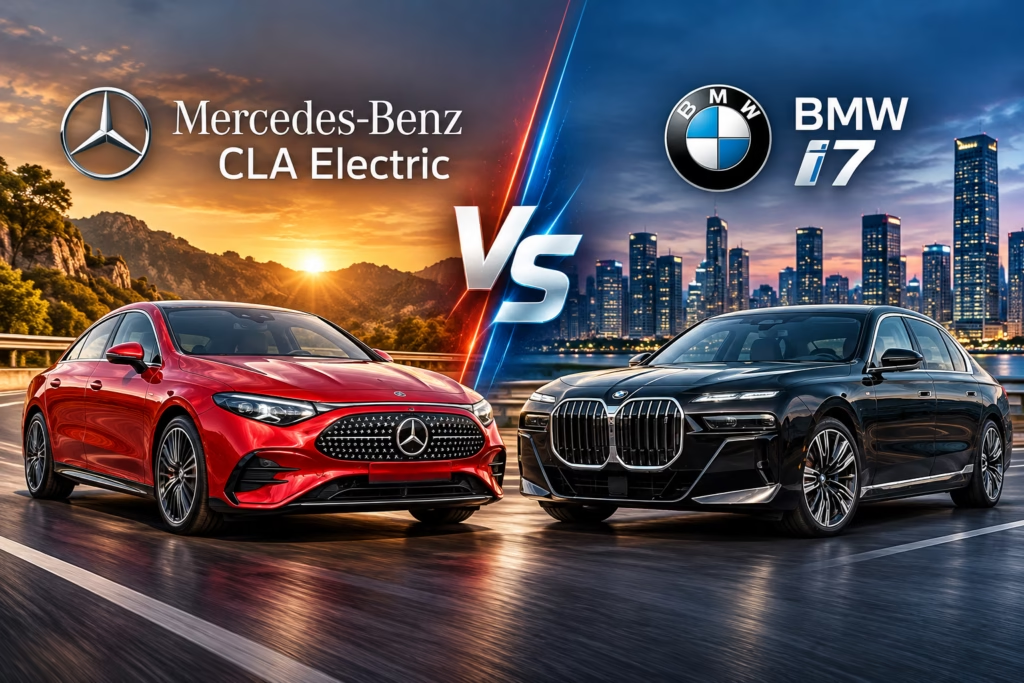
Among the most interesting developments in this segment are the Mercedes-Benz CLA Electric and BMW i7.
The Mercedes-Benz CLA Electric is a new-generation luxury electric sedan that focuses on efficiency, advanced technology and modern design. It offers an impressive claimed driving range, fast-charging capability and a stylish exterior that makes it attractive to younger luxury car buyers.
The BMW i7, on the other hand, is a flagship electric luxury sedan. It combines powerful electric motors, a large battery, advanced entertainment technology and an exceptionally comfortable cabin. The vehicle is designed for customers who expect a premium experience from every journey.
The comparison becomes particularly interesting because the two cars are positioned at very different price points.
The Mercedes-Benz CLA Electric starts at ₹55 lakh in India, while the 2026 BMW i7 facelift starts at ₹1.95 crore. Both prices are ex-showroom. Autocar India+1
So, is the more expensive BMW i7 worth the additional investment? Or does the Mercedes-Benz CLA Electric offer a smarter combination of technology, range and everyday practicality?
Let’s explore the differences in detail.
Mercedes-Benz CLA Electric vs BMW i7: Key Specifications
The following table highlights the major differences between the India-market Mercedes-Benz CLA Electric and the 2026 BMW i7.
| Specification | Mercedes-Benz CLA Electric 250+ | BMW i7 50 xDrive M Sport |
|---|---|---|
| Vehicle category | Luxury electric sedan | Flagship luxury electric sedan |
| Battery capacity | 85kWh | 112.5kWh |
| Claimed range | 792km WLTP | 728km WLTP |
| Maximum power | 272hp | 455hp |
| Maximum torque | 335Nm | 600Nm |
| Drivetrain | Rear-wheel drive | All-wheel drive |
| 0–100km/h | 6.7 seconds | 5.5 seconds |
| Maximum DC charging | Up to 320kW | High-power DC charging |
| Starting India price | ₹55 lakh | ₹1.95 crore |
| Primary focus | Efficiency and modern luxury | Comfort, performance and premium luxury |
Specifications are based on the India-market CLA Electric and 2026 BMW i7 facelift. The CLA 250+ is the long-range version, while the BMW figures refer to the i7 50 xDrive M Sport. Autocar India+2
Exterior Design: Mercedes-Benz CLA Electric vs BMW i7
The Mercedes-Benz CLA Electric and BMW i7 have distinctive exterior designs that reflect their different positions in the luxury car market.
The CLA Electric adopts a sleek and aerodynamic design, while the BMW i7 focuses on creating a bold and commanding road presence.
Mercedes-Benz CLA Electric Exterior
The Mercedes-Benz CLA Electric features a coupe-inspired design with a sloping roofline, frameless doors and smooth body surfaces.
Its aerodynamic shape is one of the most important aspects of its exterior design. The car has a reported drag coefficient of 0.21, which helps reduce air resistance and improve driving efficiency. Autocar India
The front fascia features an illuminated grille with Mercedes-Benz star elements. Its lighting design also incorporates the brand’s signature three-pointed-star identity.
The overall design is modern and sporty, making the CLA Electric particularly appealing to buyers who want a luxury sedan with a distinctive appearance.
Its proportions also make it look more dynamic than a conventional executive sedan.
BMW i7 Exterior
The BMW i7 takes a more traditional flagship luxury approach.
Its large body, long wheelbase and bold front design give it a strong road presence. The illuminated kidney grille and distinctive lighting elements help distinguish it from other BMW electric vehicles.
The i7 looks more imposing than the CLA Electric, particularly when viewed from the front and side.
Its exterior design is intended to communicate luxury, prestige and sophistication.
The larger body also supports the spacious cabin that makes the BMW i7 attractive to chauffeur-driven buyers.
Exterior verdict: The Mercedes-Benz CLA Electric is the better choice for buyers who prefer sporty and aerodynamic styling. The BMW i7 is more suitable for customers who want a large, prestigious luxury sedan.
Interior Design and Comfort
The interior experience is one of the most important differences between these two electric vehicles.
While both cars offer premium materials and advanced digital technology, the BMW i7 provides a significantly more luxurious cabin.
Mercedes-Benz CLA Electric Interior
The Mercedes-Benz CLA Electric features a modern digital dashboard with a 10.25-inch driver’s display and a 14-inch central infotainment touchscreen.
The Launch Edition also offers the Superscreen configuration, which adds a passenger-side display.
The cabin includes premium upholstery, ambient lighting, a panoramic glass roof and a contemporary dashboard design.
The CLA Electric’s interior focuses on creating a premium digital environment without making the cabin feel unnecessarily complicated.
Other available features include powered front seats, heated and massaging front seats, wireless charging and a Burmester 3D audio system. Autocar India
However, the CLA Electric’s coupe-style roofline can limit rear-seat headroom.
The cabin is better suited to buyers who frequently drive themselves rather than those who spend most of their time sitting in the rear seat.
BMW i7 Interior
The BMW i7 offers a significantly more luxurious interior.
The 2026 facelift introduces BMW Panoramic Vision, a 17.9-inch central touchscreen and a 14.6-inch passenger display.
The cabin also features premium materials, advanced ambient lighting and a Bowers & Wilkins surround-sound system with Dolby Atmos.
However, the most impressive feature is the rear-seat entertainment experience.
The BMW i7 offers a large 31.3-inch rear entertainment screen, powered doors and electrically adjustable rear seats with heating, ventilation and massage functions. Autocar India
These features make the i7 particularly suitable for customers who want a luxury vehicle for business travel or chauffeur-driven journeys.
Interior verdict: The BMW i7 is the clear winner in terms of cabin luxury, passenger comfort and rear-seat technology.
Battery Capacity and Driving Range
Driving range is one of the most important considerations when buying an electric car.
A longer range reduces the need for frequent charging stops and makes long-distance journeys more convenient.
Interestingly, the Mercedes-Benz CLA Electric offers a higher claimed range than the BMW i7 despite having a smaller battery.
Mercedes-Benz CLA Electric Range
The Mercedes-Benz CLA Electric is available in two battery configurations globally.
| Variant | Battery capacity | Claimed WLTP range |
|---|---|---|
| CLA 200 Standard Range | 58kWh | 542km |
| CLA 250+ Long Range | 85kWh | 792km |
mercedes-benz-india-locator.com
The CLA 250+ Long Range is particularly impressive because it combines a relatively efficient electric powertrain with an aerodynamic body.
Its 792km WLTP range makes it attractive for buyers who frequently travel long distances.
However, the official range should not be confused with real-world driving range.
Actual range can vary depending on driving speed, road conditions, outside temperature, air conditioning usage and passenger weight.
For example, driving at high speeds on Indian highways may result in lower range than the official WLTP figure.
BMW i7 Range
The 2026 BMW i7 facelift uses a larger 112.5kWh battery pack.
The i7 50 xDrive M Sport offers a claimed WLTP range of up to 728km.
The high-performance i7 M70 xDrive offers a reported range of up to 686km. Autocar India
The BMW i7’s larger battery supports its more powerful electric motors and heavier vehicle structure.
Although the i7 has a smaller claimed range than the CLA 250+, it remains suitable for long-distance luxury travel.
Range verdict: The Mercedes-Benz CLA Electric offers the higher claimed range and focuses more heavily on energy efficiency.
Performance and Acceleration
Electric vehicles are known for their instant torque delivery, and both the Mercedes-Benz CLA Electric and BMW i7 benefit from this characteristic.
However, the BMW i7 offers significantly more power.
Mercedes-Benz CLA Electric Performance
The CLA 250+ Long Range produces 272hp and 335Nm of torque.
It uses a rear-mounted electric motor and a rear-wheel-drive configuration.
The vehicle can accelerate from 0 to 100km/h in a claimed 6.7 seconds. Autocar India
This performance is more than sufficient for everyday driving, highway overtaking and regular commuting.
The CLA Electric focuses on delivering smooth acceleration and efficient power delivery rather than extreme performance.
BMW i7 Performance
The BMW i7 50 xDrive M Sport produces 455hp and 600Nm of torque.
It uses a dual-motor all-wheel-drive configuration and can accelerate from 0 to 100km/h in a claimed 5.5 seconds.
The higher-performance BMW i7 M70 xDrive produces up to 680hp and offers significantly greater acceleration capability. Autocar India
The i7 is designed to deliver powerful acceleration while maintaining a smooth and refined driving experience.
Its all-wheel-drive system also helps distribute power effectively across different driving conditions.
Performance verdict: The BMW i7 is the better choice for buyers who prioritise acceleration, power and high-performance electric driving.
Charging Technology
Charging technology plays an important role in the overall ownership experience of an electric vehicle.
A car with a longer range is useful, but fast charging can make long-distance journeys more convenient.
Mercedes-Benz CLA Electric Charging
The Mercedes-Benz CLA Electric uses an 800V electrical architecture.
The long-range variant supports DC fast charging at rates of up to 320kW, depending on the configuration and charging conditions.
Mercedes-Benz claims that the vehicle can recover approximately 300km of range in around 10 minutes under suitable charging conditions. Autocar India
This makes the CLA Electric particularly attractive for buyers who frequently travel long distances.
However, the actual charging speed depends on the charging station’s capacity, battery temperature and battery state of charge.
BMW i7 Charging
The BMW i7 also supports high-power DC charging.
Its larger battery provides substantial driving range, while its charging system is designed to support long-distance luxury travel.
For many owners, home charging will remain the most convenient option.
A dedicated home charging installation can allow the vehicle to recharge overnight, reducing the need to visit public charging stations regularly.
Charging verdict: The Mercedes-Benz CLA Electric has an advantage in its 800V architecture and peak charging capability. The BMW i7 remains a strong option for long-distance travel because of its larger battery.
Technology and Infotainment
Both vehicles offer advanced digital technology, but their systems focus on different priorities.
The Mercedes-Benz CLA Electric emphasises an intelligent digital cockpit, while the BMW i7 provides a more extensive luxury technology package.
The CLA Electric features Mercedes-Benz’s latest infotainment interface, connected-car functions, digital displays and voice assistance.
The BMW i7 introduces BMW Panoramic Vision, an advanced digital interface that projects information across the lower section of the windscreen.
It also offers a large central touchscreen, a passenger display and advanced rear-seat entertainment technology. Autocar India+1
The BMW i7’s technology is designed to improve both driving convenience and passenger comfort.
Technology verdict: The BMW i7 offers the more comprehensive luxury technology package, while the CLA Electric provides an impressive digital experience at a much lower price.
Safety Features
Safety is another important consideration when choosing a luxury electric sedan.
Both Mercedes-Benz and BMW have invested heavily in structural engineering, active safety technology and driver assistance systems.
The Mercedes-Benz CLA Electric offers features such as multiple airbags, automatic emergency braking, lane assistance, parking assistance and advanced driver assistance technology.
The BMW i7 also provides an extensive safety package, including collision warning, lane assistance, adaptive cruise control and advanced parking systems, depending on the market and variant.
However, safety equipment can vary between specifications.
Buyers should compare the exact Indian-market feature lists before making a purchase decision.
Safety verdict: Both vehicles offer advanced safety technology. A definitive winner should be based on comparable crash-test results and the exact equipment available in India.
Price Comparison in India
Price is one of the biggest differences between these two vehicles.
The Mercedes-Benz CLA Electric is positioned as an entry-level luxury electric sedan, while the BMW i7 is a flagship luxury vehicle.
Mercedes-Benz CLA Electric Price
The Mercedes-Benz CLA Electric was launched in India in April 2026.
Its reported ex-showroom prices are:
| Variant | Price |
|---|---|
| CLA 200 Standard Range | ₹55 lakh |
| CLA 250+ Long Range | ₹59 lakh |
| CLA 250+ Launch Edition | ₹64 lakh |
Autocar India
The CLA Electric is designed to attract buyers who want a premium electric car without entering the ultra-luxury price segment.
BMW i7 Price
The 2026 BMW i7 facelift was launched in India with the following reported prices:
| Variant | Price |
|---|---|
| BMW i7 50 xDrive M Sport | ₹1.95 crore |
| BMW i7 M70 xDrive | ₹2.65 crore |
Autocar India
The price difference is substantial.
The BMW i7 costs several times more than the Mercedes-Benz CLA Electric.
However, it also offers a larger battery, more powerful motors, a more spacious cabin and significantly more luxury features.
Price verdict: The Mercedes-Benz CLA Electric offers substantially better value for buyers focused on efficiency and everyday luxury.
The BMW i7 is worth considering for buyers who specifically want flagship luxury and are comfortable with its higher purchase and ownership costs.
Which Car Is Better for Indian Buyers?
The Indian luxury car market has different requirements from many international markets.
Buyers must consider traffic congestion, road conditions, charging infrastructure, parking availability and the availability of authorised service centres.
The Mercedes-Benz CLA Electric and BMW i7 are suited to different types of Indian customers.
The CLA Electric is a practical choice for buyers who want a luxury electric sedan for daily commuting.
Its relatively compact dimensions make it easier to manoeuvre through city traffic, while its efficient powertrain can help reduce energy consumption.
The BMW i7 is more suitable for buyers who prioritise luxury and passenger comfort.
Its spacious cabin, premium rear-seat features and powerful electric motors make it an attractive option for business executives and chauffeur-driven owners.
However, the BMW i7’s large dimensions can make it more challenging to drive through narrow streets or crowded parking areas.
For buyers who primarily drive themselves, the CLA Electric may be the more practical choice.
For buyers who regularly travel with a chauffeur, the i7 offers a more luxurious experience.
Mercedes-Benz CLA Electric vs BMW i7: Pros and Cons
Mercedes-Benz CLA Electric
Advantages
- Impressive claimed range of up to 792km
- Efficient electric powertrain
- Advanced 800V charging architecture
- Sporty and aerodynamic design
- More accessible luxury EV pricing
- Easier to drive in urban environments
Disadvantages
- Less spacious than the BMW i7
- Limited rear-seat headroom
- Not as powerful as the BMW i7
- Rear-seat comfort is not its main strength
BMW i7
Advantages
- Flagship luxury interior
- Spacious rear-seat environment
- Powerful dual-motor drivetrain
- Advanced entertainment technology
- Premium comfort features
- Strong road presence
Disadvantages
- Significantly higher purchase price
- Larger dimensions can make city driving difficult
- Higher potential ownership costs
- Lower claimed range than the CLA 250+ despite a larger battery
Final Verdict
The Mercedes-Benz CLA Electric and BMW i7 are both impressive electric luxury sedans, but they serve very different purposes.
The Mercedes-Benz CLA Electric is designed for buyers who want a stylish, efficient and technology-rich electric car for everyday driving.
Its aerodynamic design, impressive claimed range, fast-charging capability and relatively accessible price make it an attractive option for buyers entering the premium electric vehicle segment.
The BMW i7, on the other hand, is designed for buyers who want a flagship luxury experience.
Its spacious cabin, premium rear-seat features, powerful electric motors and advanced entertainment technology make it particularly appealing to luxury-focused customers.
The BMW i7 is the better vehicle if comfort, performance and prestige are the main priorities.
However, the Mercedes-Benz CLA Electric is the more practical choice for buyers who want an efficient luxury EV that can be used regularly without spending several crores.
Which Car Should You Choose?
| Your priority | Better choice |
|---|---|
| Everyday city driving | Mercedes-Benz CLA Electric |
| Long claimed driving range | Mercedes-Benz CLA Electric |
| High-power charging capability | Mercedes-Benz CLA Electric |
| Premium rear-seat comfort | BMW i7 |
| Flagship luxury experience | BMW i7 |
| High-performance electric driving | BMW i7 |
| More accessible luxury EV pricing | Mercedes-Benz CLA Electric |
| Chauffeur-driven luxury | BMW i7 |
| Self-driven daily use | Mercedes-Benz CLA Electric |
Our recommendation: For most buyers looking for a luxury electric sedan in India, the Mercedes-Benz CLA Electric is the more sensible purchase. It offers an excellent combination of efficiency, technology, range and premium design.
However, if budget is not a major concern and you want a flagship electric sedan with exceptional comfort, performance and rear-seat luxury, the BMW i7 is the more impressive vehicle.
Ultimately, the CLA Electric is about making luxury electric mobility more accessible, while the BMW i7 is about delivering the highest level of electric luxury.
FAQs
Is the Mercedes-Benz CLA Electric better than the BMW i7?
The Mercedes-Benz CLA Electric is better for buyers who prioritise efficiency, driving range, everyday usability and affordability. The BMW i7 is better for buyers who want flagship luxury, rear-seat comfort and high performance.
Which car has a longer driving range?
The Mercedes-Benz CLA Electric 250+ Long Range offers a claimed WLTP range of up to 792km. The 2026 BMW i7 50 xDrive has a claimed range of up to 728km. Actual driving range will vary depending on driving conditions and vehicle configuration.
Which electric car is more powerful?
The BMW i7 is significantly more powerful. The i7 50 xDrive M Sport produces 455hp, while the Mercedes-Benz CLA Electric 250+ produces 272hp.
Is the BMW i7 worth its higher price?
The BMW i7 can be worth its higher price for buyers who prioritise premium comfort, advanced technology, powerful performance and a spacious rear-seat environment. However, buyers who mainly need an efficient electric sedan for daily driving may find the Mercedes-Benz CLA Electric more practical.
Which car is better for Indian roads?
The Mercedes-Benz CLA Electric is easier to manoeuvre through crowded urban roads because of its relatively compact dimensions. The BMW i7 offers a more spacious and comfortable experience, particularly for rear-seat passengers. The better choice depends on whether the buyer prioritises city usability or flagship luxury.
Which car is better for long-distance travel?
Both vehicles are suitable for long-distance travel. The Mercedes-Benz CLA Electric has a higher claimed range and an 800V charging architecture, while the BMW i7 offers a larger battery and a more luxurious cabin. Charging infrastructure and actual driving range should be considered before planning long journeys.
Which electric sedan is more affordable in India?
The Mercedes-Benz CLA Electric is considerably more affordable. Its reported India launch prices started at ₹55 lakh ex-showroom, while the 2026 BMW i7 facelift starts at ₹1.95 crore ex-showroom.