|
Getting your Trinity Audio player ready...
|
The world of investing is filled with stock market indices that serve as benchmarks for economic performance and investor sentiment. In the United Kingdom, no index is more important than the FTSE 100. Often referred to simply as the “Footsie,” the FTSE 100 represents the largest and most influential publicly traded companies listed on the London Stock Exchange. For investors, economists, and financial analysts, the index serves as a vital indicator of both corporate performance and broader market trends.
Over the decades, the FTSE 100 has become one of the most recognized stock market indices globally. It includes multinational corporations operating across sectors such as banking, energy, pharmaceuticals, consumer goods, mining, telecommunications, and financial services. Because many of these companies generate substantial revenues from outside the United Kingdom, the FTSE 100 provides insight not only into the British economy but also into global business conditions.
Whether you are a beginner trying to understand how stock markets work or an experienced investor looking to diversify your portfolio, understanding the FTSE 100 is essential. This guide explores the history, structure, performance, advantages, risks, and future outlook of one of the world’s most influential financial benchmarks.
- What is the FTSE 100?
- The History of the FTSE 100
- How the FTSE 100 Works
- Major Sectors Represented in the FTSE 100
- Top Companies in the FTSE 100
- Why Investors Follow the FTSE 100
- Historical Performance of the FTSE 100
- Benefits of Investing in the FTSE 100
- Risks Associated with the FTSE 100
- FTSE 100 vs Other Global Indices
- The Future of the FTSE 100
What is the FTSE 100?
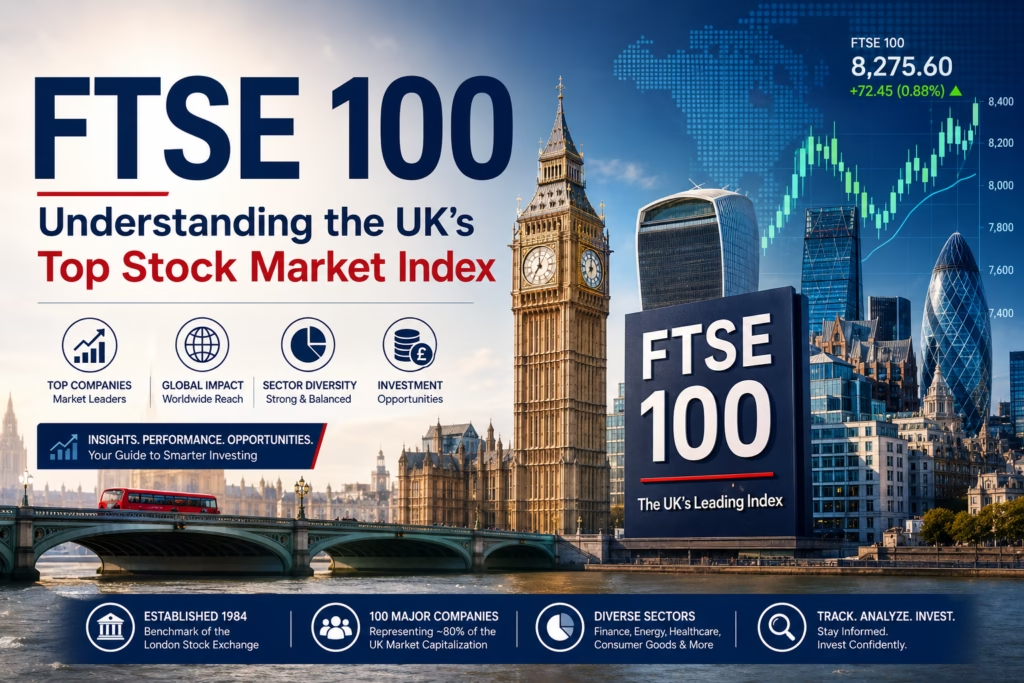
The FTSE 100, officially known as the Financial Times Stock Exchange 100 Index, tracks the performance of the 100 largest companies listed on the London Stock Exchange by market capitalization. It was launched on January 3, 1984, with a starting value of 1,000 points. Since then, it has evolved into the primary benchmark for the UK stock market.
The index is maintained by FTSE Russell, a subsidiary of the London Stock Exchange Group. The companies included in the index collectively account for approximately 80% of the total market capitalization of the London Stock Exchange.
Unlike some stock indices that primarily reflect domestic economic activity, the FTSE 100 has a unique global character. Many of its constituent companies earn a significant portion of their revenues from overseas markets, making the index highly sensitive to international economic developments.
The History of the FTSE 100
Before the FTSE 100 was introduced, investors relied on less sophisticated market indicators to measure stock market performance. The launch of the FTSE 100 in 1984 marked a major milestone in the modernization of the UK’s financial markets.
The index quickly gained prominence as the preferred benchmark for institutional and retail investors. Throughout its history, the FTSE 100 has witnessed significant economic events, including the 1987 stock market crash, the dot-com bubble, the global financial crisis of 2008, Brexit, the COVID-19 pandemic, and periods of economic recovery and expansion.
Each of these events influenced the performance of the index, demonstrating its role as a barometer of investor confidence and economic health.
How the FTSE 100 Works
The FTSE 100 operates as a market-capitalization-weighted index. This means that larger companies have a greater influence on the index’s movement than smaller companies.
For example, if a major company such as Shell plc experiences a significant increase in its share price, the overall FTSE 100 is likely to rise. Conversely, a decline in the stock price of a large constituent can pull the index lower.
The composition of the FTSE 100 is reviewed every quarter. Companies whose market capitalization grows significantly may be added to the index, while those whose value falls may be removed. This ensures that the index always reflects the largest publicly traded companies in the UK market.
Major Sectors Represented in the FTSE 100
One of the reasons investors value the FTSE 100 is its broad sector representation. The index includes companies from a variety of industries, creating diversification within a single benchmark.
The financial sector is one of the most prominent components of the index. Major banks and financial institutions contribute significantly to its overall performance. Energy companies also occupy an important position due to their large market capitalizations and global operations.
Pharmaceutical companies are another major component, reflecting the UK’s leadership in healthcare and medical research. Mining firms, consumer goods manufacturers, telecommunications providers, and industrial corporations further diversify the index.
This sector diversity helps reduce dependence on a single industry and provides investors with exposure to multiple areas of the economy.
Top Companies in the FTSE 100
The FTSE 100 contains some of the world’s most recognized corporations. These companies are leaders in their respective industries and play a major role in shaping global markets.
Among the most notable constituents are HSBC Holdings, one of the largest banking institutions in the world; AstraZeneca, a global healthcare and biotechnology leader; Unilever, known for its extensive portfolio of household brands; and BP, one of the largest energy producers globally.
Mining giant Rio Tinto and financial institution Barclays are also significant members of the index.
The performance of these companies often has a substantial impact on the direction of the FTSE 100.
Why Investors Follow the FTSE 100
The FTSE 100 serves several important functions in the investment world. First, it provides a snapshot of market sentiment. Rising index levels often indicate investor optimism, while declining levels may signal concerns about economic conditions or corporate profitability.
Second, the index acts as a benchmark for investment performance. Fund managers frequently compare their returns against the FTSE 100 to determine whether they are outperforming or underperforming the market.
Third, the FTSE 100 offers insight into global economic trends. Since many constituent companies operate internationally, developments in regions such as North America, Europe, Asia, and emerging markets can influence the index’s performance.
Finally, the FTSE 100 is widely used as the basis for exchange-traded funds (ETFs), mutual funds, derivatives, and other investment products.
Historical Performance of the FTSE 100
Over the long term, the FTSE 100 has delivered substantial returns to investors through both capital appreciation and dividends. Although short-term fluctuations are inevitable, the index has demonstrated resilience through various economic cycles.
Investors who remained committed during challenging periods often benefited from subsequent recoveries. Historical data shows that the FTSE 100 has experienced periods of strong growth following major market downturns.
Dividend income has also played a crucial role in total returns. Many FTSE 100 companies are known for paying attractive dividends, making the index particularly appealing to income-focused investors.
Benefits of Investing in the FTSE 100
One of the biggest advantages of investing in the FTSE 100 is diversification. Instead of purchasing individual stocks, investors gain exposure to 100 leading companies across multiple industries.
Another significant benefit is liquidity. The companies within the index are among the most actively traded stocks in Europe, making it easy for investors to buy and sell shares.
Dividend potential is another major attraction. Many FTSE 100 constituents have long histories of returning profits to shareholders through regular dividend payments.
Additionally, the global nature of the index provides exposure to international markets without requiring investors to directly purchase foreign stocks. This can help reduce concentration risk and broaden investment opportunities.
The FTSE 100 is also highly transparent, with publicly available information allowing investors to track performance and make informed decisions.
Risks Associated with the FTSE 100
Despite its many advantages, investing in the FTSE 100 is not without risks.
Market volatility remains one of the most significant concerns. Economic downturns, geopolitical tensions, inflation, and interest rate changes can all affect stock prices.
Currency fluctuations can also influence returns. Because many FTSE 100 companies earn revenue in foreign currencies, movements in exchange rates can impact profitability and investor sentiment.
Sector concentration represents another risk. The index has substantial exposure to energy, mining, and financial companies. If these sectors face challenges, the overall index may be negatively affected.
Global economic uncertainty can also create headwinds. Trade disputes, political instability, and international conflicts often influence market performance.
Investors should carefully consider these risks and ensure their portfolios align with their financial goals and risk tolerance.
FTSE 100 vs Other Global Indices
The FTSE 100 is often compared with major international indices such as the S&P 500, Dow Jones Industrial Average, and Nikkei 225.
While the S&P 500 has a stronger focus on technology companies, the FTSE 100 is more heavily weighted toward financials, energy, and commodities. This difference means the two indices often perform differently under varying economic conditions.
Investors frequently use a combination of international indices to achieve broader diversification and balance sector exposure.
The Future of the FTSE 100
The future of the FTSE 100 will be shaped by technological innovation, sustainability initiatives, changing consumer preferences, and global economic developments.
Many companies within the index are investing heavily in renewable energy, digital transformation, artificial intelligence, and healthcare innovation. These investments could drive future growth and reshape the composition of the index over time.
Environmental, social, and governance (ESG) considerations are also becoming increasingly important. Investors are paying closer attention to corporate responsibility, sustainability practices, and long-term environmental impact.
As the global economy evolves, the FTSE 100 is expected to continue adapting while maintaining its position as one of the world’s most influential stock market benchmarks.
Conclusion
The FTSE 100 stands as the cornerstone of the United Kingdom’s stock market and a key indicator of global economic activity. By tracking the performance of the largest companies listed on the London Stock Exchange, it provides investors with valuable insights into market trends, corporate performance, and economic conditions.
Its combination of diversification, liquidity, international exposure, and dividend potential makes it an attractive option for investors around the world. While risks such as market volatility and economic uncertainty remain, the FTSE 100 has demonstrated resilience and long-term value throughout its history.
For anyone seeking to understand international investing or gain exposure to some of the world’s leading companies, the FTSE 100 remains an essential benchmark worth following closely.
What does FTSE stand for?
FTSE stands for Financial Times Stock Exchange.
How many companies are included in the FTSE 100?
The index contains the 100 largest companies listed on the London Stock Exchange based on market capitalization.
Is the FTSE 100 a good investment?
Many investors consider it a strong long-term investment due to diversification, global exposure, and dividend opportunities.
How often is the FTSE 100 reviewed?
The index undergoes quarterly reviews to ensure it accurately reflects the largest listed companies.
Can international investors invest in the FTSE 100?
Yes. International investors can access the FTSE 100 through ETFs, index funds, mutual funds, and brokerage accounts.
Why is the FTSE 100 important?
It serves as the primary benchmark for the UK stock market and provides insights into both British and global economic performance.