|
Getting your Trinity Audio player ready...
|
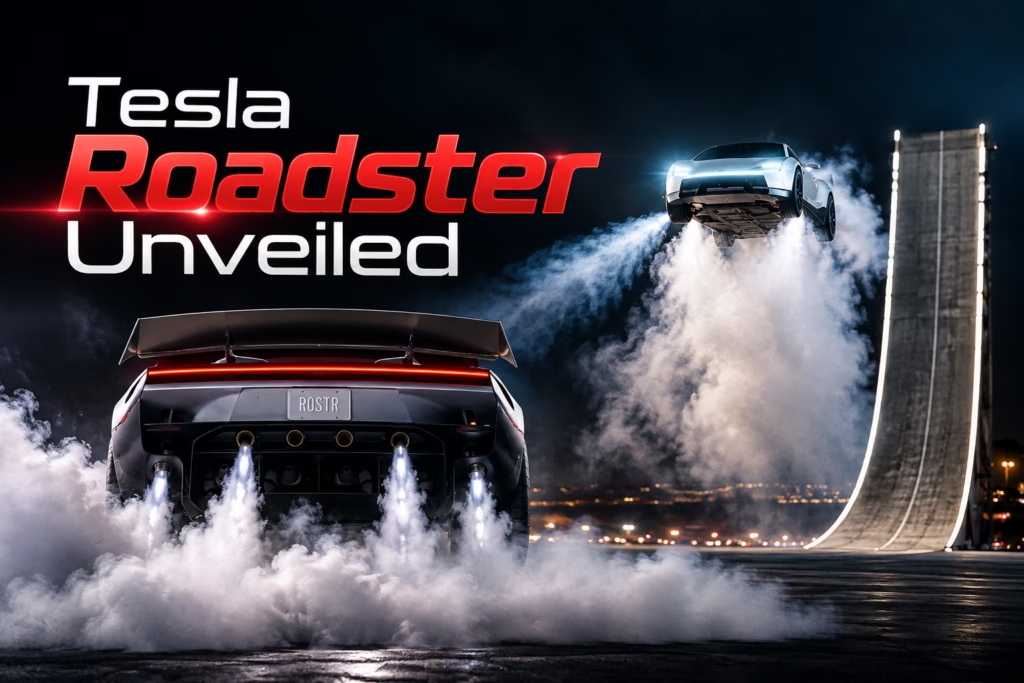
Elon Musk has once again surprised the automotive world with the unveiling of the redesigned Tesla Roadster, an electric sports car that takes vehicle performance in an entirely new direction. Revealed on October 15, 2026, at a SpaceX testing facility in McGregor, Texas, the next-generation Roadster features an angular new design, extreme acceleration claims and SpaceX-inspired cold-gas thrusters capable of lifting the prototype into the air for short manoeuvres.
Unlike conventional electric sports cars, the new Roadster combines automotive engineering with technology inspired by aerospace systems. During its unveiling, the vehicle demonstrated several unusual stunts, including moving upside down along a ramp, performing an aerial flip and jumping over other vehicles. These demonstrations quickly attracted global attention and raised questions about whether flying cars could eventually become a reality.
However, the new Roadster is still awaiting production. Tesla has targeted 2028 for the start of manufacturing, and several important details about the final production model, pricing and regulatory approval remain uncertain. Here’s everything you need to know about Tesla’s redesigned electric supercar.
Tesla Roadster 2026: Latest News and Key Highlights
Tesla’s new Roadster is the second-generation version of the company’s electric sports car project, which was originally unveiled in 2017. The latest prototype introduces significant design changes and demonstrates technology developed through collaboration between Tesla and SpaceX engineers.
The October 15 unveiling focused on performance, aerodynamic technology and the vehicle’s unusual thruster system. According to reports from the event, Tesla demonstrated a prototype capable of performing brief airborne manoeuvres rather than conventional driving alone.
Here are the major highlights of the new Tesla Roadster:
- Unveiling date: October 15, 2026
- Unveiling location: SpaceX testing facility in McGregor, Texas
- Vehicle type: Next-generation all-electric sports car
- Powertrain: Electric propulsion with SpaceX-inspired thruster technology on specialised versions
- Acceleration claim: Less than one second from 0 to 60 mph for the extreme-performance configuration
- Reported driving range: Around 300 miles, or approximately 483 kilometres
- Production target: 2028
- Special technology: Cold-gas thrusters and a multi-mode suction system
These figures reflect announcements and reports associated with the unveiling. Final production specifications may differ.
What Makes the New Tesla Roadster Different?
The most striking feature of the new Tesla Roadster is its ability to perform manoeuvres that are impossible for ordinary road cars. Tesla has combined electric vehicle technology with systems inspired by SpaceX’s aerospace engineering to create a prototype designed to push the boundaries of vehicle performance.
SpaceX-Inspired Cold-Gas Thrusters
The Roadster’s specialised thruster system is one of its biggest talking points. Instead of relying exclusively on tyres, suspension and conventional aerodynamic forces, the system uses compressed gas to generate short bursts of thrust.
During the unveiling, the prototype used this technology to perform aerial manoeuvres and lift itself above the ground. The system also helped the vehicle rotate during demonstrations.
This approach differs from the propulsion system used by an aircraft or helicopter. The Roadster is not presented as a conventional aircraft with wings or a helicopter-style rotor. Instead, its demonstration technology uses compressed gas to create brief thrust-driven movements.
The system is particularly ambitious because integrating such technology into a small vehicle introduces major engineering challenges. Weight, pressure management, stability, control systems and occupant protection will all be important considerations before a production version can be used safely.
It is also essential to understand that a successful demonstration does not automatically make a vehicle suitable for everyday flying or public-road use.
A Suction System for Unusual Manoeuvres
Another interesting feature demonstrated at the event was the Roadster’s multi-mode suction system.
The prototype used this system to move along an inverted ramp, creating the appearance of a car driving upside down. This demonstration showed how Tesla is exploring ways to increase grip and control during unusual driving manoeuvres.
Traditional performance cars depend on tyre grip, suspension design, aerodynamic downforce and carefully engineered weight distribution. A suction-based system introduces a different approach to maintaining contact with a surface under specialised conditions.
However, its usefulness during everyday driving remains uncertain. Public roads have different surfaces, weather conditions and obstacles, so a system that works during a controlled demonstration would still need extensive testing before its practical benefits could be established.
A Mid-Air Flip Demonstration
Perhaps the most dramatic moment of the unveiling came when the Roadster used its thrusters to perform an aerial manoeuvre before returning to the ground.
The demonstration highlighted the vehicle’s potential to combine rapid acceleration with controlled movement beyond the normal limits of a road car.
Nevertheless, these stunts should not be confused with sustained flight. The demonstrated prototype performed short, controlled manoeuvres, and the event did not establish that the Roadster could fly long distances, carry passengers through the air or replace an aircraft.
Its final capabilities will depend on the production configuration and the technology Tesla ultimately delivers.
New Tesla Roadster Design and Exterior
The redesigned Roadster features a sharper and more angular appearance than the vehicle shown in 2017.
Its white prototype has a low-slung body, a sporty profile and sculpted surfaces that give it the appearance of a futuristic supercar. Reports about the unveiling also noted design inspiration from advanced aircraft, including the SR-71 reconnaissance aircraft and the F-35 fighter jet.
The new design reflects Tesla’s changing visual identity, which now includes vehicles such as the Cybertruck and Cybercab.
Aerodynamic Body and Sporty Profile
The Roadster’s low profile and streamlined body are intended to support high-speed performance. At speeds above 200 mph, aerodynamic drag becomes a major challenge for any vehicle, making body shape and airflow management particularly important.
Active aerodynamic elements can potentially adjust airflow according to driving conditions, helping balance stability, drag and performance.
However, the effectiveness of the production vehicle’s aerodynamic package will need to be evaluated through final specifications and independent testing.
A Two-Seater Performance Car
Tesla has described its conventional performance-oriented versions as two-seat vehicles. The compact cabin and sports-car proportions indicate that the Roadster prioritises performance rather than family practicality.
The specialised Rocket version, meanwhile, has been described as a single-seat vehicle equipped with a more extensive thruster system.
These configurations suggest that Tesla is positioning the Roadster as a specialised performance product rather than a mass-market electric car.
Tesla Roadster Performance and Speed
Acceleration is another major reason the new Roadster has attracted attention.
At the unveiling, Tesla demonstrated a claimed 0–60 mph acceleration time of approximately one second for its extreme-performance configuration. That is an exceptionally ambitious target for a production road car.
For comparison, 60 mph is approximately 96.6 km/h. Reaching that speed in less than one second would require extraordinary traction, power delivery and control over the vehicle’s movement.
Tesla has also reported a top-speed target exceeding 230 mph, or approximately 370 km/h, for the Roadster range.
However, the advertised figures should be treated carefully. A prototype demonstration is not the same as a standardised independent test, and the most extreme acceleration claims may apply only to specialised versions with additional hardware.
The final performance of the road-legal model will depend on its production powertrain, tyres, weight, battery system and applicable safety requirements.
Tesla Roadster Range and Battery Technology
Despite its extraordinary performance features, the Roadster remains an electric vehicle.
Reports associated with the unveiling indicate a claimed range of around 300 miles, equivalent to approximately 483 kilometres, for the announced configurations.
This figure would make the Roadster suitable for more than short performance runs, although the actual distance covered on a single charge will depend on driving conditions.
High-speed driving generally consumes considerably more energy than steady cruising. Aggressive acceleration, low temperatures, tyre choice, aerodynamic resistance and repeated performance runs can also reduce real-world range.
Tesla has not established through independent testing how far the final production Roadster will travel under different conditions. Buyers should therefore wait for official battery specifications, charging information and verified range tests before making comparisons with other electric vehicles.
Tesla Roadster Price: How Much Will It Cost?
Tesla has not confirmed a final retail price for the redesigned Roadster at the October 15 unveiling. However, the reservation information reported after the event provides some insight into its premium positioning.
The reported reservation deposits differ significantly between versions.
| Version | Reported reservation information |
|---|---|
| Performance | US$50,000 deposit |
| Thrust | US$250,000 deposit |
| Rocket | Available by invitation |
These figures refer to reported reservation deposits, not confirmed total purchase prices. The final price, payment terms, delivery conditions and availability of each version may change.
The Rocket version is particularly specialised because it is designed around a more extensive thruster system and has been described as not approved for public roads.
For potential buyers, it is important to distinguish between placing a reservation and receiving a confirmed delivery date. Tesla’s reported reservation terms do not guarantee a specific delivery timeline.
Expected Tesla Roadster Price in India
The final Indian price has not been confirmed. If Tesla eventually offers the Roadster in India, the cost could be significantly higher than its US price because of import duties, taxes, shipping, homologation and other expenses.
Its specialised technology may also make the vehicle difficult to service through a conventional luxury-car ownership network.
As a result, Indian buyers should not rely on speculative rupee conversions as an indication of the actual on-road price.
Tesla Roadster Launch Date: When Will Production Begin?
Tesla has announced a target of beginning Roadster production in 2028.
Although the latest unveiling marks an important milestone, it does not mean customer deliveries will begin immediately. The company must still complete development, validate the production design and address the requirements associated with the different vehicle configurations.
The Roadster’s history also calls for caution. Tesla first unveiled the second-generation vehicle in 2017 and originally expected deliveries much earlier. The project subsequently faced repeated delays.
Consequently, 2028 should be treated as the current production target rather than a guaranteed delivery date.
The final schedule will depend on engineering development, manufacturing readiness, component availability and regulatory approvals.
Is the New Tesla Roadster Really a Flying Car?
The term flying car has become closely associated with the new Roadster because of its thruster-powered demonstrations.
However, there is an important difference between a car that can briefly lift off the ground and a vehicle designed for sustained flight.
A conventional flying vehicle needs to meet demanding requirements involving lift, stability, navigation, emergency procedures and passenger safety. It must also comply with aviation regulations wherever applicable.
The Roadster’s demonstrated capabilities do not establish that it can operate as a normal aircraft. Furthermore, the specialised Rocket version has been reported as not approved for public roads.
Even the road-oriented configurations will need to satisfy the relevant automotive safety and regulatory requirements in each market.
Therefore, the most accurate description is that Tesla has demonstrated a prototype with brief airborne capabilities, not a fully certified flying car for everyday travel.
Tesla Roadster vs Traditional Electric Supercars
The Roadster’s main distinction is its attempt to combine high-performance electric driving with aerospace-inspired technology.
Traditional electric supercars focus on rapid acceleration, battery performance, aerodynamic efficiency, braking, cornering and handling. These features are already challenging to engineer at high levels.
Tesla is attempting to go further by adding thrusters and a suction system to specialised configurations.
If the company successfully brings the technology into production, the Roadster could stand apart from other electric sports cars. However, the added complexity could also create challenges involving weight, cost, maintenance, reliability and safety.
For most drivers, conventional electric supercars will continue to offer more familiar and practical performance characteristics. The Roadster’s specialised technology is likely to appeal most to enthusiasts interested in experimental engineering and extreme vehicle performance.
What the New Roadster Means for Tesla and the EV Industry
The unveiling demonstrates Tesla’s ambition to maintain a reputation for technological innovation as the automotive industry expands into autonomous driving, robotics and advanced electric mobility.
The Roadster is not expected to become a mass-market vehicle. Instead, it could function as a showcase for engineering capabilities and help attract attention to the company’s wider technology development.
Its collaboration with SpaceX is also significant. The use of aerospace-inspired systems demonstrates how technologies developed for one industry can influence products in another.
However, the Roadster’s commercial impact remains uncertain. A highly advanced prototype may generate attention, but manufacturing a reliable, affordable and legally compliant production vehicle is a different challenge.
The company must prove that the demonstrated features can be delivered to customers without compromising essential requirements such as reliability and safety.
For the wider EV industry, the Roadster is an example of how electric vehicle development may extend beyond batteries and motors into new control systems, aerodynamic technology and experimental propulsion concepts.
Conclusion
The redesigned Tesla Roadster unveiled on October 15, 2026, is one of the most unusual developments in the electric sports-car segment. Its angular exterior, extreme acceleration claims, suction system and SpaceX-inspired cold-gas thrusters distinguish it from conventional performance cars.
However, its most ambitious features remain closely tied to prototype demonstrations, and the vehicle is not yet a commercially delivered production model. The specialised Rocket configuration also faces substantial regulatory limitations.
With production targeted for 2028, the next major milestone will be Tesla’s ability to turn its demonstrations into a practical, reliable and legally compliant vehicle.
If Tesla achieves that goal, the Roadster could become a landmark example of the crossover between electric automotive engineering and aerospace technology. Until then, its most extraordinary promises should be viewed as ambitious engineering targets rather than established everyday capabilities.
FAQs
When was the new Tesla Roadster unveiled?
Tesla unveiled the redesigned next-generation Roadster on October 15, 2026, at a SpaceX testing facility in McGregor, Texas.
Can the new Tesla Roadster actually fly?
The prototype demonstrated brief airborne manoeuvres using cold-gas thrusters. However, this does not establish that it can fly sustained distances like an aircraft.
When will the Tesla Roadster launch?
Tesla has targeted 2028 for the start of production. Actual customer delivery dates have not been guaranteed.
What is the price of the new Tesla Roadster?
Tesla has not confirmed the final retail price of the redesigned model. Reported reservation deposits vary by version, with the Performance and Thrust versions requiring different deposits and the Rocket version offered by invitation.
What is the claimed acceleration of the new Tesla Roadster?
Tesla demonstrated a claimed 0–60 mph time of approximately one second for its extreme-performance configuration. Independent production-car testing is needed to verify the final performance.
Will the new Tesla Roadster launch in India?
There is no confirmed Indian launch date or final Indian price. Availability will depend on Tesla’s market plans and the applicable regulatory requirements.