|
Getting your Trinity Audio player ready...
|
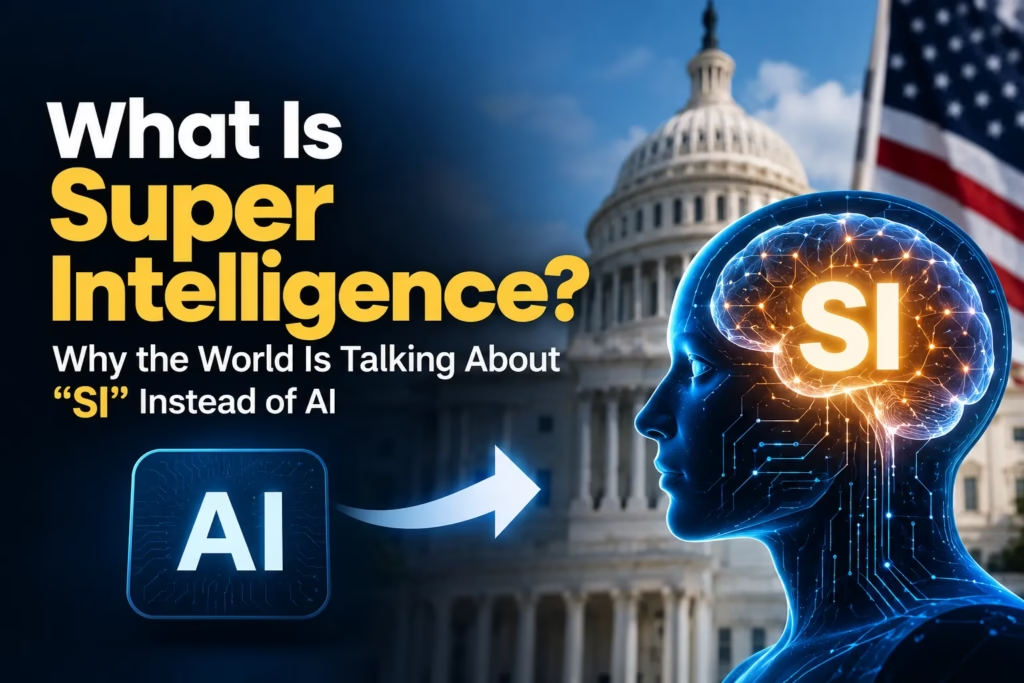
Super Intelligence, or SI, is the new term the U.S. federal government has adopted for artificial intelligence (AI). The move has put “Super Intelligence” at the center of the latest AI debate and raised a bigger question: what does SI actually mean?
The White House has officially introduced the term “Super Intelligence” (SI) as a replacement for “Artificial Intelligence” (AI) across executive-branch communications.
On September 29, 2026, President Donald Trump signed an executive order titled “Inaugurating the Era of Super Intelligence.” The order directs federal departments and agencies to use “Super Intelligence” and “SI” instead of “Artificial Intelligence” and “AI” in official communications, websites, reports, policy documents and other non-statutory materials.
What Is Super Intelligence?
Super Intelligence refers to the rapidly advancing capabilities of modern AI systems. The White House says today’s frontier systems can do more than automate individual tasks or imitate specific aspects of human intelligence.
According to the executive order, these technologies can increasingly amplify human creativity and help people achieve results that were previously difficult or impossible across areas such as science, medicine and other fields.
However, there is an important detail behind the new terminology.
The executive order currently defines “Super Intelligence” using the existing federal definition of artificial intelligence. The administration has also ordered the Assistant to the President for Science and Technology to prepare a proposed federal definition of SI within 60 days.
That means the change does not establish that today’s AI systems have suddenly reached a scientifically proven level of superintelligence.
Why Is AI Now Being Called SI?
The White House says the term Artificial Intelligence no longer fully represents the capabilities of the latest technology.
AI has developed rapidly since the field emerged as a formal area of research. Modern systems can generate text and images, analyze information, write software, assist with scientific research and perform increasingly complex tasks.
The administration argues that Super Intelligence better reflects this technological shift and the potential of advanced AI systems.
The change also signals how seriously the U.S. government views advanced AI technology.
AI vs SI: What Is the Difference?
The terms can cause confusion because AI and SI currently overlap in the U.S. government’s definition.
Artificial Intelligence (AI) is the traditional term for computer systems that can perform tasks involving functions such as prediction, recommendations, decision-making, perception and automated analysis.
Super Intelligence (SI) is the new terminology that the U.S. executive branch will use for these technologies under the September 2026 executive order.
The White House plans to develop a more specific federal definition of Super Intelligence. That future definition could modify or expand the existing legal definition of AI.
Is Super Intelligence the Same as Artificial Superintelligence?
Not necessarily.
In technology discussions, artificial superintelligence (ASI) often describes a hypothetical form of machine intelligence that could outperform humans across a very broad range of intellectual tasks.
The White House order does not say that current AI systems have reached that level.
Instead, the order uses Super Intelligence (SI) as a new government term for the technologies currently covered by the federal definition of AI, while officials work on a separate definition for the future.
This distinction matters because the phrase “superintelligence” can mean different things in government policy, technology research and public discussions.
What Is the Super Intelligence Force?
The latest development came on October 4, 2026, when President Trump announced the creation of a Super Intelligence Force (SIF).
The new federal task force will coordinate government efforts around advanced AI technology and focus on maintaining U.S. leadership in the field.
The White House has described advanced AI, now referred to as Super Intelligence, as a major technological development with potential effects across the economy, science, medicine and national security.
The task force adds another layer to the U.S. government’s growing focus on advanced AI and its potential opportunities and risks.
What Happens Next?
The next major development will come from the federal government’s planned definition of Super Intelligence.
The executive order gives the Assistant to the President for Science and Technology 60 days to submit proposed legislative language that could establish a formal federal definition of SI.
The proposal must consider whether the new definition should modify, expand or replace the existing statutory definition of artificial intelligence.
That decision could have a major impact on how the U.S. government talks about and regulates advanced AI technology in the future.
Super Intelligence Explained in Simple Terms
For now, the simplest way to understand the change is this:
AI is the traditional name. SI is the new U.S. government terminology.
The change does not mean that every AI system has suddenly become a superintelligent machine.
Instead, the U.S. government wants the term Super Intelligence to reflect what it sees as the rapidly expanding capabilities and potential of modern AI technology.
As AI systems become more capable, the debate around AI vs SI, artificial superintelligence, AI safety and the future of intelligent machines is likely to become even more important.
For now, the biggest question remains open: Will “Super Intelligence” become simply a new name for advanced AI, or will the U.S. government eventually give SI a separate legal and technical meaning?