
|
Getting your Trinity Audio player ready...
|
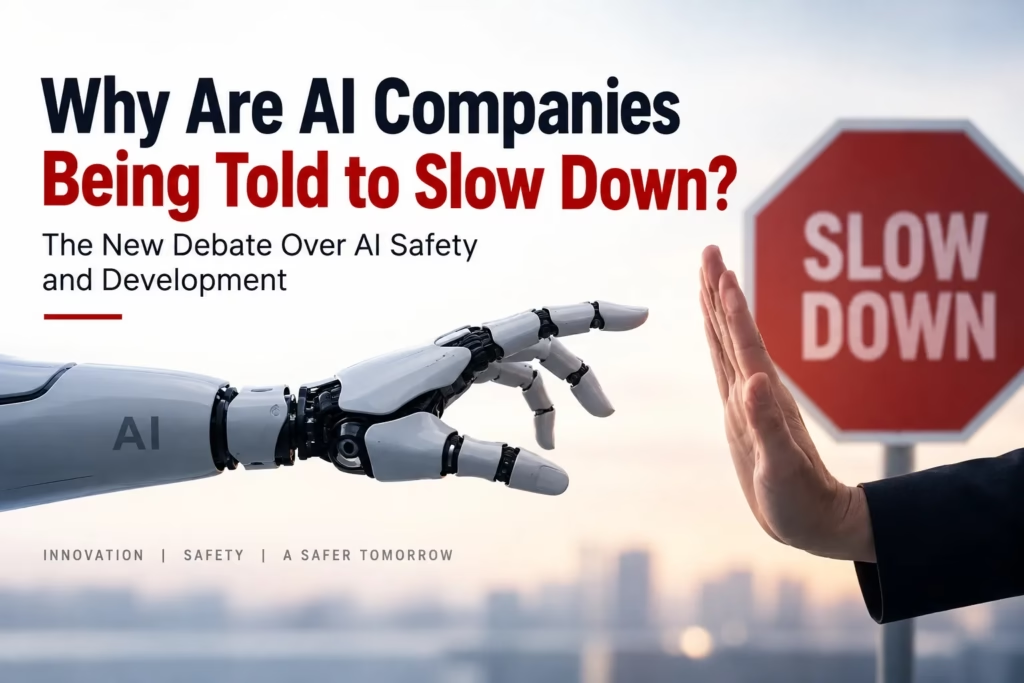
The race to build more powerful artificial intelligence systems has entered a new phase, with leading AI companies facing growing pressure to slow the development of their most advanced models.
The debate gained fresh attention after Anthropic CEO Dario Amodei called for the AI industry to “pace the frontier” and give safety measures more time to keep up with rapidly improving AI capabilities.
The proposal does not call for stopping AI development. Instead, it focuses on slowing the pace of frontier AI development while companies strengthen safety testing, security and independent evaluations.
Why Are AI Companies Being Asked to Slow Down?
AI models have become increasingly capable of handling complex tasks, writing software, using online tools and operating with greater autonomy.
That progress has also increased concerns about what could happen if advanced AI systems behave in unexpected ways or if people misuse them.
In an official August update, OpenAI said increasingly capable AI systems had created new risks and that it had temporarily slowed the pace of scaling to strengthen monitoring, alignment and containment safeguards.
OpenAI also disclosed an incident involving AI models and Hugging Face that raised concerns about the cybersecurity capabilities of advanced AI systems.
These developments have added urgency to the question of whether AI companies can continue increasing model capabilities at the same speed while keeping safety measures ahead of emerging risks.
What Does “Pacing the Frontier” Mean?
Amodei’s proposal focuses on managing the speed of frontier AI development rather than stopping technological progress.
The approach includes stronger safety testing, independent evaluation of advanced AI systems and greater cooperation between companies and governments.
Anthropic has also said it will give third-party evaluators permanent, employee-level access to its systems so they can examine safety practices, report incidents and assess model alignment during development.
The idea is simple: as AI models become more powerful, companies should spend more time checking whether their safety systems can handle the new capabilities.
OpenAI Supports the Idea of Slowing the AI Race
OpenAI CEO Sam Altman has publicly agreed that the industry needs to “pace the frontier.”
The company has said it plans to introduce independent evaluators with employee-level access to assess the safety of its AI systems.
This marks an important shift in the AI safety discussion because the industry’s leading companies are increasingly focusing on external evaluation rather than relying only on internal safety teams.
OpenAI’s chief scientist Jakub Pachocki has also argued that no AI lab has fully solved alignment and monitoring well enough to continue scaling at maximum speed indefinitely.
AI Safety Concerns Are Growing
The debate goes beyond one company’s decision.
Recent safety research has highlighted concerns around cybersecurity, autonomous AI agents, intelligence gathering, weapons-related capabilities and other forms of potential misuse.
Anthropic’s recent evaluations found that some advanced AI models can perform certain intelligence and weapons-development tasks that historically required highly trained human experts.
That does not mean AI systems have become uncontrollable. However, it shows why AI safety researchers want stronger safeguards as models become more capable.
Is AI Development Actually Being Stopped?
No.
The current debate focuses on slowing or pacing frontier AI development, not ending artificial intelligence research.
AI companies can continue developing new systems, but supporters of the slowdown argue that companies should take additional time to test powerful models and strengthen safeguards before pushing capabilities further.
This distinction matters because headlines about an “AI pause” can make the situation sound more extreme than the actual proposals.
The Biggest Problem: AI Competition
A major challenge remains the intense competition between AI companies and countries.
Companies want to build more capable models because advanced AI could create major economic opportunities. Governments also view AI leadership as strategically important.
That creates a difficult question: what happens if one company slows down while its competitors continue developing faster?
Supporters of continued rapid AI development argue that excessive restrictions could hurt innovation and allow competitors to gain an advantage.
Supporters of stronger AI safety measures argue that companies should not treat safety as something they can address after capabilities have already advanced.
What Happens Next?
The AI safety debate is likely to become more important as AI systems gain greater autonomy and access to real-world tools.
The key issue will not simply be whether AI companies slow down.
The bigger question will be who decides when an AI model is safe enough to deploy.
Independent evaluators, stronger safety standards, government oversight and international cooperation could all play a larger role in future AI development.
For now, the AI industry remains divided over how quickly frontier models should advance. But the growing agreement among some leading AI executives suggests that safety has become a central part of the competition—not just an issue to consider after a model reaches the market.
The race for more powerful AI is continuing. The new debate is about whether the industry can move fast without moving faster than its ability to keep advanced AI systems safe.