|
Getting your Trinity Audio player ready...
|
The FIFA World Cup has always been the crown jewel of international football. Every four years, nations put aside club rivalries and unite behind their flags, creating unforgettable moments that become part of sporting history. From Diego Maradona’s brilliance in 1986 to Lionel Messi finally lifting the trophy in 2022, the World Cup has consistently delivered drama, emotion, and global attention unlike any other sporting event.
Now, FIFA is preparing for its most ambitious tournament yet.
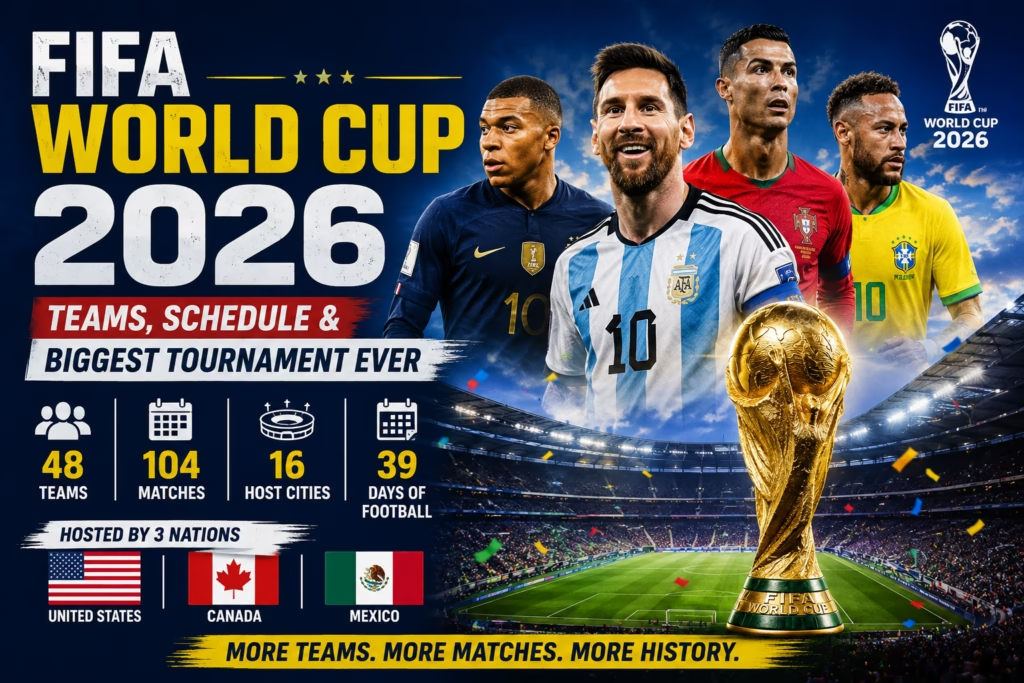
The FIFA World Cup 2026, which will be hosted by the United States, Canada, and Mexico, is set to become the largest football tournament ever staged. With 48 participating teams, 104 matches, and 16 host cities spread across three countries, the competition will be bigger than anything football has seen before.
For fans, players, and football federations around the world, the 2026 edition represents more than just another World Cup. It marks the beginning of a new era.
- A Historic First for Football
- Why FIFA Expanded the World Cup
- FIFA World Cup 2026 Schedule
- Expected Top Teams
- Understanding the New Format
- More Teams, More Stories
- Host Cities Ready for the Spotlight
- The Favorites Heading into 2026
- Technology Will Play a Bigger Role Than Ever
- Challenges FIFA Must Overcome
- A Tournament That Could Change Football Forever
- FAQs
A Historic First for Football
The 2026 World Cup will make history even before the opening whistle is blown.
For the first time, three countries will jointly host the tournament. The United States, Canada, and Mexico have combined their resources to create what FIFA believes will be the most accessible and commercially successful World Cup ever organized.
Mexico will also achieve a unique milestone by becoming the first nation in history to host matches in three separate FIFA World Cups, having previously welcomed the tournament in 1970 and 1986.
Meanwhile, Canada will host World Cup matches for the first time, reflecting the country’s growing influence in international football.
The United States, already one of the world’s largest sports markets, is expected to play the central role, hosting the majority of matches, including the final.
Why FIFA Expanded the World Cup
One of the biggest talking points surrounding the 2026 tournament is the expansion from 32 teams to 48 teams.
For years, football experts debated whether the World Cup should include more nations. Critics argued that expanding the tournament might reduce quality, while supporters believed it would make football more inclusive.
FIFA ultimately chose expansion for several reasons.
The governing body wanted to provide greater opportunities for emerging football nations, particularly from Africa, Asia, and North America. Under the previous format, several competitive countries frequently missed out on qualification due to limited spots.
The new structure allows more nations to participate, giving millions of additional fans a chance to see their countries compete on football’s biggest stage.
For developing football markets, qualification alone can transform the sport domestically by increasing investment, sponsorship opportunities, and youth participation.
FIFA World Cup 2026 Schedule
The FIFA World Cup 2026 will be the biggest tournament in football history, featuring 48 teams and 104 matches across the United States, Canada, and Mexico. The tournament is scheduled to begin on June 11, 2026, and conclude with the final on July 19, 2026.
While the complete fixture list will only be finalized after all teams qualify and the official draw takes place, FIFA has already confirmed several key tournament dates.
| Stage | Date |
|---|---|
| Opening Match | June 11, 2026 |
| Group Stage Begins | June 11, 2026 |
| Group Stage Ends | June 27, 2026 |
| Round of 32 | June 28 – July 3, 2026 |
| Round of 16 | July 4 – July 7, 2026 |
| Quarterfinals | July 9 – July 11, 2026 |
| Semifinals | July 14 – July 15, 2026 |
| Third-Place Match | July 18, 2026 |
| FIFA World Cup Final | July 19, 2026 |
Expected Top Teams
Although the final group-stage matchups will be confirmed after the official FIFA World Cup draw, the following nations are expected to be among the tournament favorites:
| Nation | Confederation | World Ranking Status |
|---|---|---|
| Spain | UEFA | Top European Contender |
| France | UEFA | Former World Champion |
| England | UEFA | Euro Finalist |
| Germany | UEFA | Four-Time World Champion |
| Portugal | UEFA | UEFA Nations League Champion |
| Argentina | CONMEBOL | Defending World Champion |
| Brazil | CONMEBOL | Five-Time World Champion |
| Netherlands | UEFA | Tournament Favorite |
| Italy | UEFA | European Giant |
| Belgium | UEFA | Golden Generation Squad |
Fans can expect several blockbuster clashes during the group stage and knockout rounds as the world’s biggest football nations compete for the most prestigious trophy in the sport.
Understanding the New Format
The 2026 World Cup will feature 48 teams divided into 12 groups of four.
Each team will play three group-stage matches. After the group stage concludes, the top two teams from each group, along with the eight best third-placed teams, will advance to the knockout rounds.
This creates a Round of 32 for the first time in World Cup history.
As a result, the tournament will grow from 64 matches in previous editions to an astonishing 104 matches.
For supporters, this means more football, more rivalries, and more opportunities for dramatic upsets.
More Teams, More Stories
One of the most exciting aspects of the expanded tournament is the possibility of seeing new nations compete on football’s biggest stage.
Historically, the World Cup has been dominated by traditional powers such as Brazil, Germany, Argentina, Italy, and France. While these nations are expected to remain contenders, the new format opens doors for countries that rarely had realistic qualification chances under the old system.
African nations will receive additional qualification spots, while Asian and North American teams will also benefit significantly.
This could lead to breakthrough appearances from nations eager to announce themselves to the world.
Football fans often remember underdog stories more vividly than champions. Croatia’s remarkable run to the 2018 final and Morocco’s historic journey to the 2022 semifinals demonstrated how quickly perceptions can change.
The 2026 edition could produce even more surprises.
Host Cities Ready for the Spotlight
Preparations are already underway across all three host nations.
Cities such as New York, Los Angeles, Dallas, Miami, Atlanta, Toronto, Vancouver, Mexico City, Guadalajara, and Monterrey are expected to welcome millions of visitors during the tournament.
The final will be held at MetLife Stadium in New Jersey, one of the largest and most technologically advanced sporting venues in North America.
Many host cities are investing heavily in infrastructure improvements, transportation upgrades, and fan engagement initiatives to ensure a smooth experience for international visitors.
For local economies, the World Cup represents a major opportunity.
Experts predict billions of dollars in tourism revenue, hotel bookings, restaurant spending, and infrastructure development throughout the tournament.
The Favorites Heading into 2026
Although qualification is still ongoing in several regions, football fans have already begun debating potential favorites.
Defending champions Argentina will aim to continue their success after ending their long wait for a World Cup title in Qatar.
France remains one of the strongest squads in world football thanks to its incredible depth of talent.
Brazil enters every World Cup with expectations of challenging for the trophy, while England continues to develop a promising generation of players capable of competing with the world’s best.
Spain, Portugal, Germany, and the Netherlands are also expected to be among the leading contenders.
However, recent tournaments have shown that reputation alone guarantees nothing.
Modern football has become increasingly competitive, with smaller nations capable of defeating traditional powerhouses on any given day.
Technology Will Play a Bigger Role Than Ever
Technology is expected to be a major feature of the 2026 World Cup.
VAR has already transformed football by assisting referees with crucial decisions, but FIFA continues to refine the system to improve accuracy and reduce delays.
Semi-automated offside technology is also expected to evolve further, providing faster and more precise decisions.
Artificial intelligence and advanced analytics are increasingly influencing tactical planning, player performance monitoring, and injury prevention.
By 2026, teams will have access to more data than ever before, potentially changing how matches are prepared and managed.
Challenges FIFA Must Overcome
While excitement surrounding the tournament continues to grow, FIFA also faces significant challenges.
One of the biggest concerns is travel.
Unlike previous tournaments hosted within a single country, teams and supporters may need to travel long distances between venues located across North America.
Managing schedules, transportation, and recovery periods will be critical for participating teams.
Player workload is another concern.
The modern football calendar is already crowded with domestic leagues, continental competitions, and international fixtures. Adding a longer World Cup could increase physical demands on players.
Nevertheless, FIFA believes the expanded format will ultimately benefit the sport by creating more opportunities and attracting new audiences worldwide.
A Tournament That Could Change Football Forever
The FIFA World Cup 2026 is more than simply an expanded competition.
It represents FIFA’s vision for the future of football—a sport that continues to grow beyond its traditional power centers and reach new communities across the globe.
With more nations involved, more matches played, and more fans engaged than ever before, the tournament has the potential to reshape international football for decades.
Whether it becomes remembered for legendary performances, shocking upsets, or unforgettable moments, one thing is already clear.
When the opening match kicks off in 2026, football will be entering a new chapter in its history.
Conclusion
The FIFA World Cup 2026 promises to be unlike anything the sport has experienced before. Featuring 48 teams, 104 matches, and three host nations, it will be the largest and most ambitious World Cup ever organized.
While questions remain about logistics, scheduling, and the impact of expansion, there is little doubt that the tournament will capture the attention of billions around the world.
For football fans, the countdown has already begun.
The world’s biggest sporting event is about to become even bigger.
FAQs
Why is FIFA World Cup 2026 historic?
It will be the first World Cup featuring 48 teams and the first hosted jointly by three countries: the United States, Canada, and Mexico.
How many matches will be played in FIFA World Cup 2026?
A total of 104 matches will be played, making it the largest World Cup in history.
Which stadium will host the 2026 FIFA World Cup Final?
MetLife Stadium in New Jersey, United States, will host the final.
Why did FIFA increase the number of teams?
The expansion aims to provide greater representation for football nations across Africa, Asia, North America, and other developing regions.
Which countries are favorites to win the FIFA World Cup 2026?
Argentina, France, Brazil, England, Spain, Germany, and Portugal are widely considered among the leading contenders.