|
Getting your Trinity Audio player ready...
|
Innovation technology is moving faster than at any other time. That all changes with device availability through the end of October 2023, and suddenly what sounded like science fiction is becoming part of everyday life. The largest innovations from 2026 onwards are no longer just automation or mobile devices – they are relaying connected systems, associated ecosystems, human-machine interaction and independent decision-making.
The future tech landscape is changing fast, from AI agents running business operations to humanoids in warehouses and hospitals. Those that adjust ahead of the curve will benefit most, but individuals who develop competency in these new technologies will forge the next decade themselves.
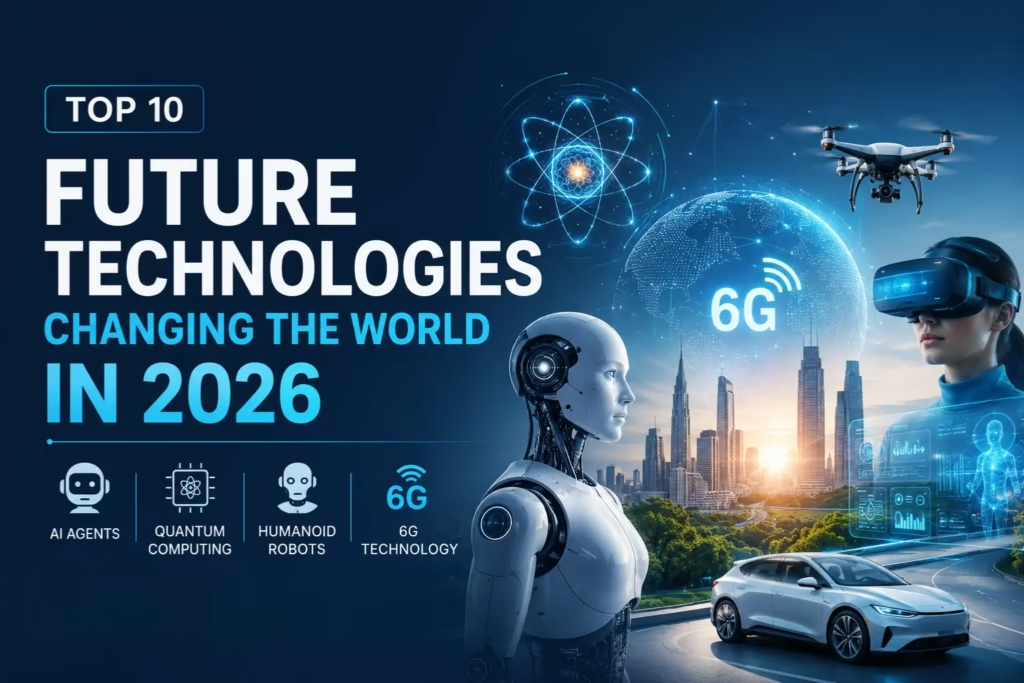
This post is about top 10 future technologies 2026 expected to revolutionize industries, also create new jobs and shift our relationship with the digital world.
- 1. Agentic AI and Autonomous AI Agents
- 2. Quantum Computing
- 3. Humanoid Robots
- 4. Edge AI
- 5. Brain-Computer Interfaces (BCIs)
- 6. Spatial Computing
- 7. 6G Technology
- 8. Digital Twins
- 9. Biotechnology and Precision Medicine
- 10. Sustainable Clean Technology
- How Future Technologies Will Change Daily Life
- Industries That Will Transform the Most
1. Agentic AI and Autonomous AI Agents
AI is moving beyond chatbots and content generation. The emergence of Agentic AI will become one of the most transformational technology trends 2026.
An AI agent refers to systems that can take one or more characters; it can make decisions and conduct actions, learn from issues and work without human involvement.
AI agents do more than just answer questions, they can:
- Manage workflows
- Analyze business data
- Negotiate with other systems
- Book appointments
- Handle customer support
- Automate research and operations
Why It Matters in 2026
The transition from AI tools to AI coworkers.
Here are some tasks for which of autonomous systems an organization might already be building;
- Finance automation
- Cybersecurity monitoring
- Logistics optimization
- Sales operations
- Software development
For instance, firms started to use AI agents that automatically compose code, test applications, find bugs and deploy new versions.
Future Impact
This would result in reduced repetitive office work and improved productivity across several industries.
Several sectors are likely to be more transformed by:
- Banking
- Healthcare
- Retail
- Legal services
- Manufacturing
Career Opportunities
High-demand roles include:
- AI Automation Engineer
- Prompt Architect
- AI Workflow Designer
- Autonomous Systems Specialist
2. Quantum Computing
Quantum computing is fast shouldering towards one of the most crucial emerging technologies of this decade.
In classical computers, you have data represented by bits (0 or 1) whereas in quantum they are represented as qubits – that can exist in more states at one point of time.
This enables them to solve very complex problems many orders of magnitude faster than classical systems.
Why Quantum Computing Matters
In the next 2026, you can expect quantum systems to breakthrough in:
- Drug discovery
- Financial modeling
- Climate simulations
- Cryptography
- Advanced materials science
It goes without saying that large pharmaceutical companies are very interested in quantum computing because it can simulate molecular interactions faster than anything we have ever seen before.
Real-World Example
By doing so, researchers are using quantum systems to expedite the new drug and battery technology for electric vehicles.
Future Impact
Quantum computing could one day shake up industries that rely on intensive computations and optimization.
If so it will also be a threat to cybersecurity practices, forcing businesses to implement quantum-safe encryption methods.
Career Opportunities
- Quantum Software Developer
- Quantum Research Scientist
- Cryptography Engineer
- Quantum Hardware Engineer
3. Humanoid Robots
Humanoid robots are transitioning from proof-of-concept prototypes to everyday assistants.
The year 2026 is when we expect businesses to deploy humanoid robots in:
- Warehouses
- Hospitals
- Hotels
- Manufacturing plants
- Elderly care facilities
Equipped with AI, advanced sensors and computer vision these robots can map the environment, interact with other humans and perform some physical tasks.
Why Humanoid Robots Matter
Labor shortages and aging populations around the world are pushing companies in a robotic direction.
They help do repetitive, harmful, or challenging bodily work.
Real-World Use Cases
This is all with help from potential future tech corporations testing robots that can:
- Delivering medical supplies
- Assisting surgeons
- Lifting heavy inventory
- Guiding customers in retail stores
Future Impact
They could help transform manual labor-based industries and increase safety in places where workplace accidents are common.
And will eventually be used at homes as personal assistants for the elderly.
Career Opportunities
- Robotics Engineer
- Human-Robot Interaction Designer
- Robot Maintenance Specialist
- AI Robotics Trainer
4. Edge AI
While cloud computing revolutionized digital infrastructure, it is Edge AI that has becomes a prerequisite for real-time intelligence.
Edge AI focuses on how data should be processed at the devices rather than sending everything to cloud servers.
It minimizes latency and hence speeds, privacy, and efficiency.
Why Edge AI Matters in 2026
Modern applications require instant decision-making.
Examples include:
- Autonomous vehicles
- Smart factories
- Medical monitoring systems
- Smart cities
- Industrial IoT devices
If you send all data to the cloud, it will invariably lead to delays. Edge AI directly tackles this challenge by analyzing information at its source.
Real-World Example
Edge AI in self-driving cars means that traffic conditions are analyzed and decisions made, without the need to wait for cloud responses.
Future Impact
This means Edge AI will drive the proliferation of smart devices and connected ecosystems.
Also, reducing data exposure will enhance cybersecurity.
Career Opportunities
- Edge AI Developer
- Embedded Systems Engineer
- IoT Architect
- AI Infrastructure Specialist
5. Brain-Computer Interfaces (BCIs)
Brain-Computer Interfaces are one of the top 10 futuristic technology trends 2026.
BCIs facilitate communication between the human brain and digital systems.
This data was trained until 2022, which means it reflected all the advancements in this field up to 2022.
Why BCIs Matter
The first major beneficiary will be Medical.
BCIs may help patients with:
- Paralysis
- Neurological disorders
- Speech impairments
- Cognitive rehabilitation
Outside the field of medicine, BCIs could fundamentally change gaming, communication and workplace productivity.
Real-World Possibilities
After running the analysis, future applications may permit users to:
- Control devices using thoughts
- Operate prosthetic limbs naturally
- Interact with virtual environments mentally
Future Impact
A BCI could revolutionize the way we relate to computers.
This technology will commence to bridge the gap between biological and digital intelligence.
Career Opportunities
- Neurotechnology Engineer
- Biomedical AI Specialist
- Neural Interface Researcher
- Cognitive Systems Analyst
6. Spatial Computing
Spatial computing fuses augmented reality (AR), virtual reality (VR), sensors, AI and 3D environments.
Rather than scrolling on flat screens, users interact with digital content embedded in real-world environments.
Why Spatial Computing Matters
Companies are investing significantly in immersive digital experiences.
Applications include:
- Virtual collaboration
- Medical training
- Industrial simulations
- Architecture visualization
- Remote education
Real-World Example
AR headsets are increasingly being adopted by manufacturing companies for training purposes and reducing operational errors.
3D Simulation 3D simulations are widely used by healthcare professionals for surgical planning.
Future Impact
In some contexts, spatial computing can make traditional interfaces like smartphones and laptops obsolete.
There is a likelihood that it will change remote working, distance learning and entertainment.
Career Opportunities
- AR/VR Developer
- Spatial UX Designer
- 3D Experience Engineer
- Mixed Reality Architect
7. 6G Technology
As the world has just begun expanding 5G networks in many regions, researchers are already working on the next generation of cellular 6G technology.
6G is expected to deliver:
- Ultra-fast speeds
- Near-zero latency
- AI-native networking
- Massive device connectivity
Why 6G Matters in 2026
This also highlights the growing need for faster, smarter communication networks using emerging technologies.
6G will support:
- Autonomous transportation
- Smart cities
- Advanced robotics
- Holographic communication
- Real-time digital twins
Future Impact
6G may open up whole new ecosystems of digital world with continuous connectivity and autonomous infrastructure driven through AI by the year 2030.
At some point, it could be the basis of future technology innovation.
Career Opportunities
- Telecommunications Engineer
- Wireless Network Architect
- 6G Infrastructure Specialist
- Network Security Analyst
8. Digital Twins
Digital twins are the virtual representation of physical assets, products, or systems.
Readings from sensors and connected devices feed continuously into them in real-time.
Why Digital Twins Matter
Businesses use digital twins to:
- Predict equipment failures
- Optimize manufacturing
- Improve urban planning
- Monitor infrastructure
Real-World Example
Airlines use digital twins to monitor aircraft performance and detect maintenance issues before failures occur.
Future Impact
Predictive Operations and Smart Infrastructure will further drive the usage of Digital twins.
Digital twins can be used to optimize traffic flow, energy usage, and emergency response systems in the future -and more functionalities might spring up in large numbers depending on needs that may arise.
- Career Opportunities
- Digital Twin Engineer
- Simulation Specialist
- Industrial Data Analyst
- Smart Infrastructure Consultant
9. Biotechnology and Precision Medicine
Artificial Intelligence (AI) is increasingly used for diagnostics, genetic analysis, and individualised treatments which will demonstrate rapid advances on the biotechnological front.
Precision medicine consists of designing healthcare according to our genetics and lifestyle factors,
Why It Matters in 2026
Healthcare systems are moving from a model based around reactive treatment to one based on predictive and preventive care.
AI-powered biotechnology can improve:
- Cancer treatment
- Disease prediction
- Drug development
- Personalized nutrition
Real-World Example
Custom treatment plan Generation with Genetic testing platforms has been aiding doctors in how they can devise tailored measures for their patients.
Future Impact
Increased precision medicine might decrease treatment expenses over a daily basis and radically modify finish results.
Career Opportunities
- Bioinformatics Scientist
- Genetic Data Analyst
- Personalized Healthcare Consultant
- Medical AI Researcher
10. Sustainable Clean Technology
Sustainability is now optional for businesses.
Environment: Clean Technology will be a significant innovation and investment driver in 2026.
Why Clean Tech Matters
Directions that governments and corporations are looking towards are:
- Renewable energy
- Smart grids
- Carbon capture
- Green hydrogen
- Sustainable manufacturing
Real-World Example
Billions of systems called energy management systems, powered by artificial intelligence and machine learning to both cut emissions and also make electricity use at factories optimal.
Future Impact
Energy infrastructure will be remade by green technologies, and the world-wide march of sustainability will footpace.[5]
Career Opportunities
- Renewable Energy Engineer
- Sustainability Analyst
- Climate Tech Consultant
- Green Infrastructure Planner
How Future Technologies Will Change Daily Life
The next wave of future technologies in 2026 will become a core part of daily life.
People may soon:
- Work alongside AI agents
- Learn through immersive spatial computing
- Use wearable health monitoring devices
- Travel in autonomous vehicles
- Robots in homes and workplaces
Technologies will grow more predictive, personalized and interwoven with physical spaces.
Industries That Will Transform the Most
Healthcare
Support Development of AI diagnostics, robotics and precision medicine for better patient outcomes & accessibility.
Education
For one, the future will interweave spatial computing experiences with AI tutors that are tailored to your own learning style.
Finance
Quantum computing and AI agents will analyze things like fraud detection, automate customer service.
Manufacturing
Production and maintenance will perform better because of humanoid robots and digital twins.
Retail
Firstly, Edge ai and Immersive shopping experience will redefine how we engage with customers.
FAQ
What are the top future technologies in 2026?
Some of the biggest future tech trends include AI agents, quantum computing, humanoid robots, Edge AI, brain-computer interfaces, spatial computing, and 6G technology.
Why are AI agents important?
AI agents can perform complex tasks autonomously, improving efficiency, reducing operational costs, and transforming business automation.
How will quantum computing affect industries?
Quantum computing could revolutionize drug discovery, cybersecurity, financial modeling, and scientific research.
What is spatial computing?
Spatial computing merges physical and digital environments using AR, VR, AI, and sensors to create immersive experiences.
Which technology careers will be in demand in 2026?
High-demand careers include AI engineers, robotics specialists, quantum developers, cybersecurity analysts, and spatial computing designers.
Conclusion
The technology of 2026 won’t just be faster devices or cleverer software. The focus is on intelligent ecosystems where AI, Robotics, connectivity and human task automation change the scope of industries and society together.
Wake up to the new normal: Businesses which have adopted emerging technologies at an early stage will enjoy a structural edge in productivity, innovation and customer experience for years to come.
The future is for professionals who adapt, learn and build expertise at the pace of new technologies.
AI agents, Quantum Computing, Humanoid Robots, Brain-Computer Interfaces harbingers of an era set to change the course of human lives in terms of communication — work, Crisis resolution for this global challenge over the next few years.