
|
Getting your Trinity Audio player ready...
|
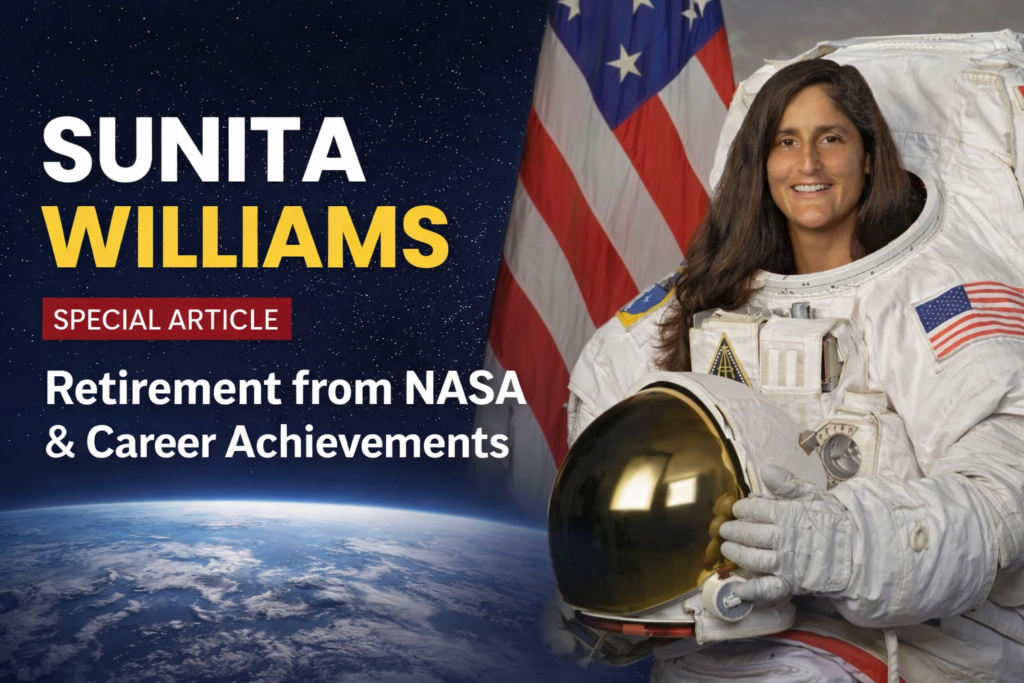
Sunita Williams is not just an astronaut. She is a symbol of courage, discipline, endurance, and scientific excellence. After serving NASA for nearly three decades, she officially retired following an extraordinary 27-year career that redefined what humans—especially women—can achieve in space.
Her journey from a Navy helicopter pilot to one of the most experienced space travelers in history is nothing short of remarkable. With over 600 days spent in orbit, multiple leadership roles, and record-breaking spacewalks, Williams leaves behind a legacy that will continue to inspire generations.
Early Life and Education
Sunita Lyn Williams was born on September 19, 1965, in Euclid, Ohio. Her father was of Indian origin, and her mother was of Slovenian descent, giving her a multicultural background that shaped her global outlook.
She completed her Bachelor of Science degree at the United States Naval Academy and later earned a Master’s degree in Engineering Management from the Florida Institute of Technology. Her education laid a strong foundation in science, leadership, and engineering—skills that later proved crucial in space missions.
Military Career: The Foundation of Excellence
Before joining NASA, Williams served in the United States Navy. She was a helicopter pilot and later became a test pilot, flying more than 30 different aircraft and logging thousands of flight hours.
Her military experience taught her discipline, decision-making under pressure, and advanced aviation skills. These qualities made her a perfect candidate for astronaut training.
In 1998, she was selected by NASA as an astronaut candidate—a highly competitive and prestigious honor.
NASA Career and Space Missions
Sunita Williams participated in three long-duration missions to the International Space Station. Each mission strengthened her reputation as one of the most dependable and skilled astronauts NASA has ever had.
First Mission: Expedition 14/15
Her first spaceflight took place in 2006. She served as a flight engineer and performed multiple spacewalks. During this mission, she gained worldwide attention for her endurance, adaptability, and technical expertise.
Second Mission: Expedition 32/33
In 2012, she returned to space and later became the Commander of the International Space Station. This was a major milestone, as only a handful of women had commanded the station before her.
Her leadership was praised for its calm, precision, and collaborative approach. She supervised scientific experiments, station operations, and international crew coordination.
Third Mission: Extended Commercial Crew Mission
In 2024, Williams flew as part of the commercial crew program. What was supposed to be a short mission turned into a long-term stay due to technical challenges. Instead of panicking, she adapted—once again proving her mental strength and professionalism.
She safely returned to Earth in 2025, concluding her final spaceflight.
Record-Breaking Achievements
Sunita Williams’ career is filled with historic accomplishments.
She spent a total of 608 days in space, placing her among the most experienced astronauts in history.
She performed nine spacewalks, accumulating more than 62 hours outside spacecraft. This is the highest spacewalk time by any woman and among the top overall.
She became one of the few women to command the International Space Station.
She was also the first astronaut to run a full marathon in space, using a treadmill aboard the ISS.
These records are not just statistics—they represent physical endurance, mental toughness, and unmatched dedication.
Medals, Honors, and Awards
Sunita Williams has received numerous awards for her service to science, the military, and humanity.
Some of her most notable honors include:
Defense Superior Service Medal
Legion of Merit
Navy Commendation Medal
Navy and Marine Corps Achievement Medal
NASA Spaceflight Medal
Russian Medal for Merit in Space Exploration
Padma Bhushan (one of India’s highest civilian awards)
These awards reflect the international respect she commands and the global impact of her work.
Philosophy and Perspective After Space
After spending so much time looking at Earth from orbit, Williams has often spoken about how space changed her perspective.
She has said that from space, human conflicts seem meaningless. Borders disappear. Politics fade. What remains is one fragile, beautiful planet shared by all.
This mindset has made her an advocate for unity, peace, and scientific collaboration across nations.
Retirement from NASA
After returning from her final mission, Sunita Williams officially retired from NASA, concluding a 27-year-long career.
However, retirement for her does not mean stepping away from purpose. She continues to mentor young scientists, speak at global forums, and support STEM education—especially for girls and underrepresented communities.
Her mission has simply evolved—from exploring space to shaping the future.
Why Sunita Williams Matters
Sunita Williams is not famous just because she went to space. She matters because she proved that resilience beats obstacles, that leadership is calm under pressure, and that curiosity can change the world.
- She broke gender barriers.
- She shattered endurance records.
- She led international teams.
- She represented hope for millions.
Her life teaches us that greatness is not inherited—it is built, step by step, through effort and belief.
Final Thoughts
Sunita Williams’ story is not just about rockets, space stations, or records. It is about the human spirit—about daring to go where few have gone and returning to inspire those who follow.
Her legacy will live on in textbooks, research labs, classrooms, and in the dreams of young minds who look at the stars and think, “Maybe I can go there too.”
And because of Sunita Williams, they just might.