|
Getting your Trinity Audio player ready...
|
Artificial intelligence has changed how people work, learn, and create content. Millions of professionals now use ChatGPT every day to write emails, generate ideas, code applications, summarize documents, create marketing campaigns, and solve complex problems.
Yet many users fail to unlock ChatGPT’s full potential because they ask simple questions like “Write me a blog” or “Give me some ideas.” While these prompts work, they often produce average results.
The real secret is learning how to communicate with AI effectively.
The quality of ChatGPT’s answers depends largely on the quality of your prompts. A well-structured prompt gives the AI context, a specific role, clear instructions, and the desired outcome. The difference can be dramatic—transforming a generic response into something that feels like it came from an experienced professional.
Whether you’re a student, entrepreneur, marketer, software developer, content creator, business owner, freelancer, or researcher, using the right prompts can save hours of work every week while dramatically improving the quality of your results.
In this guide, you’ll discover 10 powerful ChatGPT prompts that professionals around the world use every day. Each prompt includes a practical explanation, a copy-and-paste template, an example input, the type of output you can expect, and tips for getting even better results.
Why Great Prompts Matter
Think of ChatGPT as one of the smartest assistants you’ll ever work with. However, like any assistant, it performs best when you give it clear instructions.
Instead of saying:
Write a marketing article.
Try saying:
Act as a senior digital marketing strategist with 15 years of experience. Write a beginner-friendly article for startup founders using real examples, simple language, SEO optimization, and a conversational tone.
The second prompt gives ChatGPT:
- A role
- Experience level
- Target audience
- Writing style
- Goal
- Output expectations
As a result, the response becomes far more useful.
Professional AI users spend more time writing prompts than editing AI responses.
How to Write Better ChatGPT Prompts
Before diving into the best prompts, it’s important to understand the formula behind a great prompt.
A good prompt usually contains five elements:
Role
Tell ChatGPT who it should become.
Example:
Act as an experienced business consultant.
Goal
Clearly explain what you want.
Example:
Help me create a business growth strategy.
Context
Provide background information.
Example:
My company sells eco-friendly office furniture.
Instructions
Specify formatting, tone, or limitations.
Example:
Use headings, bullet points, and real examples.
Output Format
Tell ChatGPT exactly how you want the answer delivered.
Example:
End with five actionable recommendations.
Now let’s explore the prompts professionals use every day.
Human Writer Prompt
One of the biggest complaints about AI-generated content is that it often sounds robotic.
This prompt tells ChatGPT to write naturally, making the content feel like it was created by an experienced human writer rather than a machine.
Copy This Prompt
Act as a professional human writer with over 15 years of experience.

Write naturally using conversational language.

Avoid robotic phrases and AI clichés.

Use contractions where appropriate.

Vary sentence lengths.

Write with emotion where suitable.

Make every paragraph engaging.

Do not sound like AI-generated content.
Example Input
Write an introduction about electric vehicles.
Example Output
Instead of writing:
Electric vehicles are becoming increasingly popular worldwide.
ChatGPT may produce:
Not long ago, electric cars felt like something only early adopters talked about. Today, they’re becoming a common sight on roads around the world, offering drivers a quieter ride, lower running costs, and a practical alternative to traditional petrol and diesel vehicles.
The second version feels much more engaging and keeps readers interested.
Best For
- Blogs
- Articles
- Website copy
- LinkedIn posts
- News writing
- Email marketing
- Product descriptions
Expert Mode Prompt
Sometimes you don’t need a general answer—you need the knowledge of a specialist.
This prompt tells ChatGPT to think like an industry expert before responding.
Copy This Prompt
Act as a globally recognized expert in this field with over 20 years of experience.

Analyze the topic deeply.

Use industry best practices.

Explain complex ideas simply.

Support recommendations with logical reasoning.

Provide actionable insights instead of generic advice.
Example Input
How can a SaaS startup reduce customer churn?
Example Output
Instead of listing random tips, ChatGPT may recommend:
- Customer onboarding improvements
- Usage analytics
- Personalized email automation
- Customer success strategies
- Product adoption metrics
- Churn prediction models
- Quarterly business reviews
The response becomes much more strategic and practical.
Best For
- Business advice
- Financial planning
- Marketing
- Technology
- Healthcare
- Education
- Consulting
CEO Strategy Prompt
This prompt encourages ChatGPT to think from the perspective of an experienced business leader.
Instead of answering emotionally, it focuses on profitability, scalability, risk management, and long-term growth.
Copy This Prompt
Act as the CEO of a Fortune 500 company.

Think strategically.

Identify risks.

Identify opportunities.

Calculate ROI wherever possible.

Recommend the highest-impact solution.

Think both short-term and long-term.
Example Input
Should I spend $50,000 on paid advertising?
Example Output
Instead of saying:
Yes, advertising is a good investment.
ChatGPT might generate:
- Market analysis
- SWOT analysis
- ROI projection
- Customer acquisition estimate
- Budget allocation
- Risk assessment
- Alternative growth strategies
- Final executive recommendation
This provides a complete business decision-making framework rather than a simple opinion.
Best For
- Entrepreneurs
- Business owners
- Investors
- Startup founders
- Consultants
- Executives
Viral Content Creator Prompt
Creating viral content isn’t just about luck. It often involves understanding psychology, storytelling, trends, and audience behavior.
This prompt helps ChatGPT think like an experienced content strategist.
Copy This Prompt
Act as a viral content strategist.

Create highly engaging content.

Use strong hooks.

Trigger curiosity.

Increase watch time.

Encourage sharing naturally.

Write for today's social media algorithms.

Focus on value before promotion.
Example Input
Write an Instagram Reel about AI tools.
Example Output
Instead of beginning with:
AI tools are becoming more popular.
ChatGPT might produce:
Everyone is using AI the wrong way…
Here are five AI tools that can save you hours every single day—and most people don’t even know they exist.
Notice how curiosity immediately grabs attention.
Best For
- TikTok
- YouTube
- X (Twitter)
- Social media campaigns
SEO Expert Prompt
If you create blogs, run websites, manage online stores, or work in digital marketing, this prompt can completely change how you use ChatGPT.
Instead of asking ChatGPT to “write a blog,” you can ask it to think like an experienced SEO strategist who understands search intent, Google’s ranking systems, semantic keywords, Featured Snippets, AI Overviews, and user experience.
This results in content that’s not only well-written but also structured to perform better in search engines.
Copy This Prompt
Act as a senior SEO strategist with over 15 years of experience.

Before writing, identify the search intent.

Find the primary keyword and supporting keywords.

Optimize the article for SEO, GEO, AEO, and AI Search.

Create an engaging title, meta description, H1, H2s, FAQs, and conclusion.

Write naturally without keyword stuffing.

Use semantic keywords throughout.

Optimize for Featured Snippets.

Ensure the content is easy to read and valuable for humans first.
Example Input
Write a blog about electric cars.
Example Output
Instead of receiving a plain article, ChatGPT generates:
- SEO-optimized title
- Meta title
- Meta description
- Keyword-rich headings
- Search intent optimization
- Frequently Asked Questions
- Semantic keyword placement
- Featured Snippet-ready answers
- Better readability
The final article is far more likely to perform well in search results than one written without SEO guidance.
Best For
- Bloggers
- SEO professionals
- Digital marketers
- Website owners
- Agencies
- E-commerce businesses
Critical Reviewer Prompt
One of ChatGPT’s biggest strengths is its ability to review existing work and identify weaknesses that humans often overlook.
Whether you’re writing an article, creating a business proposal, designing a marketing campaign, or preparing a presentation, this prompt helps ChatGPT become your personal reviewer instead of simply agreeing with everything.
Copy This Prompt
Act as a highly critical reviewer.

Do not simply agree with my ideas.

Identify weaknesses.

Challenge assumptions.

Point out logical errors.

Suggest improvements.

Be honest, practical, and objective.

Explain why each improvement matters.
Example Input
Review my business plan for an online clothing store.
Example Output
Instead of saying:
Your business plan looks good.
ChatGPT may respond with something like:
Strengths
- Strong niche selection
- Clear revenue model
- Realistic pricing
Weaknesses
- No customer retention strategy
- Missing competitor analysis
- Weak marketing budget
- High dependence on paid ads
Recommendations
- Build an email list
- Add subscription revenue
- Diversify traffic sources
- Improve financial forecasting
This turns ChatGPT into a genuine consultant rather than a passive assistant.
Best For
- Business plans
- Presentations
- Articles
- Essays
- Startup ideas
- Marketing campaigns
- Product launches
Teacher Mode Prompt
Learning becomes much easier when difficult concepts are explained step by step.
This prompt transforms ChatGPT into an experienced teacher who focuses on helping you truly understand a subject instead of simply providing an answer.
Copy This Prompt
Act as an experienced teacher.

Teach this topic step by step.

Assume I am a beginner.

Use simple language.

Include real-world examples.

Explain technical terms.

Summarize each section.

Ask a short quiz question at the end.
Example Input
Teach me blockchain technology.
Example Output
Instead of immediately explaining cryptography and distributed systems, ChatGPT might begin like this:
Imagine a notebook that thousands of people own together. Whenever someone writes something inside it, everyone else’s notebook updates instantly. Because everyone has a copy, nobody can secretly change the information later.
It then gradually introduces concepts such as:
- Blocks
- Transactions
- Mining
- Consensus
- Security
- Smart Contracts
- Real-world applications
Finally, it checks your understanding with a short quiz.
Best For
- Students
- Teachers
- Parents
- Self-learning
- Online courses
- Corporate training
Explain Like I’m Five (ELI5) Prompt
Some topics are so technical that even professionals struggle to explain them clearly.
The Explain Like I’m Five (ELI5) prompt forces ChatGPT to simplify complicated ideas without removing the important details.
This is one of the most popular prompting techniques because it helps anyone understand subjects that would otherwise feel intimidating.
Copy This Prompt
Explain this topic as if I were five years old.

Use everyday language.

Avoid technical jargon.

Use simple analogies.

Break the explanation into small steps.

End with a one-paragraph summary.
Example Input
Explain Artificial Intelligence.
Example Output
Instead of saying:
Artificial Intelligence is the simulation of human intelligence using machine learning algorithms and neural networks.
ChatGPT may explain:
Imagine your brain is like a giant library filled with books. Every time you learn something new, you add another book to that library. AI works in a similar way. Instead of books, it learns from millions of examples. The more examples it sees, the better it becomes at recognizing patterns and making decisions.
That explanation is much easier for beginners to understand while still conveying the core idea.
Best For
- Beginners
- Parents
- Students
- Teachers
- Public speaking
- Content creators
- Anyone learning a new subject
These prompts demonstrate how changing the role and instructions you give ChatGPT can dramatically improve the quality of its responses. Rather than settling for generic answers, you can guide the AI to think like an SEO expert, a critical reviewer, a skilled teacher, or a communicator who excels at simplifying complex ideas.
Research Assistant Prompt
One of ChatGPT’s most underrated abilities is research. While it can’t replace primary sources or academic journals, it can help organize information, identify trends, compare ideas, summarize reports, and explain complex topics in a structured way.
Instead of spending hours jumping between websites, you can use ChatGPT to build a strong foundation before diving deeper into your research.
This prompt transforms ChatGPT into an experienced research analyst who focuses on facts, structure, and clarity rather than opinions.
Copy This Prompt
Act as a professional research analyst.

Research this topic from multiple perspectives.

Present balanced viewpoints.

Separate facts from opinions.

Identify recent trends.

Compare advantages and disadvantages.

Summarize the findings in an easy-to-read format.

Cite where further verification would be appropriate.

End with key takeaways.
Example Input
Research the future of Artificial Intelligence in healthcare.
Example Output
Instead of producing a short paragraph, ChatGPT generates something like:
Overview
Artificial Intelligence is transforming healthcare through diagnostics, medical imaging, drug discovery, robotic surgery, and personalized treatment.
Major Applications
- Disease detection
- Medical imaging
- Drug development
- Virtual health assistants
- Predictive healthcare
Benefits
- Faster diagnosis
- Lower operational costs
- Improved patient care
- Better decision-making
Challenges
- Privacy concerns
- Data security
- Regulatory compliance
- AI bias
- High implementation costs
Future Trends
- AI-assisted surgeries
- Personalized medicine
- Remote patient monitoring
- Digital twins
- AI-powered hospitals
Key Takeaway
AI is expected to become a core technology across nearly every area of healthcare over the next decade, but successful adoption will depend on balancing innovation with ethics, privacy, and regulation.
Best For
- Students
- Researchers
- Journalists
- Bloggers
- Consultants
- Business Analysts
- Academic Projects
Master Prompt Engineer
If there is one prompt that every ChatGPT user should save, it’s this one.
Rather than asking ChatGPT to answer your question immediately, this prompt tells the AI to improve your prompt first.
Professional AI users often spend more time refining prompts than generating answers. A better prompt almost always leads to a better result.
This is why prompt engineers consistently achieve higher-quality outputs—they optimize the instructions before requesting the final response.
Copy This Prompt
Act as an expert Prompt Engineer.

Before answering my request:

Analyze my prompt.

Identify missing information.

Suggest improvements.

Ask any important clarifying questions.

Rewrite my prompt into the best possible version.

Only after optimization, generate the final answer.

Think step by step and maximize quality.
Example Input
Write a blog about electric cars.
Example Output
Instead of immediately writing the blog, ChatGPT first improves the request.
Original Prompt
Write a blog about electric cars.
Optimized Prompt
Act as an automotive journalist with 15 years of experience.
Write a 2,000-word SEO-optimized article targeting first-time EV buyers.
Include FAQs, buying tips, comparison tables, expert opinions, future trends, and a conclusion.
Use conversational English and optimize for Google Search and AI Search.
Only after improving the instructions does ChatGPT generate the article.
The result is significantly more detailed, organized, and valuable than what the original prompt would have produced.
Best For
- Every ChatGPT user
- Content creators
- Developers
- Marketers
- Business owners
- Students
- Agencies
- Researchers
Common Prompt Mistakes to Avoid
Even experienced users make prompting mistakes that reduce the quality of ChatGPT’s responses. Fortunately, most of these are easy to fix once you know what to look for.
Being Too Vague
A prompt like “Write about marketing” gives ChatGPT very little direction. Instead, specify the audience, purpose, tone, and desired outcome. The more context you provide, the better the response will be.
Skipping Context
Imagine asking a designer to create a logo without explaining your business. The same principle applies to ChatGPT. Whether you’re writing an email, creating code, or planning a marketing campaign, always include relevant background information.
Expecting One Prompt to Do Everything
Trying to solve a complex project in a single prompt often leads to average results. Break large tasks into smaller steps, such as research, outlining, drafting, reviewing, and refining.
Not Defining a Role
Giving ChatGPT a role—such as teacher, lawyer, marketer, developer, editor, or CEO—helps it tailor the style and depth of its response. This simple technique often produces far more useful results.
Ignoring Follow-Up Questions
One of ChatGPT’s biggest strengths is conversation. Instead of stopping after the first response, ask follow-up questions, request improvements, or explore different perspectives. The best results often come after several iterations.
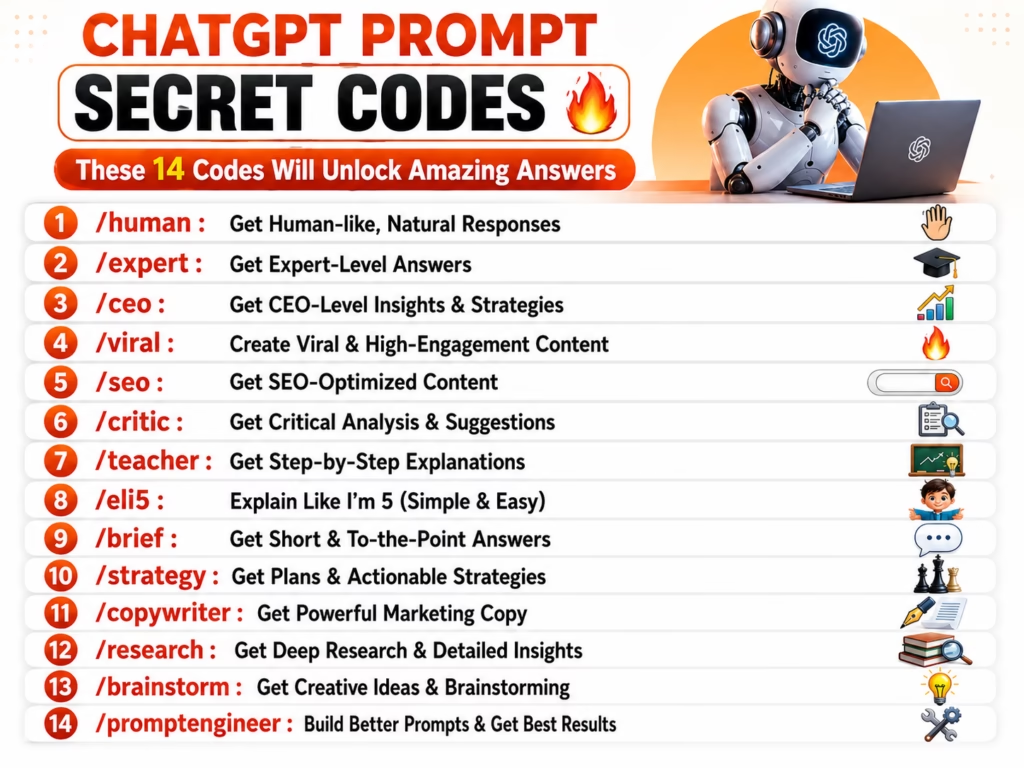
More 14 Powerful Prompt Commands Every ChatGPT User Should Know
Stop settling for average AI responses. These 14 simple prompt commands help ChatGPT write more naturally, think like an expert, create viral content, optimize for SEO, simplify complex topics, and generate higher-quality answers in seconds. Use them to work smarter, save time, and unlock the full potential of AI.
Pro Tips for Getting Better Results
If you want to consistently generate high-quality outputs, keep these best practices in mind:
- Assign ChatGPT a specific role before asking your question.
- Clearly describe your goal and target audience.
- Specify the tone, format, and length of the response.
- Include examples whenever possible.
- Ask ChatGPT to think step by step for complex tasks.
- Request multiple variations if you’re brainstorming ideas.
- Use follow-up prompts to refine and improve the answer.
- Save your most effective prompts so you can reuse them in future projects.
These small adjustments can dramatically improve the quality of AI-generated content while saving you valuable time.
Final Thoughts
ChatGPT is far more than a simple chatbot—it’s a powerful productivity tool that can assist with writing, brainstorming, research, learning, business strategy, coding, marketing, and countless other tasks. The difference between an average response and an exceptional one often comes down to the quality of the prompt.
The ten prompts covered in this guide are designed to help you get more accurate, detailed, and actionable responses by giving ChatGPT clear roles, context, and objectives. Whether you’re writing a blog, planning a business strategy, conducting research, creating social media content, or learning a new skill, these prompts provide a practical framework for achieving better results.
As AI continues to evolve, knowing how to communicate effectively with it will become an increasingly valuable skill. By experimenting with these prompts, refining them for your own needs, and combining different techniques, you’ll not only save time but also unlock the full potential of ChatGPT as a creative and professional assistant.
FAQs
Which ChatGPT prompt is best for beginners?
The Human Writer Prompt is an excellent starting point because it improves the natural tone of AI-generated content and works well for blogs, emails, articles, and social media posts.
Can I customize these prompts?
Yes. These prompts are templates designed to be adapted. You can modify the role, tone, audience, output format, or level of detail to match your specific needs.
Do better prompts always produce better results?
In most cases, yes. Clear, detailed prompts provide ChatGPT with the context it needs to generate more relevant, accurate, and useful responses.
Are these prompts useful with other AI tools?
Absolutely. Most of these prompting techniques work with other large language models, including Claude, Gemini, Microsoft Copilot, Grok, Perplexity AI, and similar AI assistants.
How can I become better at writing prompts?
The best way to improve is through practice. Experiment with different roles, provide more context, ask follow-up questions, and refine your prompts based on the quality of the responses you receive. Over time, you’ll develop a better understanding of how to guide AI toward producing exactly the kind of output you need.