|
Getting your Trinity Audio player ready...
|
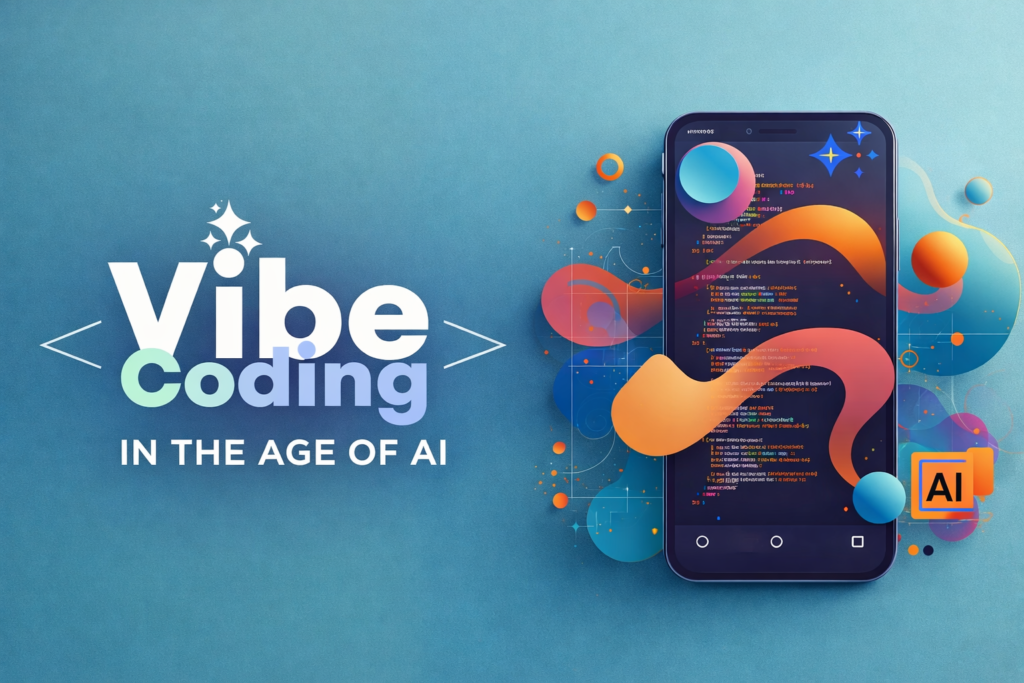
Software development is undergoing a quiet but powerful shift. The focus is moving away from rigid processes and heavy upfront planning toward speed, intuition, and creative flow. At the center of this shift is vibe coding, a style of development that prioritizes momentum and instinct. When combined with artificial intelligence, vibe coding becomes even more impactful.
Vibe coding in the age of AI is not about abandoning best practices. It is about using AI as a force multiplier to turn ideas into working software faster than ever, while still knowing when to slow down and apply structure.
This blog explains what vibe coding means today, how AI has reshaped it, where it works best, and why it represents a major change in how software is built.
What Is Vibe Coding?
Vibe coding is a mindset rather than a methodology. It describes a way of coding where developers focus on staying in flow, following intuition, and letting ideas guide implementation.
Instead of starting with perfect architecture, vibe coding emphasizes:
- Rapid experimentation
- Minimal friction between idea and execution
- Iteration over perfection
- Creativity before optimization
The goal is simple: get something working first, then improve it once the direction is clear.
Why AI Changed Vibe Coding Completely
Vibe coding existed long before AI, but artificial intelligence has amplified it to a new level. AI removes many of the traditional obstacles that break focus during development.
With AI assistance, developers no longer need to constantly:
- Search documentation
- Write repetitive boilerplate
- Debug simple syntax errors
- Manually refactor large blocks of code
AI handles these tasks instantly, allowing developers to remain in a creative state for longer periods. This uninterrupted flow is the foundation of effective vibe coding.
Prompt-Driven Development and Creative Flow
In the age of AI, vibe coding is often prompt-driven. Developers describe what they want in natural language and refine the output through iteration.
This creates a fast feedback loop:
- Idea is expressed as a prompt
- AI generates an initial solution
- Developer tweaks, adjusts, and experiments
- The solution evolves organically
This approach reduces friction and encourages exploration. Ideas that might have been abandoned due to time or complexity now get a chance to exist.
AI as a Coding Partner, Not a Replacement
AI works best in vibe coding when treated as a collaborator rather than an authority. It accelerates execution but does not replace judgment.
Strong developers still:
- Decide what to build
- Validate logic and edge cases
- Ensure security and performance
- Make architectural decisions
AI provides speed and suggestions, but responsibility remains human. This balance is what separates productive vibe coding from careless automation.
Benefits of Vibe Coding with AI
When used correctly, vibe coding with AI offers clear advantages.
Faster Prototyping
Ideas move from concept to working product quickly, making it ideal for MVPs and experiments.
Higher Creative Output
Developers spend more time thinking about solutions and less time on mechanical tasks.
Lower Learning Barriers
Beginners can build real projects earlier, learning through experimentation instead of memorization.
Reduced Burnout
Less friction and faster progress keep motivation high.
The Hidden Risks
Despite its advantages, vibe coding in the age of AI has risks that cannot be ignored.
Technical Debt
Quick solutions can become long-term problems if never refactored.
Shallow Understanding
Overreliance on AI can weaken core problem-solving skills.
Maintenance Issues
Code written purely for speed may be difficult for others to understand later.
False Confidence
Just because code runs does not mean it is reliable or scalable.
Vibe coding requires awareness. Without discipline, speed becomes a liability.
When Vibe Coding Works Best
Vibe coding with AI excels in situations where speed and creativity matter more than long-term stability.
It is ideal for:
- Prototypes and demos
- Early-stage startups
- Side projects
- Hackathons
- Learning new technologies
It is less suitable for systems that demand:
- High security
- Regulatory compliance
- Mission-critical reliability
- Long-term maintainability from day one
Understanding context is essential.
Responsible Vibe Coding in the AI Era
The most effective developers treat vibe coding as a phase, not a permanent workflow.
A balanced approach looks like this:
- Use AI and vibe coding to explore ideas quickly
- Lock in direction once the concept proves valuable
- Refactor for clarity and structure
- Add testing, documentation, and safeguards
- Optimize before scaling
This approach preserves creativity without sacrificing quality.
How AI Is Reshaping Developer Thinking
AI-driven vibe coding is changing how developers think about their role. Coding is becoming less about writing every line manually and more about:
- Designing systems
- Asking better questions
- Evaluating outcomes
- Guiding intelligent tools
This shift favors developers who can combine creativity with critical thinking.
Is This the Future of Software Development?
Vibe coding in the age of AI reflects how humans naturally create. Ideas rarely arrive fully formed. They emerge through exploration, trial, and iteration.
AI supports this process by removing friction, accelerating feedback, and expanding what individuals can build alone. The future of development is not rigid or chaotic. It is adaptive.
The winning developers will be those who:
- Embrace creative flow
- Use AI intelligently
- Respect engineering fundamentals
- Know when to switch from speed to structure
Final Thoughts
Vibe coding in the age of AI is not a shortcut. It is a shift in how software is imagined and built. When used with intention, it unlocks speed, creativity, and innovation. When misused, it creates fragile systems.
The real skill lies in balance.
Code with intuition.
Build with momentum.
Refine with discipline.
That is the true power of vibe coding in the age of AI.