|
Getting your Trinity Audio player ready...
|
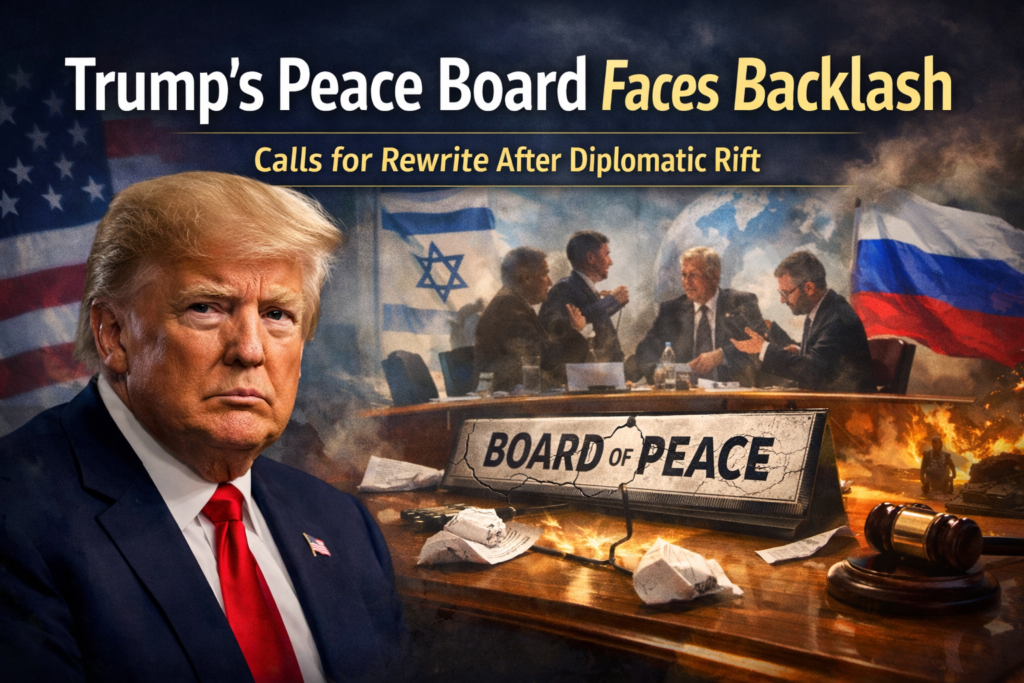
Donald Trump’s newly announced “Board of Peace” was meant to be a bold step toward reshaping how post-war reconstruction and global conflict resolution are handled. Introduced as a high-impact initiative to stabilize war-torn regions, starting with Gaza, the board aimed to position itself as a faster, more decisive alternative to existing global institutions.
Instead of applause, however, the idea has been met with confusion, criticism, and diplomatic discomfort. Within days of its launch, calls for rewriting its structure and mandate began circulating among international leaders and policy circles. What was supposed to symbolize stability has now become a source of friction.
This blog breaks down why the Peace Board is facing resistance, what went wrong at launch, and what this could mean for global diplomacy in 2026.
The Vision Behind the Peace Board
The Peace Board was presented as a new form of international authority—one through which post-war governance, economic rebuilding, and long-term stability in conflict zones would be overseen. Unlike traditional institutions that are driven by consensus-based processes, this board was framed as decisive, streamlined, and results-oriented.
Furthermore, it was positioned by Trump as a solution to what have often been described as the inefficiencies of global bodies. Through this structure, actions were expected to be taken swiftly, funds were to be deployed directly, and political transitions were intended to be shaped without the bureaucratic delays that frequently stall international interventions.
On paper, this approach appeared revolutionary. In practice, however, it has been met with alarm.
Why Diplomats Are Uncomfortable
From the outset, discomfort was signaled by several major world leaders. While some chose not to attend the ceremonial launch, others were reported to have raised concerns behind closed doors.
At the heart of the issue, however, lies not the idea of peace—but the question of control.
It has been widely felt that the board is overly centered around U.S. leadership, with limited safeguards being put in place to prevent political dominance. Consequently, unease has been felt among allies. Peace, it is argued, should be neutral, collaborative, and multilateral. When it appears personalized or politically branded, trust is gradually eroded.
And at present, that erosion is already being witnessed.
The Membership Controversy
Another major point of criticism has been the reported membership model of the Peace Board. According to concerns raised, countries seeking permanent influence are allegedly required to make massive financial commitments.
As a result, accusations have been made that the board is being operated more like an exclusive club than a global peace forum.
Moreover, it has been argued that peace should not be tied to economic power. If permanent voices are granted only to wealthy nations, then the very communities most affected by war are inevitably sidelined.
That contradiction, therefore, is becoming increasingly difficult to ignore.
Regional Tensions and Strategic Risks
Notably, the backlash has not been limited to Europe or Western democracies.
In the Middle East, concerns have been raised by several governments that regional stakeholders were not sufficiently included during the board’s formation. While some leaders reportedly felt blindsided, others questioned the neutrality of its structure.
Additionally, the inclusion and exclusion of certain nations have become political flashpoints. Every seat on the board is seen as a message. Every absence is interpreted as one too.
Rather than easing tensions, the board’s formation has, in many ways, reignited them.
A Threat to Existing Global Institutions?
Perhaps the most serious concern has been the perception that the Peace Board is challenging existing international organizations rather than complementing them.
For decades, peacekeeping, reconstruction, and mediation have been handled by globally recognized institutions. Although these systems are far from perfect, they have been built upon shared legitimacy.
By contrast, the Peace Board has been perceived as a parallel system—one through which traditional frameworks could be bypassed.
This, in turn, raises a critical question: Is reform being pursued, or is replacement being attempted?
Among many diplomats, it is believed that the latter is more likely.
Why Rewrite Calls Are Growing Louder
The demand for a rewrite of the board’s charter has not been merely symbolic—it has been fundamental.
Critics have called for a clearer mission, more balanced leadership, transparent funding rules, fairer representation, and legal alignment with existing global systems.
Without these changes, it has been argued, legitimacy will never be achieved.
After all, peace initiatives are not sustained through authority alone. They are sustained through trust.
And at present, that trust is missing.
The Bigger Picture
In a broader sense, Trump’s Peace Board has reflected a growing pattern in modern geopolitics. Faster results, fewer negotiations, and greater centralized control are increasingly being sought by global leaders.
However, peace is not a business transaction. It cannot be rushed, branded, or centralized without consequences.
This backlash, therefore, has revealed something crucial: even in a fractured world, shared ownership of peace processes continues to be valued.
And that, in itself, is a powerful signal.
Final Thoughts
The Peace Board was designed to appear strong, decisive, and transformative. Instead, its early days have been marked by structural weaknesses, diplomatic blind spots, and serious credibility challenges.
If it is to survive, evolution will be required.
Because peace cannot be dictated. It must be built.
And at this moment, more rebuilding is required of the Peace Board than of the conflicts it seeks to resolve.