|
Getting your Trinity Audio player ready...
|
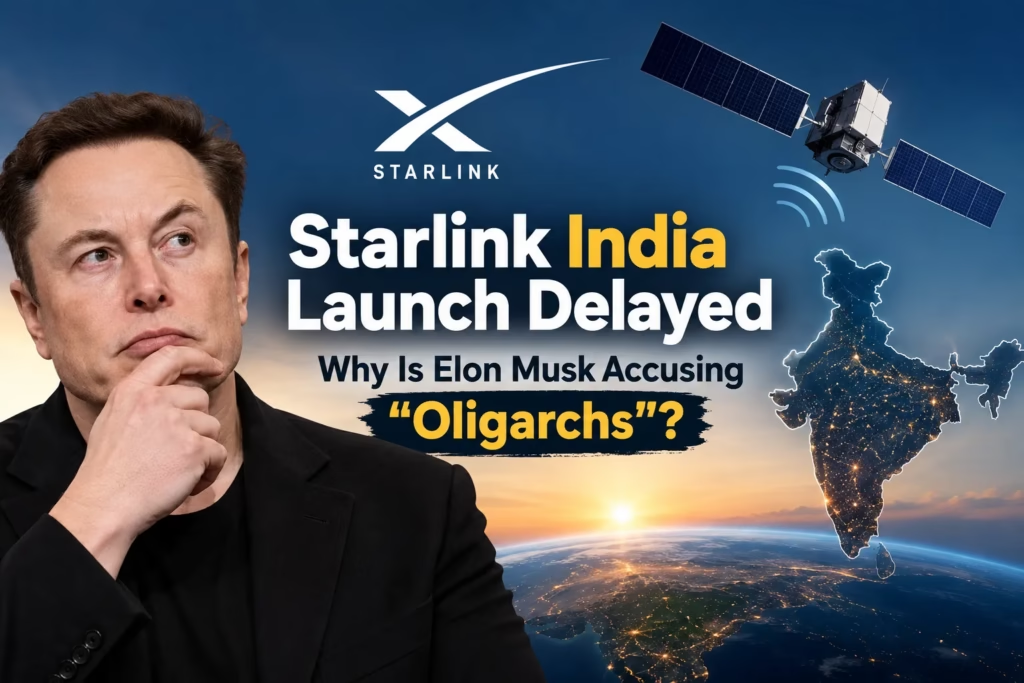
Elon Musk has reignited the debate over Starlink’s India launch after accusing unnamed “oligarchs” of blocking the satellite internet service in the country.
Musk claimed that certain powerful interests were trying to maintain a “monopolistic chokehold” over the Indian market. He also called the situation a “crime against the people of India.”
However, the bigger question is simple: Why has Starlink still not started commercial operations in India despite receiving a licence?
Starlink Has an India Licence
Starlink has already cleared an important regulatory step in India.
According to the Department of Telecommunications (DoT), Starlink Satellite Communications Private Limited received a Unified Licence with authorisation for Global Mobile Personal Communication by Satellite (GMPCS) services.
The Indian government has also confirmed that Starlink is one of the companies authorised to provide satellite communication services in India.
This means Starlink has cleared the licensing stage. However, a licence alone does not automatically give a satellite operator the right to use spectrum.
Why Is Starlink Still Waiting to Launch in India?
India treats telecom licensing and spectrum assignment as separate processes.
The DoT states that a telecom licence does not automatically provide the right to use spectrum. Operators need a separate frequency assignment from the Wireless Planning and Coordination (WPC) Wing of the DoT.
Security compliance also forms part of India’s licensing framework.
Therefore, Starlink’s licence does not mean that the company can immediately switch on commercial satellite internet services across India.
What Did Elon Musk Mean by “Oligarchs”?
Musk has accused unnamed “oligarchs” of blocking Starlink in India to protect their position in the market.
However, Musk did not publicly identify the individuals or companies he was referring to.
That distinction matters.
There is currently no official evidence establishing that a particular Indian company or business group is responsible for delaying Starlink’s commercial launch.
So claims identifying specific individuals as the “oligarchs” should be treated as speculation unless Musk or an official authority provides evidence.
What Does the Indian Government Say About Satellite Internet?
India’s official position shows that the country wants satellite communication to expand connectivity, particularly in areas where traditional telecom infrastructure can be difficult to deploy.
The government has highlighted the potential of satellite services for rural, underserved and unserved areas, including remote, coastal, border and mountainous regions.
The DoT also maintains that spectrum assignment remains a separate regulatory process.
This framework applies to satellite communication services rather than creating an automatic spectrum right for any one operator.
Why Is Starlink India Important?
Starlink uses satellites in low Earth orbit to provide internet connectivity.
That technology can potentially help connect locations where laying fibre or building extensive terrestrial networks remains difficult.
India already has a huge internet market, but connectivity challenges remain in remote and difficult-to-reach regions.
The government has therefore recognised satellite communication as one technology that can help address last-mile connectivity.
Starlink India Launch: What Happens Next?
Starlink’s next major hurdle remains the completion of the regulatory process required before commercial services can begin.
The company already has its Indian satellite communication licence, but spectrum assignment and applicable security requirements remain critical parts of the process.
Until those requirements are completed, Starlink cannot simply begin nationwide commercial operations because it has obtained a licence.
Conclusion
Elon Musk’s latest comments have put the Starlink India launch back in the spotlight.
Musk says powerful interests are blocking Starlink to protect a monopoly. But he has not publicly identified those alleged “oligarchs”, and the accusation should not be treated as an established fact.
The official Indian regulatory framework tells a more specific story: Starlink has received a GMPCS licence, while spectrum assignment remains a separate requirement and security compliance forms part of the regulatory process.
For Indian consumers waiting for Starlink, the key question now is not whether Starlink has a licence. It does.
The real question is when Starlink will complete the remaining regulatory requirements and finally begin commercial satellite internet services in India.