
|
Getting your Trinity Audio player ready...
|
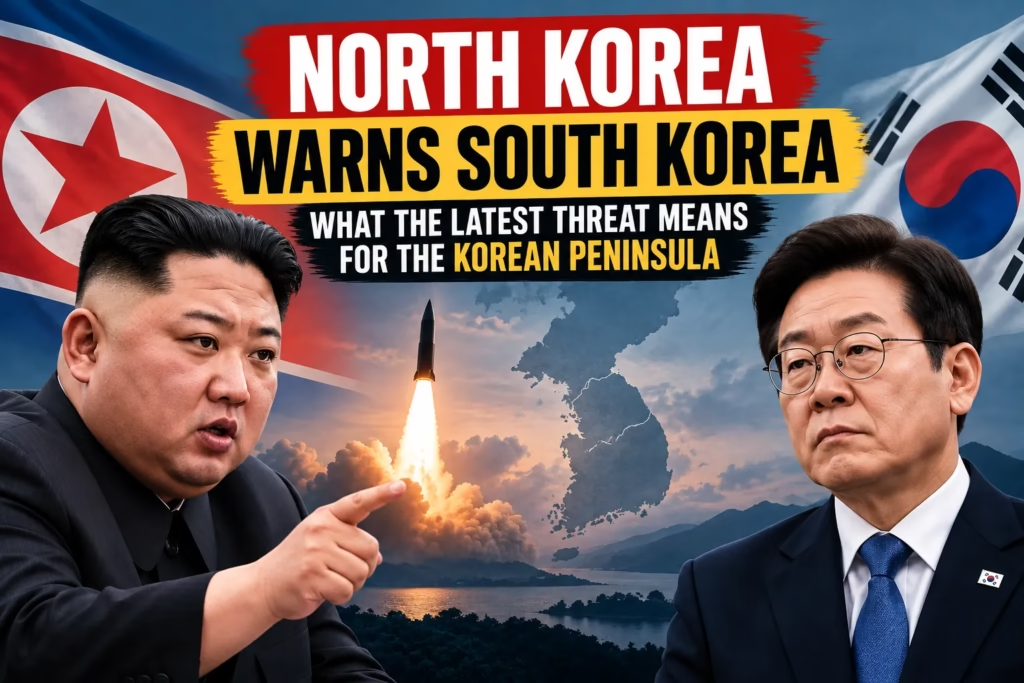
North Korea has warned that South Korea could become a “decisive target” of collective punishment if Seoul continues to develop a central role in a U.S.-led collective defense system. The warning comes amid growing military cooperation between South Korea and the United States and rising tensions on the Korean Peninsula.
The latest warning came on Friday, September 25, through a commentary carried by North Korea’s state-run Korean Central News Agency (KCNA).
Kang Chol-su, section chief at North Korea’s Institute of Enemy State Studies, criticized recent remarks by U.S. Forces Korea Commander Gen. Xavier Brunson. Brunson had described South Korea as a key center for collective defense and stressed closer cooperation between the United States and South Korea.
North Korea strongly objected to that approach.
North Korea Warns of Retaliation
In the KCNA commentary, Kang said South Korea could become a “decisive target of collective punishment” because of its expanding military role alongside the United States.
North Korea accused Washington of using South Korea as a strategic military base for broader regional operations. Pyongyang also criticized joint military exercises, increased defense spending in South Korea and the deployment of additional U.S. military assets.
The statement said North Korea had prepared countermeasures against actions it considers a threat to its security.
Pyongyang also criticized South Korea’s participation in multinational military exercises and its growing integration with regional defense systems.
Why North Korea Is Angry With South Korea
The latest North Korea warning centers on the changing role of the U.S.-South Korea military alliance.
North Korea has repeatedly opposed joint military exercises between Washington and Seoul. Pyongyang views the strengthening of military cooperation as a direct security threat.
The latest KCNA statement specifically focused on the idea of South Korea becoming a major center for collective defense beyond the Korean Peninsula.
North Korea argues that such a role could allow U.S. forces to use South Korean territory for operations connected to wider regional conflicts.
South Korea and the United States, however, maintain that their military cooperation supports deterrence and regional security.
North Korea Has Recently Tested Missiles
The warning comes only days after North Korea carried out another missile test.
South Korea’s military detected two short-range ballistic missiles launched from North Korea’s eastern coastal area on September 20. The missiles traveled hundreds of kilometers toward the sea.
North Korea later announced the test of a new weapons system. North Korean leader Kim Jong Un observed the test, according to KCNA.
The recent missile activity has added another layer of tension to already difficult relations between North Korea, South Korea and the United States.
U.S.-South Korea Military Cooperation Remains a Key Issue
The United States maintains a significant military presence in South Korea under the two countries’ longstanding defense alliance.
Gen. Xavier Brunson recently emphasized the importance of improving combined military capabilities and interoperability between U.S. and South Korean forces.
North Korea has interpreted these developments as part of a broader military strategy involving South Korea.
Pyongyang’s latest statement therefore sends a clear warning: North Korea says it could respond strongly if South Korea becomes more deeply integrated into a wider U.S.-led defense structure.
Does the Warning Mean War Is Imminent?
The latest statement does not by itself indicate that North Korea has announced plans to start a war.
North Korea has frequently used strong military language when criticizing U.S.-South Korean cooperation and military exercises. However, the latest warning comes alongside recent missile tests and continued development of military capabilities, making the situation important to monitor.
The Korean Peninsula remains one of the world’s most heavily militarized regions. Any major military incident involving North Korea and South Korea could quickly create wider regional security concerns.
For now, the latest development represents a sharp escalation in North Korean rhetoric, rather than confirmation of an imminent armed conflict.
What Happens Next?
The next focus will remain on North Korea’s military activity, South Korea’s response and future U.S.-South Korea defense cooperation.
Any additional missile launches, military exercises or direct military incidents could further increase tensions on the Korean Peninsula.
North Korea’s latest warning also highlights the growing disagreement over the future security structure of Northeast Asia. While Seoul and Washington continue to strengthen their military cooperation, Pyongyang continues to portray those moves as a direct threat to North Korea.
The situation remains closely watched as North Korea, South Korea and the United States continue to navigate heightened tensions across the Korean Peninsula.