|
Getting your Trinity Audio player ready...
|
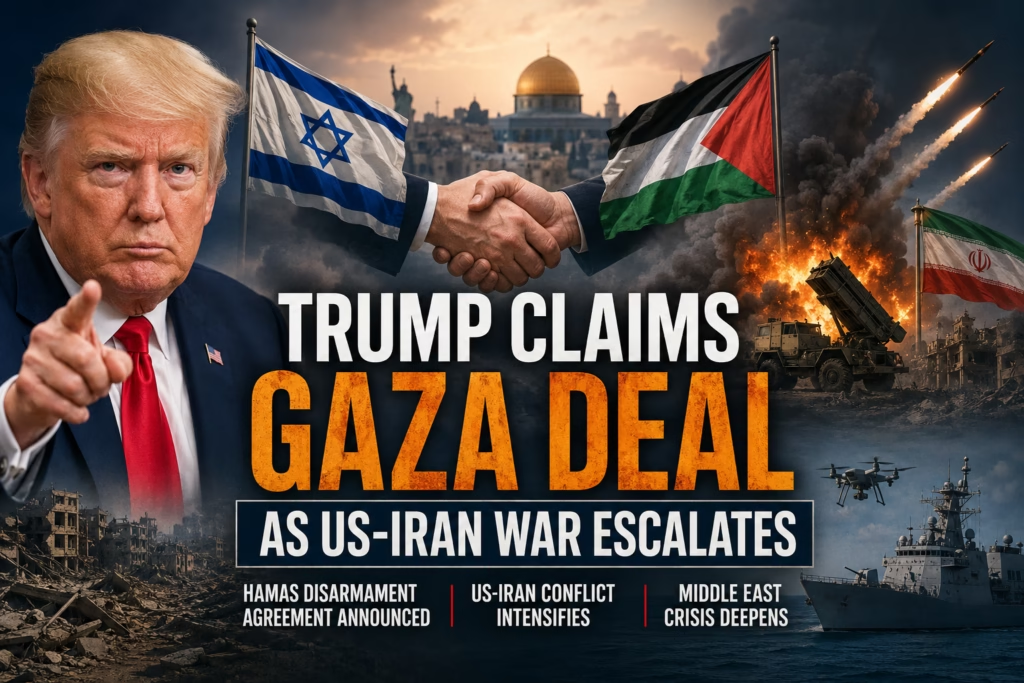
As tensions continue to grip the Middle East, a dramatic diplomatic announcement has emerged alongside an increasingly dangerous military conflict. US President Donald Trump has claimed that a historic agreement has been reached to disarm Hamas and begin the phased withdrawal of Israeli forces from Gaza. At the same time, fighting between the United States and Iran has intensified, raising fears of a broader regional conflict.
While Trump’s announcement has generated global attention, officials from Israel and Hamas have signaled that significant disagreements remain over how such a deal would actually be implemented.
Trump’s Announcement: A Historic Gaza Agreement?
President Donald Trump announced that his administration’s Board of Peace had negotiated what he described as a “historic” agreement aimed at ending years of conflict in Gaza.
According to Trump’s statement, the proposed framework includes:
- Complete disarmament of Hamas and other armed groups.
- Gradual withdrawal of Israeli military forces from Gaza.
- Formation of a new Palestinian governing authority.
- International assistance for Gaza’s reconstruction.
- Long-term security arrangements intended to prevent renewed conflict.
Trump described the agreement as a major step toward lasting peace in the region.
Is the Deal Official?
Despite Trump’s optimistic announcement, the answer is not yet.
Several reports indicate that negotiations are still facing major obstacles.
Among the biggest unresolved questions are:
- Should Hamas surrender its weapons before Israeli troops withdraw?
- How will disarmament be verified?
- Who will govern Gaza during the transition?
- Which international organizations will oversee implementation?
- What security guarantees will Israel receive?
Israeli officials have not formally endorsed the proposal, while Hamas representatives have reportedly attached several conditions before accepting any permanent arrangement.
Meanwhile, the US-Iran Conflict Continues
The diplomatic developments come during one of the most dangerous periods in the Middle East in recent years.
According to live updates:
- Iran launched drone attacks targeting US military facilities in Kuwait.
- The attacks were described as retaliation for recent US airstrikes that reportedly caused civilian casualties.
- Shipping through the Strait of Hormuz continues to face disruption.
- Oil markets remain volatile due to concerns over regional energy supplies.
- Several neighboring countries have increased military readiness as fears of wider escalation continue.
Why Gaza Matters in the Middle of the Iran Conflict
Analysts believe the Gaza negotiations may be closely connected to the broader regional security situation.
With Iran engaged in direct confrontation with the United States and Israel, reducing violence in Gaza could:
- Prevent additional military fronts from opening.
- Reduce pressure on Israeli forces.
- Limit opportunities for regional proxy groups.
- Improve humanitarian conditions inside Gaza.
- Create space for broader diplomatic negotiations.
However, experts caution that even if political agreements are announced, implementation will likely take months and remain vulnerable to setbacks.
Major Challenges Ahead
Even if all parties agree in principle, numerous practical challenges remain.
Hamas Disarmament
Disarming Hamas has long been considered one of the most difficult aspects of any peace process. Questions remain over:
- Heavy weapons
- Underground tunnel networks
- Armed factions operating independently
- Verification mechanisms
Israeli Security Concerns
Israel continues to insist that any agreement must guarantee long-term security and prevent future attacks.
Humanitarian Crisis
Gaza’s humanitarian situation remains severe. Reconstruction would require:
- Massive international funding
- Restoration of infrastructure
- Medical assistance
- Housing projects
- Food and water security
Global Reaction
International observers have reacted cautiously.
Many governments have welcomed any effort that could reduce violence but have emphasized that political announcements alone are insufficient without concrete implementation.
Diplomatic analysts note that previous ceasefire agreements have struggled due to disagreements over timelines, security guarantees, and verification mechanisms.
Impact on Oil Markets
The continuing US-Iran confrontation has also affected global energy markets.
Investors remain concerned about:
- Possible disruption of Gulf shipping routes.
- Increased insurance costs for cargo vessels.
- Potential supply shortages.
- Rising geopolitical risk premiums.
Although oil prices have fluctuated sharply, markets continue to monitor developments closely.
What Happens Next?
Several developments are expected over the coming days:
- Israel may clarify its official position on Trump’s proposal.
- Hamas negotiators could provide additional conditions.
- International mediators may attempt to finalize implementation details.
- Military activity between Iran and the United States will remain closely watched.
- Regional governments are expected to continue diplomatic efforts to prevent further escalation.
Conclusion
The latest developments present both hope and uncertainty.
Trump’s announcement of a potential Gaza agreement could represent one of the most significant diplomatic initiatives in recent years. However, major disagreements over implementation remain unresolved, and no final agreement has been confirmed by all parties.
At the same time, the ongoing US-Iran conflict continues to fuel instability across the Middle East, making successful diplomacy more important—and more challenging—than ever.
For now, the region remains at a critical crossroads, with negotiations and military developments unfolding simultaneously.