
|
Getting your Trinity Audio player ready...
|
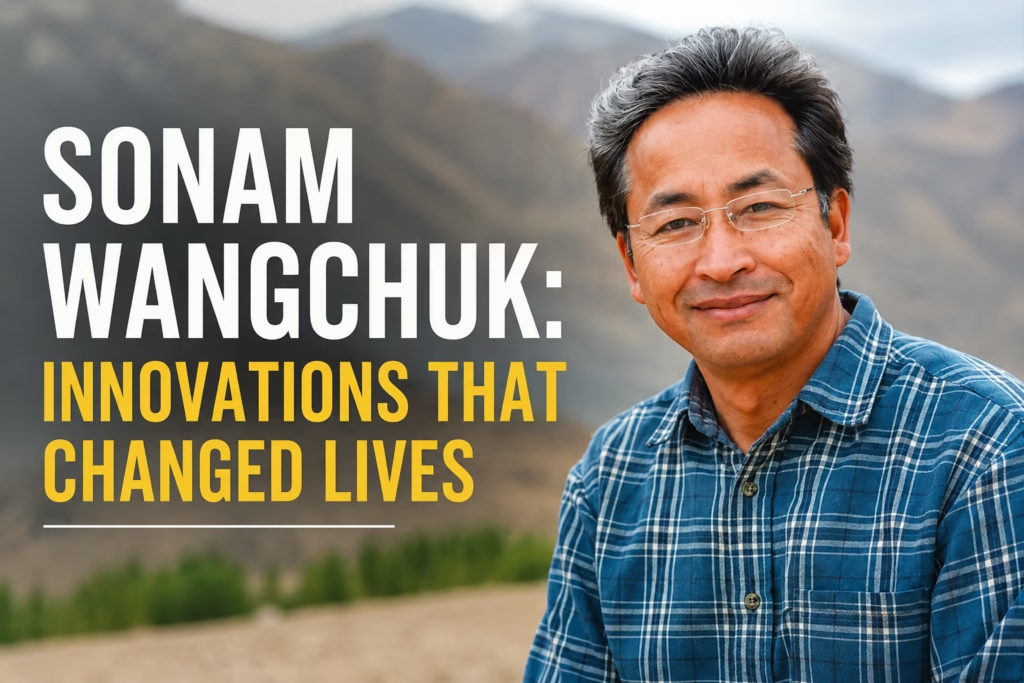
When people hear the name Sonam Wangchuk, many immediately think of the iconic character Phunsukh Wangdu from the blockbuster film 3 Idiots. However, the real Sonam Wangchuk is far more remarkable than any movie character. He is an engineer, innovator, education reformer, environmentalist, entrepreneur, and social activist whose ideas have transformed lives in Ladakh and inspired sustainable solutions around the world.
Over the past three decades, Wangchuk has dedicated himself to solving real-world problems rather than merely discussing them. Whether it is improving education for remote Himalayan students, creating artificial glaciers to combat water shortages, building solar-heated campuses in extreme weather conditions, or advocating for environmental protection, his work demonstrates how innovation can directly improve people’s lives. His contributions have earned global recognition, including the prestigious Ramon Magsaysay Award, often referred to as Asia’s Nobel Prize.
Early Life: Growing Up in Remote Ladakh
Sonam Wangchuk was born on 1 September 1966 in Alchi, a small village in Ladakh. Growing up in one of India’s most remote regions, he experienced challenges that most urban students never face. Ladakh’s harsh climate, geographical isolation, and limited educational resources created significant barriers for young learners.
One of the biggest difficulties Wangchuk faced during childhood was language. He spoke only Ladakhi when he entered school, but education was delivered in languages unfamiliar to him. This disconnect between local realities and the formal education system would later become the foundation of his life’s mission.
Despite these obstacles, he excelled academically and eventually pursued engineering at the National Institute of Technology (NIT), Srinagar. Rather than choosing a conventional engineering career in a major city, Wangchuk decided to return to Ladakh and solve problems affecting his community.
The Birth of SECMOL: Revolutionising Education
After completing his engineering degree, Wangchuk and a group of friends established the Students’ Educational and Cultural Movement of Ladakh (SECMOL) in 1988.
At that time, nearly 95% of Ladakhi students were failing board examinations. Many people blamed students for poor performance, but Wangchuk believed the real problem was an education system that ignored local culture, language, geography, and practical needs.
SECMOL was designed to change that.
Instead of focusing solely on textbook learning, the organisation encouraged students to develop practical skills, critical thinking abilities, entrepreneurship, environmental awareness, and leadership qualities.
Over time, SECMOL became one of India’s most successful alternative education models. Thousands of students who had previously been labelled failures discovered their talents and went on to become entrepreneurs, educators, engineers, farmers, and community leaders.
Operation New Hope: Fixing Government Schools
In 1994, Wangchuk launched one of his most impactful initiatives, called Operation New Hope.
The programme brought together teachers, village communities, government officials, and civil society organisations to improve public education in Ladakh. Instead of blaming a single group for poor educational outcomes, the initiative created shared responsibility among all stakeholders.
The results were remarkable.
School performance improved significantly, teacher accountability increased, and local communities became more actively involved in children’s education. The project later became a model for educational reform discussions across India.
Operation New Hope demonstrated that meaningful change is possible when governments and communities work together rather than operating separately.
The Innovation That Changed the World: Ice Stupa
Among all of Wangchuk’s inventions, none has received more global attention than the Ice Stupa.
Ladakh experiences severe water shortages during spring. Farmers need water in April and May for planting crops, but glaciers usually begin melting later. As climate change accelerated, this mismatch became increasingly problematic.
Wangchuk searched for a solution and developed the Ice Stupa concept in 2013–14.
What Is an Ice Stupa?
An Ice Stupa is essentially an artificial glacier.
During winter, excess stream water is diverted through pipes and sprayed into freezing air. The water freezes instantly and gradually forms a large cone-shaped tower of ice.
The unique shape minimises surface area exposed to sunlight, allowing the structure to melt slowly during spring and early summer.
As temperatures rise, the stored ice releases water precisely when farmers need it most.
Why Is It Revolutionary?
The Ice Stupa solves multiple problems simultaneously:
- Stores unused winter water
- Provides irrigation during dry months
- Helps communities adapt to climate change
- Requires minimal energy
- Uses locally available materials
- Supports agriculture in water-scarce regions
The first prototype stored approximately 150,000 litres of water, proving the concept could work on a practical scale.
How Ice Stupas Help India
The significance of Ice Stupas extends far beyond Ladakh.
India is facing increasing water stress due to population growth, changing weather patterns, glacier retreat, and climate change. Many Himalayan communities depend on seasonal meltwater for survival.
Ice Stupa technology offers a low-cost and environmentally friendly solution that can help preserve water resources in mountain regions.
The innovation has become a symbol of climate adaptation and community-led water conservation.
Global Impact of Ice Stupa Technology
What began as a local solution quickly gained international attention.
Researchers, environmental organisations, and governments from various countries studied the project because many mountain regions face challenges similar to Ladakh.
The Ice Stupa concept has inspired experiments and adaptations in parts of Europe, particularly in Alpine regions where changing snowfall and glacier patterns threaten water supplies.
This transformed Wangchuk from a regional innovator into a globally recognised climate solution pioneer.
Solar-Powered Schools and Sustainable Architecture
Another major contribution of Sonam Wangchuk is sustainable architecture.
The SECMOL campus is famous for operating almost entirely on renewable energy. Buildings are constructed using local materials such as mud and earth while applying passive solar design principles.
Even when outside temperatures drop below minus 15 to minus 30 degrees Celsius, these structures remain comfortable without conventional heating systems.
Benefits of These Buildings
- Minimal energy consumption
- Reduced carbon footprint
- Lower construction costs
- Improved living conditions
- Sustainable use of local resources
These designs have influenced eco-friendly construction projects in Ladakh, Nepal, Sikkim, and other mountainous regions.
Innovations for Indian Soldiers
Wangchuk’s innovations have also benefited India’s defence sector.
His team developed solar-heated shelters and tents designed for soldiers stationed in extreme Himalayan conditions. These structures reduce dependence on fuel-based heating systems while providing greater comfort and energy efficiency.
Such innovations are particularly valuable in remote border areas where transporting fuel is expensive and logistically difficult.
Himalayan Institute of Alternatives (HIAL)
Recognising the limitations of traditional higher education, Wangchuk founded the Himalayan Institute of Alternatives, Ladakh (HIAL).
The institution was created to provide practical, hands-on learning focused on solving real-world problems. Rather than relying solely on theoretical knowledge, students are encouraged to work on projects involving sustainability, entrepreneurship, renewable energy, architecture, agriculture, and climate adaptation.
HIAL reflects Wangchuk’s belief that education should prepare students to create solutions rather than simply seek jobs.
A Different Philosophy of Education
Throughout his career, Wangchuk has consistently criticised rote learning and examination-centred education.
He argues that schools should encourage:
- Creativity
- Innovation
- Critical thinking
- Problem-solving
- Entrepreneurship
- Environmental responsibility
According to Wangchuk, education should help young people understand and improve their communities rather than merely memorising information for examinations.
This philosophy has inspired educators across India and beyond.
Awards and Global Recognition
Wangchuk’s contributions have received international recognition.
Some of his most prestigious awards include:
| Year | Award |
|---|---|
| 2018 | Ramon Magsaysay Award |
| 2018 | Eminent Technologist of Himalayan Region |
| 2017 | Global Award for Sustainable Architecture |
| 2017 | GQ Social Entrepreneur of the Year |
| 2016 | Rolex Award for Enterprise |
| 2016 | International Terra Award |
| 2008 | CNN-IBN Real Heroes Award |
| 2002 | Ashoka Fellowship |
| 1996 | Governor’s Medal for Educational Reform |
These awards recognise his work in education, sustainability, climate adaptation, and social innovation.
Beyond Innovation: Environmental Activism
In recent years, Wangchuk has become a prominent environmental advocate.
He has repeatedly spoken about the dangers of uncontrolled development in fragile Himalayan ecosystems. Through peaceful protests, climate campaigns, and public awareness initiatives, he has highlighted issues such as glacier loss, water scarcity, sustainable development, and local governance.
His activism reflects the same principle that guides his inventions: solving problems before they become crises.
Why Sonam Wangchuk Matters Today
India faces some of the world’s biggest challenges related to education, water security, climate change, and sustainable development.
Sonam Wangchuk’s work offers practical examples of how these challenges can be addressed through innovation, community participation, and local knowledge.
Rather than waiting for solutions from governments or large corporations, he has shown how ordinary people can create extraordinary change when they understand local problems deeply and think creatively about solutions.
Conclusion
Sonam Wangchuk’s journey from a small village in Ladakh to becoming one of the world’s most respected innovators is a powerful reminder that meaningful change begins with solving real problems.
Through SECMOL, Operation New Hope, the Ice Stupa project, sustainable architecture, renewable energy initiatives, and educational reform, he has transformed thousands of lives and influenced communities far beyond India’s borders.
His story is not just about innovation. It is about using knowledge with purpose, technology with compassion, and education as a tool for creating a better future. As climate change, water scarcity, and educational challenges continue to affect millions, Sonam Wangchuk’s ideas may prove more important than ever before.
FAQs
Who is Sonam Wangchuk?
Sonam Wangchuk is an Indian engineer, innovator, environmentalist, and education reformer known for SECMOL, Ice Stupa technology, and sustainable development initiatives.
What is Sonam Wangchuk famous for?
He is best known for inventing the Ice Stupa artificial glacier system and reforming education in Ladakh through SECMOL and Operation New Hope.
Is Sonam Wangchuk the real Phunsukh Wangdu?
Many aspects of the character Phunsukh Wangdu from 3 Idiots were inspired by Sonam Wangchuk’s life and work.
What is the Ice Stupa project?
The Ice Stupa project creates artificial glaciers that store winter water and release it during spring when farmers need irrigation.
Which award did Sonam Wangchuk receive?
His most notable recognition is the Ramon Magsaysay Award, awarded in 2018 for his contributions to education and innovation.