
|
Getting your Trinity Audio player ready...
|
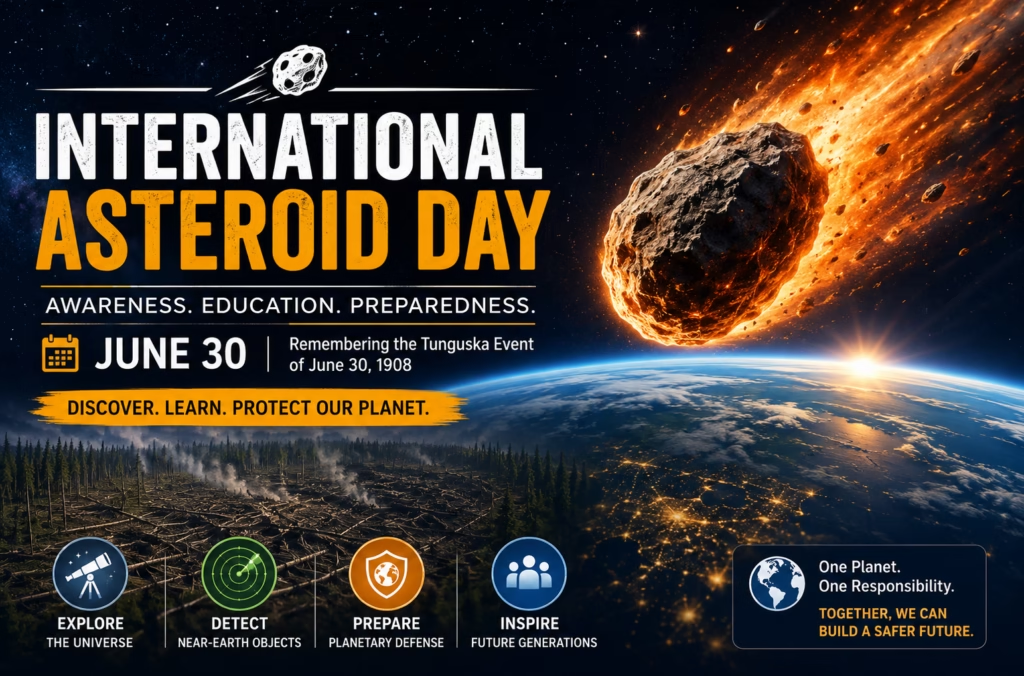
Every year on June 30, scientists, astronomers, educators, and space enthusiasts around the world observe International Asteroid Day, a global awareness event dedicated to understanding asteroids, promoting planetary defence, and educating people about one of the most overlooked natural threats to Earth. While the day celebrates scientific discovery and advances in space research, its origins are rooted in a real historical disaster that occurred more than a century ago in the remote forests of Siberia.
On the morning of June 30, 1908, a massive object from space entered Earth’s atmosphere and exploded over the Tunguska region of Siberia, Russia. The explosion released an enormous amount of energy, flattening millions of trees across thousands of square kilometres without leaving a traditional impact crater. Although the event occurred in an isolated area and caused very few human casualties, scientists later recognised that if the same explosion had happened over a densely populated city, it could have become one of the deadliest natural disasters in modern history.
More than one hundred years later, that remarkable event continues to influence scientific research and international cooperation. Governments and space agencies now monitor thousands of near-Earth asteroids every day, develop technologies capable of changing an asteroid’s path, and organise educational campaigns that encourage the public to understand the importance of planetary defence. International Asteroid Day serves as a reminder that while catastrophic asteroid impacts are extremely rare, preparing for them is an essential part of protecting future generations.
As interest in space exploration grows worldwide through missions led by NASA, the European Space Agency, ISRO, JAXA, and several private aerospace companies, International Asteroid Day has become much more than an annual observance. It represents humanity’s commitment to scientific collaboration, early detection systems, and the responsible use of technology to safeguard our planet from potential cosmic threats.
What Is International Asteroid Day?
International Asteroid Day is a globally recognised science awareness event observed every year on June 30. Its primary objective is to educate people about asteroids, explain the potential risks posed by near-Earth objects, encourage scientific research, and promote international efforts to detect and monitor objects travelling through our Solar System.
Unlike many international observances that focus on history or culture, Asteroid Day looks toward the future. It encourages governments, researchers, educational institutions, and the general public to learn about planetary defence and the importance of identifying potentially hazardous asteroids long before they could ever pose a danger to Earth.
The movement began in 2015 through the efforts of scientists, astronauts, educators, and filmmakers who wanted to increase public awareness following decades of important discoveries in astronomy. The initiative gained worldwide recognition almost immediately because of growing public interest in space exploration and increasing awareness of asteroid detection programmes.
Recognising its global significance, the United Nations General Assembly officially declared June 30 as International Asteroid Day in 2016. Since then, observatories, museums, universities, schools, and space agencies around the world have organised public lectures, live broadcasts, educational workshops, documentaries, telescope observations, and online campaigns to celebrate the occasion.
Today, International Asteroid Day is observed in dozens of countries and continues expanding each year as new discoveries about our Solar System capture worldwide attention.
Why Is International Asteroid Day Celebrated on June 30?
The date was chosen to commemorate one of the most extraordinary natural events ever recorded—the Tunguska Event, which occurred on June 30, 1908 in the remote forests of Siberia, Russia.
Early that morning, witnesses reported seeing an intensely bright fireball racing across the sky before a tremendous explosion shook the surrounding region. The object, believed to have been either an asteroid or a comet fragment approximately 50 to 80 metres in diameter, entered Earth’s atmosphere at incredible speed.
Instead of striking the ground directly, the object exploded in mid-air several kilometres above the Earth’s surface. Scientists describe this phenomenon as an airburst, where the intense pressure and heat generated during atmospheric entry cause the object to disintegrate violently before impact.
The resulting explosion was astonishing. Modern scientific estimates suggest it released energy equivalent to 10 to 15 megatons of TNT, making it hundreds of times more powerful than the atomic bomb dropped on Hiroshima during World War II.
The shockwave flattened approximately 80 million trees across an area covering more than 2,150 square kilometres, creating a distinctive radial pattern that remains visible in historical aerial photographs and scientific reconstructions. The blast was detected thousands of kilometres away, while atmospheric disturbances produced unusually bright night skies across parts of Europe and Asia for several nights afterward.
Remarkably, because the explosion occurred over an extremely remote forest, there were no confirmed large-scale human fatalities. Had the same object exploded above a modern city such as New York, London, Tokyo, Mumbai, or São Paulo, the consequences would almost certainly have been catastrophic, potentially affecting millions of people.
The Tunguska Event remains the largest known asteroid-related explosion in recorded human history and serves as the inspiration for International Asteroid Day.
What Happened During the Tunguska Event?
The Tunguska Event remains one of the greatest mysteries and most important scientific case studies in planetary science. Although researchers have spent more than a century studying the incident, no one actually witnessed the explosion from directly beneath the blast because the affected region was sparsely populated. However, eyewitness accounts collected years later, combined with modern scientific analysis, have allowed researchers to reconstruct what most likely occurred.
On the morning of June 30, 1908, a large asteroid or comet fragment entered Earth’s atmosphere at an estimated speed of between 50,000 and 60,000 kilometres per hour. As it descended through the atmosphere, the tremendous friction generated immense heat, causing the object to glow brighter than the Sun. Residents living hundreds of kilometres away described seeing a blazing fireball streak across the sky before hearing an enormous explosion several minutes later.
Instead of striking the Earth’s surface, the object exploded approximately 5 to 10 kilometres above the ground. This atmospheric explosion, known as an airburst, released a shockwave powerful enough to flatten forests across an area roughly the size of a major metropolitan region. Millions of trees were knocked down in a distinctive butterfly-shaped pattern radiating outward from the centre of the blast, while the intense heat scorched vegetation directly beneath the explosion.
The pressure wave travelled around the globe multiple times and was recorded by seismic stations thousands of kilometres away. Atmospheric disturbances also produced unusually bright skies across Europe for several nights after the explosion, allowing people to read newspapers outdoors at midnight without artificial lighting. Scientists later linked these glowing nights to microscopic particles injected high into the atmosphere by the blast.
Because the object disintegrated before reaching the ground, investigators never found a large impact crater. Instead, the evidence consisted primarily of flattened forests, burned vegetation, microscopic mineral particles, and unusual chemical signatures preserved within the surrounding environment. These clues continue helping researchers improve models of asteroid impacts and atmospheric explosions.
Scientific Investigations and Early Expeditions
Despite the scale of the explosion, the remote location meant that scientists did not immediately investigate the site. Political instability, limited transportation, and the outbreak of World War I delayed serious research for nearly two decades.
The first major scientific expedition arrived in 1927 under the leadership of Russian mineralogist Leonid Kulik. Expecting to discover a massive impact crater, Kulik instead found something entirely unexpected. Millions of trees had been flattened in every direction, yet the central area still contained standing tree trunks stripped of their branches. The absence of a crater puzzled researchers and fuelled decades of scientific debate.
Over the following decades, numerous theories attempted to explain the Tunguska explosion. Some suggested it was caused by an asteroid, while others proposed a comet fragment composed largely of ice. More unusual hypotheses included underground gas explosions, antimatter, miniature black holes, or even extraterrestrial spacecraft. As scientific knowledge advanced, however, evidence increasingly supported the asteroid airburst explanation.
Modern satellite imagery, computer simulations, geochemical studies, and atmospheric modelling have strengthened the conclusion that the event resulted from a rocky asteroid or possibly an icy comet fragment exploding before impact. While some details remain uncertain, scientists generally agree that an atmospheric airburst best explains the available evidence.
The Tunguska Event has become one of the most valuable natural laboratories for understanding how relatively small cosmic objects can produce enormous destruction without ever striking the Earth’s surface directly.
What Are Asteroids?
Asteroids are rocky objects that orbit the Sun and are remnants left over from the formation of the Solar System approximately 4.6 billion years ago. Most reside within the Asteroid Belt located between Mars and Jupiter, where millions of objects ranging from tiny rocks to dwarf planets continue orbiting the Sun.
Not all asteroids remain confined to the Asteroid Belt. Gravitational interactions with planets, particularly Jupiter, can gradually alter their orbits over millions of years. Some eventually become Near-Earth Asteroids (NEAs), meaning their orbits bring them relatively close to Earth’s path around the Sun.
It is important to understand that the overwhelming majority of these asteroids pose absolutely no danger. Space agencies continuously monitor their trajectories, calculating future positions with remarkable precision. Thousands of close approaches occur safely every year without causing any concern.
Scientists classify certain objects as Potentially Hazardous Asteroids (PHAs) if they exceed a specific size and pass within a defined distance of Earth’s orbit. Even then, being classified as potentially hazardous does not mean an impact is expected. Instead, these objects receive additional monitoring to ensure any future orbital changes are detected as early as possible.
How NASA and Other Space Agencies Protect Earth
Unlike previous generations, humanity now possesses sophisticated technologies capable of detecting potentially hazardous asteroids long before they approach Earth. Several international organisations collaborate to identify, monitor, and study near-Earth objects using powerful telescopes, radar systems, satellites, and advanced computer models.
NASA operates one of the world’s largest asteroid observation programmes through its Planetary Defense Coordination Office, which works alongside observatories around the globe to catalogue newly discovered objects and calculate their future trajectories. The European Space Agency, the Japanese Aerospace Exploration Agency, ISRO, and numerous national observatories contribute additional observations, creating a worldwide network dedicated to planetary defence.
One of the most significant milestones occurred in 2022, when NASA successfully completed the Double Asteroid Redirection Test (DART) mission. For the first time in history, a spacecraft deliberately collided with an asteroid to test whether its orbit could be changed. The mission successfully altered the asteroid’s orbital period, proving that humanity may one day possess the capability to deflect a dangerous asteroid before it reaches Earth.
This achievement transformed planetary defence from theoretical research into demonstrated technology. While no known asteroid currently threatens Earth, the success of DART showed that international cooperation and scientific innovation can provide practical solutions should a genuine threat ever emerge in the future.
Could Another Asteroid Hit Earth?
One of the most common questions people ask during International Asteroid Day is whether another event like Tunguska could happen again. The simple answer is yes—but the probability of a catastrophic impact in the near future is extremely low.
Every day, Earth is bombarded by thousands of small pieces of space debris. Most are no larger than grains of sand and burn up harmlessly as meteors while entering the atmosphere. Slightly larger objects occasionally produce spectacular fireballs visible across large regions, but they rarely survive long enough to reach the ground.
Larger asteroids, like the one responsible for the Tunguska Event, are much rarer. Scientists estimate that objects capable of producing Tunguska-sized explosions may enter Earth’s atmosphere once every few hundred years. Even then, because nearly 70 percent of Earth’s surface is covered by oceans and vast areas of land remain sparsely populated, the chances of such an event striking a major city are extremely small.
Far larger asteroids—those measuring one kilometre or more in diameter—could cause global consequences if they were ever to collide with Earth. Fortunately, space agencies have already identified and continue monitoring nearly all known large near-Earth asteroids. Current observations show that no known large asteroid poses a significant impact threat to Earth within the next century.
This constant monitoring is precisely why International Asteroid Day exists. Rather than creating fear, the goal is to educate the public about the importance of early detection. If scientists discover a hazardous asteroid decades before a possible impact, humanity has time to develop strategies that could alter its trajectory and prevent disaster.
Why Planetary Defense Is Becoming More Important
Planetary defence has evolved into one of the fastest-growing fields in modern space science. Unlike many natural disasters, asteroid impacts are among the few global threats that humanity may eventually be able to prevent through scientific planning and international cooperation.
Governments, research institutions, universities, and private aerospace companies are investing in increasingly advanced technologies capable of identifying smaller asteroids at greater distances from Earth. New space telescopes, infrared observatories, artificial intelligence systems, and improved computer simulations are helping astronomers discover objects that were previously impossible to detect.
Future planetary defence strategies may involve multiple approaches depending on the size and composition of an asteroid. These include kinetic impactors similar to NASA’s DART mission, gravity tractors that slowly alter an asteroid’s orbit through prolonged gravitational influence, and other technologies currently being studied by scientists around the world.
The success of planetary defence depends not only on technology but also on international collaboration. Asteroids do not recognise national borders, making global cooperation essential for monitoring potential threats and coordinating responses if necessary. International Asteroid Day encourages exactly this type of cooperation by bringing together scientists, educators, policymakers, and the public.
How International Asteroid Day Is Celebrated Around the World
Although International Asteroid Day is rooted in science, it has become an engaging educational event for people of all ages. Universities, observatories, museums, science centres, schools, and astronomy clubs organise activities that make complex space science accessible to the public.
Astronomers often host telescope observation sessions where visitors can view planets, the Moon, and occasionally larger asteroids. Educational institutions organise lectures explaining asteroid formation, the history of the Solar System, and the importance of planetary defence. Many space agencies release special documentaries, interviews with scientists, interactive presentations, and educational resources designed for students.
Online participation has also become increasingly important. Social media campaigns, live discussions with astronauts, virtual observatory tours, and question-and-answer sessions allow millions of people worldwide to participate regardless of location. These activities inspire young people to pursue careers in science, engineering, astronomy, and aerospace technology while increasing public understanding of our place within the Solar System.
Interesting Facts About Asteroids
Asteroids have fascinated scientists for centuries, and research continues revealing remarkable discoveries about these ancient remnants of planetary formation. More than 1.4 million asteroids have now been identified within our Solar System, although scientists believe millions more remain undiscovered.
Most asteroids are located in the Main Asteroid Belt between Mars and Jupiter, where gravitational influences prevented them from forming into a planet. However, some asteroids travel through Earth’s neighbourhood, making continuous monitoring essential.
The asteroid believed to have contributed to the extinction of the dinosaurs approximately 66 million years ago measured around 10 kilometres in diameter and struck what is now Mexico’s Yucatán Peninsula. Its impact dramatically altered Earth’s climate and changed the course of biological evolution.
Modern space missions have also transformed our understanding of asteroids. Spacecraft have successfully landed on asteroid surfaces, collected samples, photographed unusual rock formations, and even demonstrated humanity’s ability to alter an asteroid’s orbit through the DART mission. These achievements represent significant milestones in both planetary science and future planetary defence.
Final Thoughts
International Asteroid Day is much more than an annual scientific observance. It serves as a reminder that our planet exists within a dynamic Solar System where natural cosmic events continue shaping planetary history. The Tunguska Event of June 30, 1908 demonstrated how even a relatively small asteroid could release enormous energy and devastate thousands of square kilometres without ever reaching the Earth’s surface.
More than a century later, scientific progress has dramatically improved humanity’s ability to detect, track, and study near-Earth asteroids. Organisations such as NASA, the European Space Agency, ISRO, and observatories around the world continuously monitor thousands of objects, ensuring that any potential future threats are identified as early as possible. Missions like DART have shown that planetary defence is no longer just a theoretical concept but a practical scientific capability.
International Asteroid Day encourages curiosity, scientific literacy, and international cooperation. It reminds us that protecting Earth is a shared responsibility requiring collaboration across nations, disciplines, and generations. As technology continues advancing and humanity expands its presence deeper into space, understanding asteroids will remain essential not only for planetary defence but also for unlocking new discoveries about the origins of our Solar System.
FAQs
What is International Asteroid Day?
International Asteroid Day is observed every year on June 30 to raise awareness about asteroids, near-Earth objects, planetary defence, and scientific research. It also commemorates the 1908 Tunguska Event in Siberia.
Why is June 30 important?
June 30 marks the anniversary of the Tunguska Event, the largest recorded asteroid-related explosion in human history, which flattened around 80 million trees across Siberia in 1908.
Can an asteroid hit Earth again?
Yes. Small asteroids enter Earth’s atmosphere regularly, but large, dangerous impacts are extremely rare. Space agencies continuously monitor near-Earth asteroids to detect any potential threats decades in advance.
What was NASA’s DART mission?
The Double Asteroid Redirection Test (DART) was NASA’s first planetary defence mission. In 2022, it successfully changed the orbit of a small asteroid by deliberately crashing a spacecraft into it, proving that asteroid deflection is possible.
Is there any asteroid currently expected to hit Earth?
No. According to current observations, scientists have not identified any known large asteroid that poses a significant impact threat to Earth within the foreseeable future, although monitoring continues around the clock.