|
Getting your Trinity Audio player ready...
|
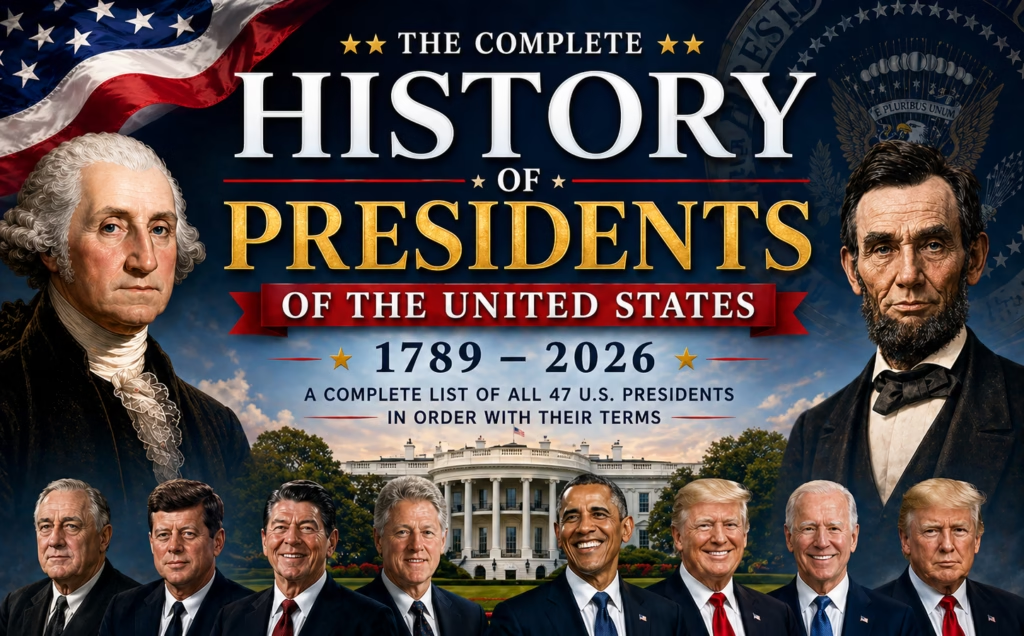
The history of the United States is deeply shaped by its presidents. From the founding era to modern times, each leader has left a distinct mark on the nation’s political, economic, and social fabric.
This blog presents a complete chronological overview of US presidents, highlights those who had the greatest influence, and critically evaluates leadership decisions across different eras.
- Complete List of US Presidents
- Early Foundations: Building a Nation
- The Civil War Era: Defining Unity
- Theodore Roosevelt
- Woodrow Wilson
- The Longest Serving President: Franklin D. Roosevelt
- Post-War Leadership and Cold War Politics
- Modern Era: Economic Growth and Challenges
- Who Ruled the Most?
- Critical Analysis: Leadership Strength vs Weakness
- Donald Trump: A Controversial Presidency
- Patterns Across Presidential History
Complete List of US Presidents
Below is a simplified chronological list of US presidents:
| No. | President | Term |
|---|---|---|
| 1 | George Washington | 1789–1797 |
| 2 | John Adams | 1797–1801 |
| 3 | Thomas Jefferson | 1801–1809 |
| 4 | James Madison | 1809–1817 |
| 5 | James Monroe | 1817–1825 |
| 6 | John Quincy Adams | 1825–1829 |
| 7 | Andrew Jackson | 1829–1837 |
| 8 | Martin Van Buren | 1837–1841 |
| 9 | William Henry Harrison | 1841 |
| 10 | John Tyler | 1841–1845 |
| 11 | James K. Polk | 1845–1849 |
| 12 | Zachary Taylor | 1849–1850 |
| 13 | Millard Fillmore | 1850–1853 |
| 14 | Franklin Pierce | 1853–1857 |
| 15 | James Buchanan | 1857–1861 |
| 16 | Abraham Lincoln | 1861–1865 |
| 17 | Andrew Johnson | 1865–1869 |
| 18 | Ulysses S. Grant | 1869–1877 |
| 19 | Rutherford B. Hayes | 1877–1881 |
| 20 | James A. Garfield | 1881 |
| 21 | Chester A. Arthur | 1881–1885 |
| 22 | Grover Cleveland | 1885–1889 |
| 23 | Benjamin Harrison | 1889–1893 |
| 24 | Grover Cleveland | 1893–1897 |
| 25 | William McKinley | 1897–1901 |
| 26 | Theodore Roosevelt | 1901–1909 |
| 27 | William Howard Taft | 1909–1913 |
| 28 | Woodrow Wilson | 1913–1921 |
| 29 | Warren G. Harding | 1921–1923 |
| 30 | Calvin Coolidge | 1923–1929 |
| 31 | Herbert Hoover | 1929–1933 |
| 32 | Franklin D. Roosevelt | 1933–1945 |
| 33 | Harry S. Truman | 1945–1953 |
| 34 | Dwight D. Eisenhower | 1953–1961 |
| 35 | John F. Kennedy | 1961–1963 |
| 36 | Lyndon B. Johnson | 1963–1969 |
| 37 | Richard Nixon | 1969–1974 |
| 38 | Gerald Ford | 1974–1977 |
| 39 | Jimmy Carter | 1977–1981 |
| 40 | Ronald Reagan | 1981–1989 |
| 41 | George H. W. Bush | 1989–1993 |
| 42 | Bill Clinton | 1993–2001 |
| 43 | George W. Bush | 2001–2009 |
| 44 | Barack Obama | 2009–2017 |
| 45 | Donald Trump | 2017–2021 |
| 46 | Joe Biden | 2021–2025 |
| 47 | Donald Trump | 2025–Present |
Early Foundations: Building a Nation
The first few presidents laid the groundwork for the United States.
George Washington
As the first president, he set critical precedents:
- Established the Cabinet system
- Maintained neutrality in foreign conflicts
- Ensured peaceful transfer of power
His leadership created stability in a fragile new nation.
Thomas Jefferson
- Expanded US territory through the Louisiana Purchase
- Promoted democratic ideals
- Strengthened the republic’s vision
These early leaders focused on survival, structure, and identity.
The Civil War Era: Defining Unity
Abraham Lincoln
Lincoln remains one of the most influential presidents:
- Led the country through the Civil War
- Abolished slavery with the Emancipation Proclamation
- Preserved the Union
His leadership defined the moral and political direction of the United States.
Industrial Growth and Global Rise
As the US expanded, presidents began shaping global influence.
Theodore Roosevelt
- Strengthened federal power
- Regulated big corporations
- Expanded national parks
He redefined the presidency as an active force in governance.
Woodrow Wilson
- Led the US during World War I
- Proposed the League of Nations
- Promoted international diplomacy
This era marked America’s entry into global politics.
The Longest Serving President: Franklin D. Roosevelt
Franklin D. Roosevelt (FDR)
FDR holds the record for the longest presidency, serving four terms from 1933 to 1945.
Major Contributions
- Introduced the New Deal to combat the Great Depression
- Strengthened the federal government’s role in economic recovery
- Led the US through World War II
Impact
FDR reshaped:
- Economic policy
- Social welfare systems
- Global leadership
His presidency is often considered the most transformative in modern US history.
Post-War Leadership and Cold War Politics
Harry S. Truman
- Authorized the use of atomic bombs
- Initiated the Marshall Plan
- Contained the spread of communism
John F. Kennedy
- Led during the Cuban Missile Crisis
- Advanced the space race
- Inspired a generation with progressive ideals
Ronald Reagan
- Played a key role in ending the Cold War
- Promoted economic liberalization
- Strengthened military power
These presidents shaped global geopolitics during tense times.
Modern Era: Economic Growth and Challenges
Bill Clinton
- Oversaw strong economic growth
- Reduced unemployment
- Balanced the federal budget
Barack Obama
- Passed the Affordable Care Act
- Managed the aftermath of the 2008 financial crisis
- Improved international relations
These leaders focused on economic recovery and social reforms.
Who Ruled the Most?
The longest-serving president was:
Franklin D. Roosevelt
- Served 12 years (4 terms)
- Only president to break the two-term tradition
After his tenure, the 22nd Amendment limited presidents to two terms.
Critical Analysis: Leadership Strength vs Weakness
Presidents are often judged by:
- Crisis management
- Economic performance
- Long-term impact
While many leaders strengthened the nation, others faced heavy criticism.
Donald Trump: A Controversial Presidency
Donald Trump
The presidency of Donald Trump remains one of the most polarizing in US history.
Key Actions
- Focused on “America First” policies
- Reduced corporate taxes
- Renegotiated international trade deals
Criticism
His presidency faced strong opposition due to:
- Deep political polarization
- Handling of the COVID-19 pandemic
- Controversial public statements and policies
Why He Is Considered Among the Worst by Critics
Many analysts argue:
- His leadership intensified divisions within the country
- Institutional trust declined during his tenure
- Crisis management faced serious scrutiny
However, it is important to note that:
- His supporters highlight economic growth pre-pandemic
- He maintained a strong voter base
Trump’s presidency is best understood as highly divisive rather than universally defined, but it undeniably reshaped political discourse in the US.
Patterns Across Presidential History
Looking across all presidencies, several patterns emerge:
1. Crisis Defines Greatness
- Lincoln during Civil War
- FDR during Great Depression
- Truman during WWII aftermath
2. Economic Policy Shapes Legacy
- Roosevelt’s New Deal
- Reagan’s economic reforms
- Clinton’s growth era
3. Public Trust Is Critical
Presidents who maintain trust tend to leave stronger legacies.
Evolution of the Presidency
The role of the US president has evolved significantly:
- Early presidents focused on nation-building
- Mid-era leaders handled wars and expansion
- Modern presidents deal with global leadership and economic complexity
Today, the presidency is one of the most powerful political roles in the world.
Conclusion
The history of US presidents is a story of leadership, crisis, transformation, and controversy.
From George Washington establishing the foundation to Joe Biden navigating modern challenges, each leader reflects the priorities and pressures of their time.
Some presidents changed the course of history, while others struggled under its weight. Figures like Franklin D. Roosevelt and Abraham Lincoln stand as transformative leaders, while others remain subjects of debate and criticism.
The presidency is not just about power—it is about responsibility, decision-making under pressure, and the ability to shape a nation’s future.
And history, ultimately, decides who succeeded and who fell short.