|
Getting your Trinity Audio player ready...
|
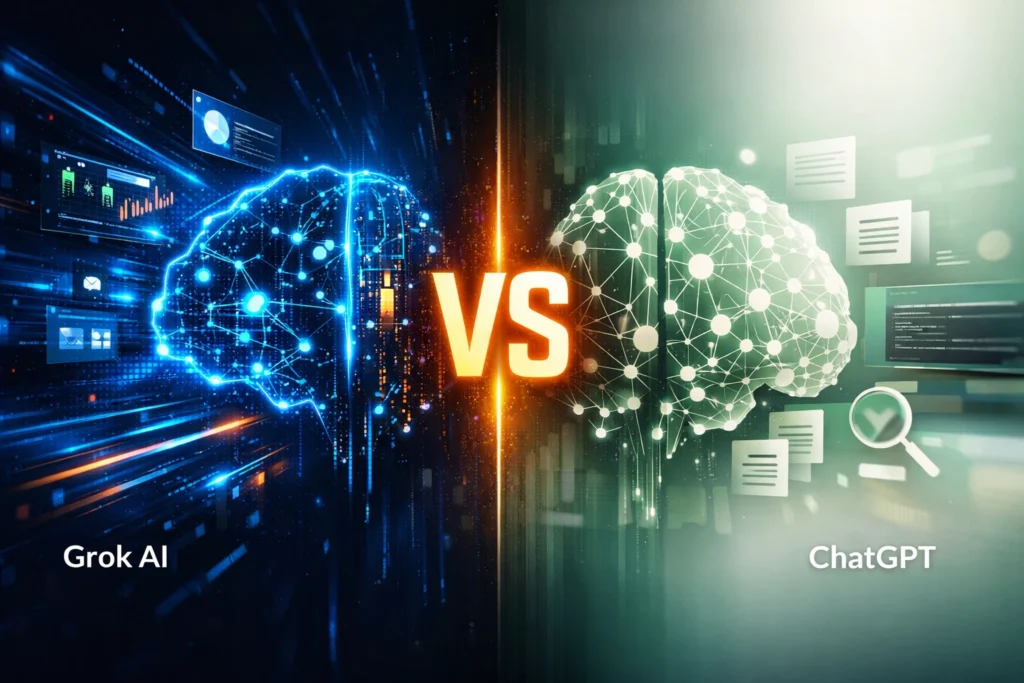
Artificial intelligence in 2026 isn’t a novelty — it’s a utility, a workplace partner, and for many, a money-making assistant. But not all AI models are built the same. When it comes to Grok AI and ChatGPT, each has strengths, limitations, and very different philosophies behind how they think and answer.
In this detailed comparison, you’ll get:
✔ Feature differences
✔ Pricing breakdowns
✔ Strengths & limitations
✔ Best use cases
✔ Who wins in real world tasks
Let’s dive right in.
Overview: What Are These Tools?
Grok AI
Grok AI is an opinion-aware, real-time conversational AI developed to tap into live trends and present information with context and personality. It focuses on up-to-the-minute data, trending discussion interpretation, and less sterile output.
ChatGPT
ChatGPT — the flagship AI from OpenAI — is a robust large language model known for balanced responses, wide support for tasks, reliable accuracy, and a massive ecosystem of plugins, business tools, and third-party integrations.
Both are powerful, but they serve slightly different purposes.
Pricing: What It Costs
👉 Note: Pricing can change, but here’s the most accurate structure as of early 2026.
Grok AI Pricing
- Free Tier: Basic access with limited queries
- Subscription Tier: Monthly or annual plans
- Real-time data processing included
- Priority response speed
- Enhanced conversational context
(Exact pricing may vary by region and package — always check provider page for latest.)
ChatGPT Pricing
- Free Plan: Access to GPT-3.5 capabilities
- ChatGPT Plus: ~₹799/month (varies by country) for GPT-4 access
- Business/Enterprise: Custom pricing with compliance, security, and API credits
- API Access: Pay-as-you-go, excellent for developers
Winner (pricing): It depends on usage pattern. ChatGPT’s free tier is generous, while Grok AI’s paid tier tends to be competitive with Plus.
Feature Comparison
| Feature | Grok AI | ChatGPT (GPT-4/4.1) |
|---|---|---|
| Real-Time Data | ✅ Yes | ❌ No (static dataset; sometimes updated) |
| Trend Awareness | 🔥 Strong | 📈 Limited |
| Long-Form Content | 👍 Good | ⭐️ Excellent |
| Code & Technical Help | 👌 Good | ⭐️ Excellent |
| Memory / Context over long chats | 👍 Medium | ⭐️ Stronger |
| Integration & Plugins | ❌ Minimal | ⭐️ Huge ecosystem |
| API Available | Depends | ⭐️ Yes, strong API support |
| Safety Filters | Moderate | Stronger |
| Creativity & Tone Control | Good | Excellent |
| Multimodal (Images/Audio) | Limited | Yes (in premium plans) |
Key Takeaways:
- Grok AI wins in live context and trend interpretation.
- ChatGPT wins in structured tasks, creativity range, safety, and ecosystem support.
Strengths: What Each Does Best
Why You Might Choose Grok AI
- Real-time interpretation of trending news and discussions
- Conversational style feels less canned
- Better for live social media analysis
- Opinion-aware responses (useful for marketing analysis)
Great For:
Digital marketers, trend analysts, social media managers, content ideation on current topics.
Why ChatGPT Still Leads in Many Areas
- Vast knowledge base with deep contextual memory
- Better for creative writing, storytelling, scripts
- Strong code generation and explanation
- Tons of plugins and integrations (browsers, calendars, docs, sheets)
- Reliable for education and professional tasks
Great For:
Students, developers, writers, product teams, professional services.
Limitations: Honest Bugs & Trade-Offs
Grok AI Limitations
- Real-time data noise: Live data can be messy and introduce errors
- Safety moderation is lighter: More opinionated but occasionally controversial
- Smaller ecosystem: Limited tools, plugins, and third-party support
- Not optimized for heavy writing: While solid, it’s not as deep as top GPT models
ChatGPT Limitations
- Not real-time aware: Static dataset means trends/new events require plugins or tools like browsing
- Less personality out-of-box: More neutral by design
- API costs can add up: Enterprise users pay for usage
Performance: Who’s Smarter?
Speed:
- Grok AI: Fast responses and sometimes more conversational
- ChatGPT: Fast, but depends on load and subscription tier
Accuracy:
- ChatGPT leads for technical and factual precision
- Grok AI better at interpreting trends and recent events
Use Task Examples
- Writing long articles? — ChatGPT wins
- Real-time market insight? — Grok AI shines
- Coding help? — ChatGPT preferred
- Trend detection? — Grok AI shines
Use Case Scenarios
Blogging & Content Creation
- Use ChatGPT for structure, depth, SEO optimization
- Use Grok AI for topic ideation based on real-time buzz
Marketing & Analytics
- Grok AI to catch trending phrases, social sentiment
- ChatGPT to refine campaigns, write copy, and scale execution
Learning & Education
- ChatGPT: better explanations, examples, clarity
- Grok AI: can help tie lessons to current topics
Development & Technical Support
- ChatGPT: superior code generation, debugging help
- Grok AI: useful for high-level trend or tech news context
Who Should Use Which?
| User Type | Best Fit |
|---|---|
| Casual user | ChatGPT (balanced, safe, free tier) |
| Marketing pro | Grok AI (real-time edge) + ChatGPT (execution) |
| Developer | ChatGPT (code accuracy) |
| Researcher | Mix of both |
| SEO/content creator | ChatGPT for writing, Grok AI for ideation |
Real-World Example: How They Stack Up
Scenario: You want ideas for viral topics for a tech blog this week
- Grok AI: Scans live trends, suggests hot topics based on current conversations
- ChatGPT: Polishes topic ideas into outlines and full articles that rank
Scenario: You want an accurate code snippet for an API integration
- ChatGPT: Delivers detailed code with explanations
- Grok AI: Offers higher-level insights but may lack deep technical precision
Final Verdict: Which One Wins?
✔ No clear universal winner — it depends on your goals.
- Want speed, live context, social insights? → Grok AI
- Want depth, precision, writing power, and ecosystem? → ChatGPT
- Want the ultimate AI workflow? → Use both together.
Straight Talk: Grok AI is bold and fast, ChatGPT is reliable and deep. In 2026, the smartest users don’t choose just one — they stack them for strengths.
Also Read: Perplexity’s Comet Browser: Unlocking the Future of Browsing