|
Getting your Trinity Audio player ready...
|
Oil has always been about power. What changed recently is how openly that power is being exercised.
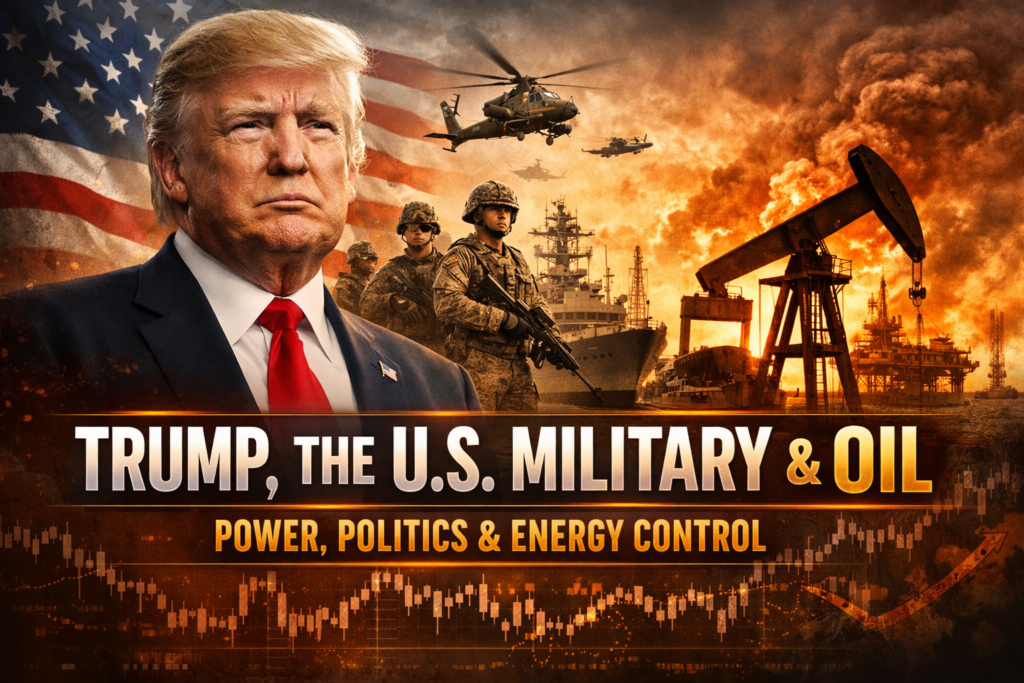
When Donald Trump declared that Venezuela would send millions of barrels of oil to the United States, global oil prices immediately reacted. Crude slipped, traders recalculated supply forecasts, and geopolitical risk premiums shifted. But this story is not just about prices. It is about how oil, military strength, and political authority are being fused into a single strategic weapon.
This is not diplomacy. This is leverage.
Oil as a Strategic Weapon, Not a Commodity
For decades, oil was treated as a market-driven commodity influenced by supply, demand, and alliances. Under Trump’s approach, oil is no longer passive. It is a pressure point.
By signaling direct access to Venezuelan oil, the United States effectively told markets that supply constraints can be removed through political and military decisions. That message alone was enough to push prices lower. Traders understood the subtext immediately: geopolitical force can override traditional oil market mechanics.
This marks a shift from negotiation-based energy policy to power-backed energy control.
Why Venezuela Matters So Much
Venezuela holds the largest proven oil reserves on the planet. That fact alone makes it impossible for any major power to ignore. For years, sanctions restricted its exports, forcing the country to sell crude at discounts and rely on limited buyers.
The new direction changes everything.
By reopening Venezuelan oil flows toward the United States, Washington is reshaping global crude routes. Barrels that once moved toward Asia are now being redirected. That disrupts established trade balances and sends shockwaves through OPEC strategies, non-OPEC producers, and emerging market economies.
This is not aid. It is extraction through influence.
The US Military’s Quiet but Central Role
The U.S. Army and broader military apparatus are no longer operating in the background. They are an active pillar of energy strategy.
Military presence in the Caribbean, naval control of shipping lanes, tanker seizures, and security enforcement around oil infrastructure are not coincidence. These actions ensure compliance, signal dominance, and deter opposition.
In simple terms, oil flows where power allows it to flow.
This sets a dangerous precedent. Once military force becomes normalized as a tool for managing energy supply, the line between national security and economic ambition disappears.
Market Reaction: Why Oil Prices Fell
Oil prices fell not because demand collapsed, but because markets anticipated excess supply. The announcement suggested that millions of additional barrels could enter the U.S. system quickly.
Traders hate uncertainty, but they fear oversupply even more.
When supply expands without corresponding demand growth, prices adjust downward. That is exactly what happened. The signal was clear: geopolitical decisions can instantly rewrite supply assumptions.
This also weakens producers who rely on higher oil prices, from Middle Eastern exporters to smaller oil-dependent economies.
America’s Energy Strategy Has Changed
The United States is already one of the world’s largest oil producers. So why pursue Venezuelan crude at all?
Because this is not about shortage. It is about control.
By diversifying supply sources under U.S. influence, Washington reduces dependence on rivals, limits leverage from OPEC, and strengthens its negotiating position globally. Cheap oil also helps control domestic inflation and fuel political narratives around economic strength.
Energy independence is no longer just about drilling more. It is about commanding supply chains beyond national borders.
Geopolitics Over Global Stability
This strategy does not exist in isolation. Other global powers are watching closely.
China views this move as a direct challenge to its energy security interests. Russia sees it as a signal that economic resources can be seized under security justifications. Smaller nations see a warning: strategic resources make you vulnerable.
The long-term cost is instability.
Once oil becomes openly militarized, retaliation becomes inevitable. Naval deployments, counter-sanctions, and regional tensions increase. Markets respond by pricing in long-term risk, even if short-term prices fall.
Is This About Democracy or Dominance?
The official narrative often frames intervention as restoring order or protecting stability. The reality is more blunt.
This is about dominance over resources.
Energy has always shaped empires. From coal to oil to gas, control over fuel defines global hierarchy. What makes this moment different is how openly that truth is being acted upon.
There is no subtlety. The message is direct: oil-rich nations without power protection are exposed.
What This Means Going Forward
The fusion of oil policy and military strategy will not stop here.
Expect:
- Greater volatility in oil markets driven by political statements
- Increased military presence near energy corridors
- Faster price reactions to geopolitical news than to economic data
- A renewed race among nations to secure energy through alliances or force
Renewable energy discussions may dominate headlines, but oil still decides global power equations.
The Bottom Line
Trump’s oil strategy involving Venezuela and the U.S. military exposes a hard truth many prefer to ignore: energy security is enforced, not negotiated.
Oil prices did not fall because the world became more stable. They fell because power was exercised decisively.
In today’s geopolitical reality, oil is not just fuel. It is influence. And influence is backed by force.
That is the real story behind Trump, the U.S. military, and oil.