|
Getting your Trinity Audio player ready...
|
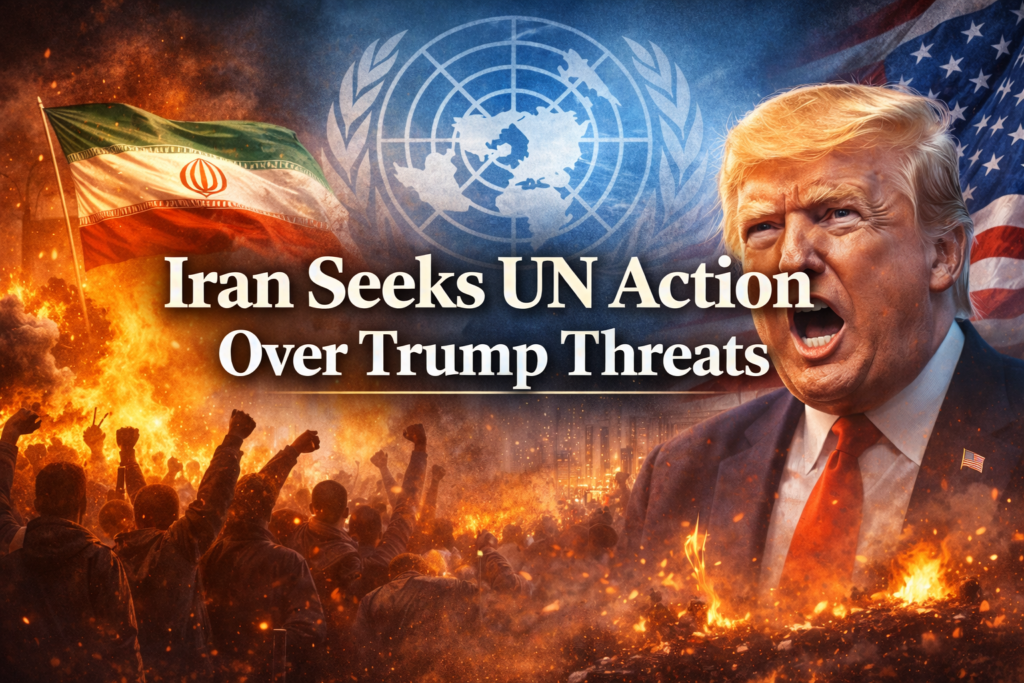
Tensions between Iran and the United States have intensified after sharp remarks by former US President Donald Trump on ongoing protests inside Iran. What began as domestic unrest has now turned into a diplomatic confrontation, with Tehran formally urging the United Nations to intervene.
Protests Driven by Economic Pressure
Protests erupted across multiple Iranian cities as citizens voiced anger over rising prices, inflation, and economic hardship. While demonstrations started as peaceful expressions of frustration, clashes with security forces quickly escalated tensions on the ground.
Economic strain remains the core issue. A weakened currency and increasing cost of living have pushed many Iranians to the brink, transforming economic protests into broader political dissent.
Trump’s Remarks Trigger Diplomatic Fallout
Donald Trump publicly warned Iran against using force on protesters and suggested that the United States was prepared to respond if violence continued. His language, described by Iranian officials as aggressive and irresponsible, immediately drew global attention.
Such direct statements on another country’s internal protests are rare and carry serious geopolitical weight. As a result, Iran viewed the remarks not as commentary but as a potential threat.
Iran’s Appeal to the United Nations
Iran’s leadership responded by formally approaching the United Nations, accusing Trump of issuing “reckless” and “provocative” threats. Tehran argued that these statements violate international norms and undermine national sovereignty.
Iran also warned that any escalation resulting from such remarks would hold the United States responsible, signaling that Tehran considers rhetoric itself a destabilizing force.
Why This Matters Beyond Iran
This episode highlights how internal protests can rapidly transform into international flashpoints.
- Diplomatic escalation: What starts on the streets can end up in global institutions.
- Sovereignty vs human rights: The situation reignites debate over how far foreign leaders should go in commenting on domestic unrest.
- Regional stability: Any miscalculation risks destabilising an already volatile Middle East.
Who Controls the Narrative?
Iran insists that foreign intervention worsens unrest and strengthens hardliners. Meanwhile, Trump’s remarks position the US as a moral watchdog but risk being perceived as political provocation rather than humanitarian concern.
Both sides are fighting not just politically, but narratively — shaping how the world interprets the protests.
What Could Happen Next
Several paths lie ahead:
- Increased diplomatic exchanges at the UN
- Stronger internal security measures inside Iran
- Heightened rhetoric that could spill into broader regional tensions
The direction will depend on whether global actors choose restraint or escalation.
Final Take
Iran’s protests are no longer just a domestic issue. Trump’s comments have internationalised the crisis, pushing it into the realm of global diplomacy. As Iran calls on the United Nations to step in, the situation underscores a hard truth: words from powerful leaders can carry consequences as serious as actions.
How this unfolds will shape not only Iran–US relations, but the global approach to protests, sovereignty, and intervention in the years ahead.