
|
Getting your Trinity Audio player ready...
|
Yemen’s fragile political balance suffered another blow in early January 2026 after Saudi Arabia accused the Southern Transitional Council (STC) of blocking an official delegation from landing in Aden. The incident has exposed growing cracks within the anti-Houthi alliance and raised fresh concerns about stability in the country’s south.
What Triggered the Crisis
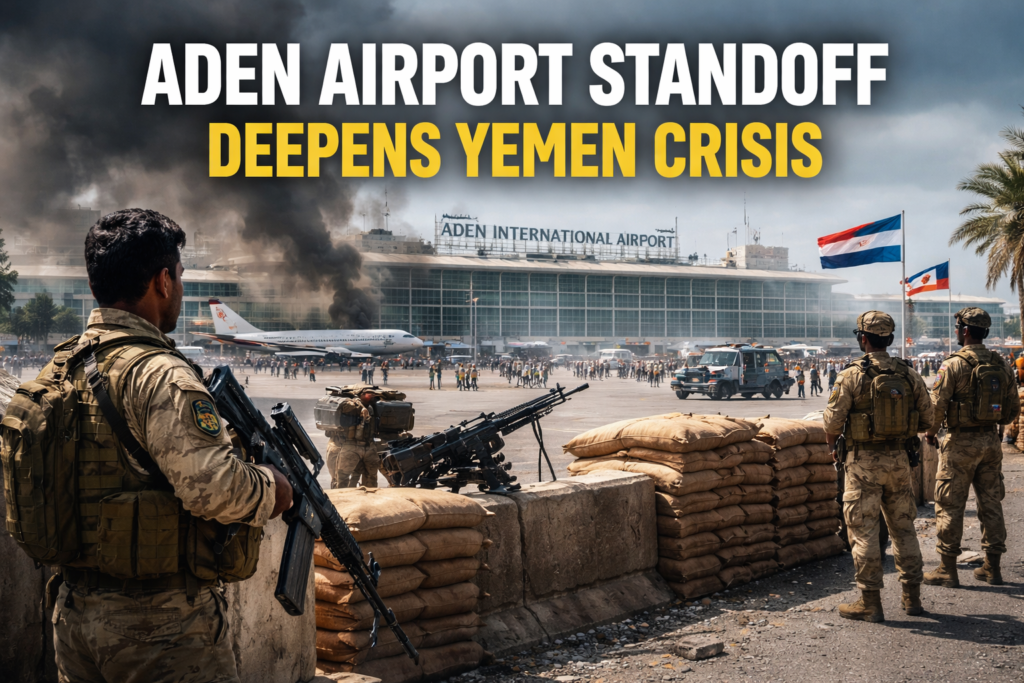
According to Saudi officials, a plane carrying a Saudi-led delegation was denied permission to land at Aden International Airport. The delegation was reportedly traveling to ease tensions and coordinate with local authorities.
Saudi Arabia alleged that the decision came directly from Aidarus al‑Zoubaidi, the head of the Southern Transitional Council, a powerful political and military group that controls much of southern Yemen and seeks an independent southern state.
As a result, operations at Aden airport were disrupted, leaving passengers stranded and further isolating the city.
STC’s Counter-Claims
The STC rejected Saudi accusations and instead blamed Riyadh for what it described as an air blockade. Officials linked to the council said Saudi-imposed restrictions and inspections on flights passing through Saudi airspace made normal operations impossible.
This exchange of blame highlights how coordination between former allies has all but collapsed.
Why Aden Matters
Aden is not just another city. It serves as the interim capital of the internationally recognised Yemeni government and is a strategic port on the Arabian Sea. Any disruption there sends shockwaves across southern Yemen.
The incident also underlines a deeper issue: southern Yemen is no longer politically aligned under one authority. While Saudi Arabia backs the recognised government, the STC — supported by the UAE — is increasingly acting independently.
A Fractured Alliance
Since the Yemen war began in 2015, Saudi Arabia and the UAE worked together against the Houthi movement. However, their priorities have diverged:
- Saudi Arabia focuses on preserving Yemen’s unity under a central government.
- The UAE has backed southern forces that want autonomy or full independence.
The Aden airport standoff is a clear sign that this strategic split has moved from behind the scenes into open confrontation.
Impact on Ordinary Yemenis
As always, civilians are paying the price. Airport closures affect medical travel, business, and family movement in a country already struggling with economic collapse and humanitarian stress. Each political dispute further erodes public trust and day-to-day stability.
What This Means Going Forward
This episode suggests that Yemen’s conflict is entering a more complex phase. Even areas outside Houthi control are now vulnerable to internal power struggles.
Unless regional backers align their strategies and Yemeni factions return to serious political dialogue, incidents like the Aden airport standoff could become routine — pushing any hope of lasting peace even further away.
In short: this is not just an airport issue. It is a warning signal that Yemen’s southern fault lines are widening fast.