|
Getting your Trinity Audio player ready...
|
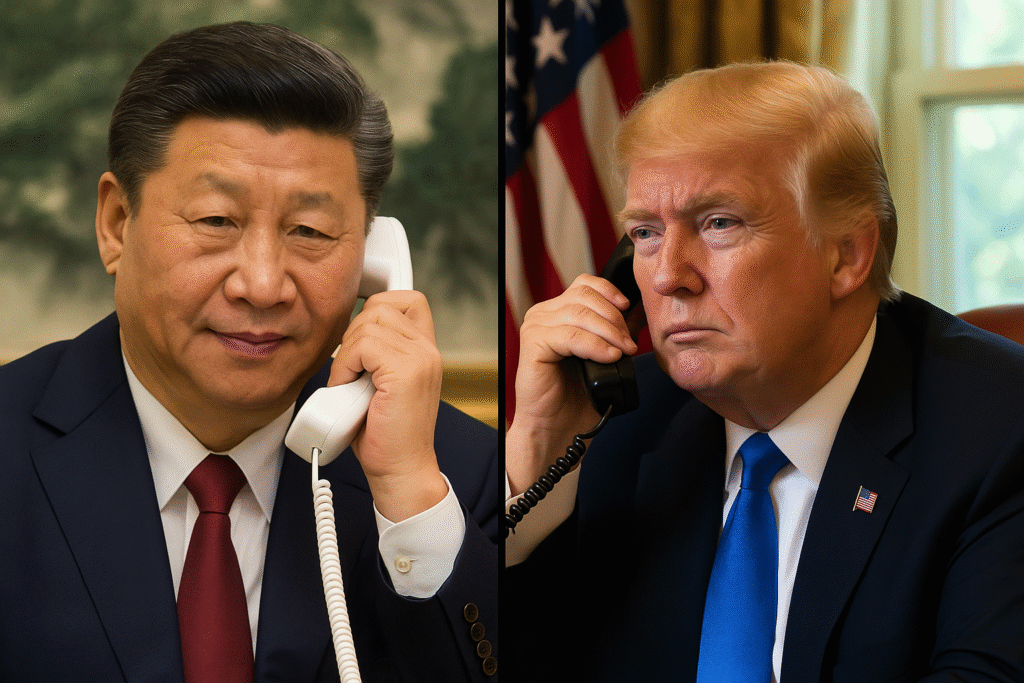
In a call that caught global attention, Xi Jinping (China’s President) and Donald Trump (former U.S. President) spoke to “maintain momentum” in bilateral ties, with Taiwan emerging as a key topic. The conversation reflects an evolving geopolitical climate, with broad implications for global trade, security, and regional dynamics.
Context of the Call
The phone call came shortly after a high-profile meeting between Xi and Trump in South Korea, where both signalled an intent to reduce friction in major areas: trade, rare-earth exports, and strategic competition. The follow-up conversation underlines Beijing’s desire to lock in the progress announced.
Xi explicitly referenced the historical cooperation between China and the U.S. in defeating fascism and militarism, suggesting a larger framing of the relationship beyond trade. For China, the central message is that Taiwan must “return” as part of the post-war order. Meanwhile, the U.S. side sticks to its long-standing position of “strategic ambiguity” regarding Taiwan’s defence, while supplying weapons to the island.
Why This Matters for India and the World
Strategic Equilibrium
India watches this closely. When two global superpowers engage dialogue rather than confrontation, the regional balance shifts. A less-adversarial U.S.–China axis could impact India’s own strategy in the Indo-Pacific, from trade to defence.
Trade and Commerce
Trade agreements and tariff reductions were on the agenda. With the U.S. reducing certain tariffs and China lifting export restrictions on rare-earth materials, global supply chains may begin to realign. For India, which already straddles the U.S. and China in multiple domains, this shift could create both opportunities (as a supplier or alternative base) and risks (if sidelined in major trade blocs).
Taiwan Factor
Taiwan remains a flashpoint. China’s insistence on the island’s “return” and the U.S.’s commitment to supplying defence equipment mean any mis-step can escalate rapidly. This phone call signals both sides may prefer broader stability over immediate confrontation — but that does not remove the underlying risk.
Key Takeaways from the Call
- The phrase “maintain momentum in ties” was coined by Xi to emphasize continuity in diplomatic and economic engagement rather than disruption.
- China reaffirmed the Taiwan issue as a core aspect of its view of the international order.
- The U.S. did not publicly repudiate Taiwan’s status, but reiterated opposition to forceful seizure and continued arms supplies.
- There was mention of specific trade actions: U.S. tariffs were reduced in select areas and China agreed to lift export restrictions on some rare-earth sectors.
- Both sides hinted at upcoming visits: Trump to China (April next year) and Xi to the U.S. sometime thereafter.
Implications for India
- Diplomatic positioning: India may need to recalibrate its diplomacy, balancing its ties with both China and the U.S. as they shift toward greater accommodation.
- Supply-chain impact: As China eases controls on rare-earth exports and the U.S. lowers tariffs, India could gain by positioning itself as an alternative manufacturing hub—provided it acts swiftly.
- Security lens: With Taiwan’s status potentially receiving less overt conflict attention (for now), the Indo-Pacific becomes a theatre of subtle realignment. India must watch Chinese military posture, U.S. naval movements, and how regional partners respond.
- Regional influence: India could step into a gap if the U.S. and China engage more with each other and less with smaller regional players. That presents a chance to expand its diplomatic footprint—but it also risks being marginalized if it doesn’t act.
Potential Risks and Uncertainties
- Back-lash or reversal: Talks are easy; follow-through is hard. If either side feels disadvantaged, old tensions could flare up.
- Ambiguity on Taiwan: Strategic ambiguity is a short-term stabiliser, not a solution. A miscalculation in the Taiwan Strait could still spark major escalation.
- India’s role sidelined: As U.S.–China talk increases, India might find itself bumped out of key negotiations unless it proactively engages.
- Trade complexity: Reductions in barriers don’t guarantee benefits. India must ensure its policies align with new trade flows rather than watch them bypass.
What to Watch Next
- A possible visit by Trump to China in April and a reciprocal visit by Xi to the U.S.: will they yield a concrete roadmap?
- Actual implementation of the tariff cuts and rare-earth export controls: how deep and wide are they?
- Moves on Taiwan: any changes to U.S. arms sales, Chinese military posture or diplomatic signals.
- India’s response: will it lean in more with the U.S., diversify supply chains, or engage China on new terms?
- Wider regional dominoes: how will Southeast Asian countries, Japan, Australia and India adapt to any shift in U.S.–China dynamics?
Conclusion
The phone call between Xi Jinping and Donald Trump marks more than a diplomatic exchange—it signals a potential pivot in the U.S.–China relationship, one with far-reaching consequences for trade, security and geopolitics. For India, the message is clear: the world is shifting, and staying reactive won’t suffice. To benefit, India must be proactive—reassessing alliances, reinforcing its economic competitiveness and staying strategically nimble.
The privilege lies in being a pivot, not a bystander. The question is: will India seize it or watch from the sidelines?