|
Getting your Trinity Audio player ready...
|
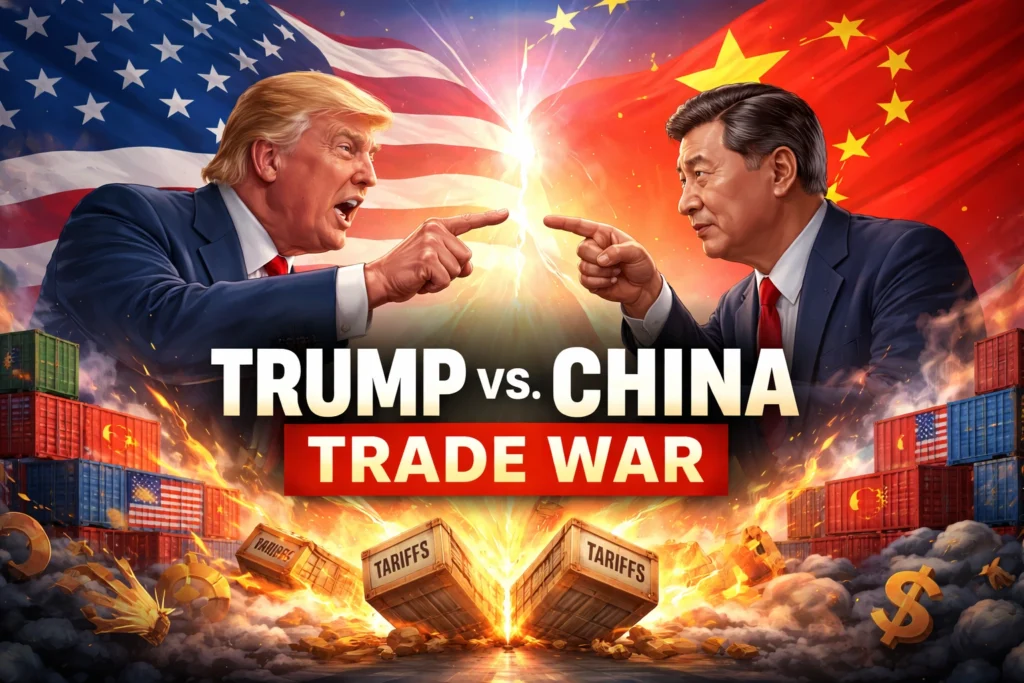
The trade war between the United States and China under Donald Trump reshaped global economics and geopolitics. It was not just a tariff battle; rather, it was a strategic confrontation over technology, manufacturing dominance, and economic power. As we move deeper into 2026, understanding this conflict’s timeline and future outlook is crucial for businesses, policymakers, and global investors.
This blog breaks down the complete timeline of the Trump–China trade war and analyzes what the future may hold for the US, China, and the global economy.
What Triggered the Trump–China Trade War?
The trade war officially began in 2018 when the Trump administration accused China of unfair trade practices, intellectual property theft, and forced technology transfers. Trump pushed the “America First” strategy aggressively. As a result, the United States imposed tariffs on billions of dollars worth of Chinese imports.
China responded immediately with retaliatory tariffs on US goods. Consequently, a full-scale trade war erupted, affecting global supply chains and investor confidence.
Trade War Timeline: Key Events That Shaped the Conflict
2017: Early Warnings and Investigations
In 2017, the Trump administration initiated investigations into China’s trade practices under Section 301 of the Trade Act. The administration argued that China’s policies harmed US companies and innovation. This investigation laid the groundwork for future tariffs.
2018: Tariffs Spark the Trade War
In March 2018, Trump imposed tariffs on steel and aluminum imports, targeting China heavily. Shortly after, the US announced tariffs on $50 billion worth of Chinese goods. China retaliated with tariffs on US agriculture, automobiles, and industrial products.
This escalation triggered volatility in global markets. Businesses began reconsidering supply chains, while investors worried about long-term economic consequences.
2019: Intensification and Technology War
In 2019, the conflict moved beyond tariffs into the technology sector. The US restricted Chinese tech giant Huawei from accessing American technology. Meanwhile, both countries increased tariffs on hundreds of billions of dollars in goods.
However, negotiations continued throughout the year. Although talks showed progress occasionally, tensions remained high. As a result, global trade slowed, and uncertainty dominated financial markets.
2020: Phase One Trade Deal
In January 2020, the United States and China signed the Phase One trade deal. China agreed to increase purchases of US goods, especially agricultural products. Additionally, China promised better protection for intellectual property rights.
Although the deal reduced tensions temporarily, structural issues remained unresolved. Therefore, the trade war did not truly end; instead, it entered a strategic pause.
2021–2024: Strategic Competition Continues
Even after Trump left office, the US maintained most tariffs on Chinese goods. This decision reflected bipartisan concerns about China’s economic influence. Moreover, tensions expanded into semiconductors, AI technology, and global supply chain control.
During these years, companies diversified manufacturing to India, Vietnam, and Mexico to reduce dependence on China. Consequently, global supply chains began shifting permanently.
Economic Impact of the Trump–China Trade War
Impact on the United States
The trade war produced mixed results for the US economy. On one hand, it encouraged domestic manufacturing and reduced reliance on Chinese imports. On the other hand, tariffs increased costs for American businesses and consumers.
Farmers suffered significantly due to Chinese retaliatory tariffs. Nevertheless, government subsidies helped offset some losses. Meanwhile, US tech companies faced restrictions in the Chinese market, affecting revenue growth.
Impact on China
China experienced slower export growth due to US tariffs. However, it responded strategically by strengthening domestic consumption and expanding trade partnerships across Asia and Europe.
China also accelerated its technological self-reliance strategy. As a result, it invested heavily in semiconductor manufacturing, artificial intelligence, and electric vehicle production.
Global Economic Consequences
The trade war disrupted global supply chains dramatically. Companies shifted production away from China to reduce risk. Countries like India and Vietnam benefited from this shift by attracting new manufacturing investments.
Furthermore, global markets faced repeated volatility due to tariff announcements and policy changes. Investors realized that geopolitical tensions now play a major role in economic decision-making.
How Trump’s Trade Policies Changed Global Trade Dynamics
Trump’s aggressive tariff strategy altered how nations view trade relationships. Previously, globalization dominated policy decisions. However, the trade war introduced the concept of economic nationalism.
Countries now prioritize supply chain security, local manufacturing, and strategic independence. Consequently, global trade has become more regionalized rather than purely globalized.
Moreover, the trade war exposed vulnerabilities in technology supply chains, especially in semiconductors. This realization pushed governments to invest heavily in domestic chip manufacturing.
Future Outlook: What Lies Ahead for US–China Trade Relations?
Continued Strategic Rivalry
Even in 2026, the US–China relationship remains competitive rather than cooperative. While full-scale tariff escalation may not return immediately, strategic competition in technology and defense will continue.
The United States aims to reduce reliance on Chinese manufacturing, especially in critical sectors like semiconductors and pharmaceuticals. Meanwhile, China seeks technological independence and global economic influence.
Technology War Will Intensify
The next phase of conflict will focus more on technology than tariffs. AI, 5G infrastructure, and semiconductor dominance will become central battlegrounds. Therefore, trade tensions will evolve into a broader technological rivalry.
This shift will shape global innovation ecosystems and determine future economic leadership.
Supply Chain Diversification Will Accelerate
Businesses have learned a crucial lesson from the trade war: overdependence on one country is risky. As a result, companies will continue diversifying manufacturing to countries like India, Mexico, and Southeast Asia.
This transformation will redefine global production networks for the next decade.
Potential for Limited Cooperation
Despite rivalry, limited cooperation between the US and China is still possible. Climate change, global health crises, and financial stability require collaboration. Therefore, both nations may maintain a balance between competition and selective cooperation.
Conclusion
The Trump–China trade war marked a turning point in global economic history. It started as a tariff dispute but evolved into a long-term strategic rivalry over technology, manufacturing, and geopolitical influence. The timeline reveals how quickly trade tensions can reshape global markets and policy decisions.
Looking ahead, the conflict will not disappear. Instead, it will transform into a deeper competition focused on innovation and supply chain dominance. Businesses, investors, and governments must adapt to this new reality where geopolitics directly impacts economic growth.
Ultimately, the Trump–China trade war has permanently changed global trade dynamics. Its legacy will continue influencing economic strategies and international relations for years to come.