|
Getting your Trinity Audio player ready...
|
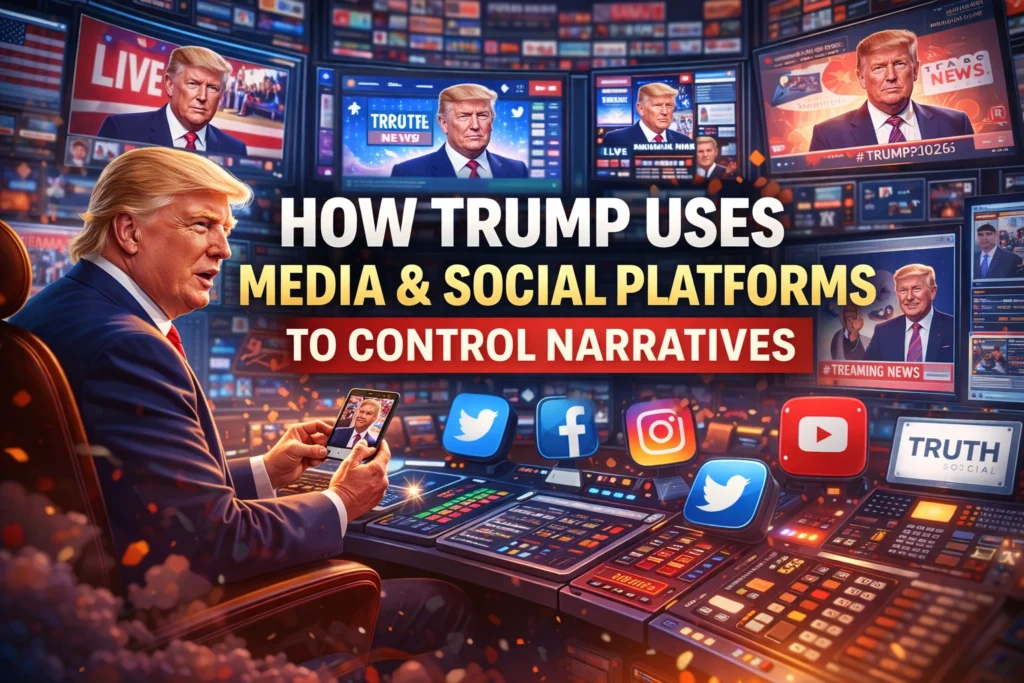
Donald Trump transformed modern political communication by aggressively leveraging media and social platforms to shape narratives. Unlike traditional politicians who relied heavily on press briefings and filtered interviews, Trump built a direct communication ecosystem that allowed him to speak straight to the public. As a result, he bypassed gatekeepers, dominated news cycles, and influenced public perception on a massive scale.
This blog explores how Trump uses media and social platforms to control narratives, why his strategy works, and what it means for politics in the digital era.
The Shift from Traditional Media to Direct Communication
For decades, politicians depended on television networks, newspapers, and official press conferences to reach audiences. However, Trump disrupted this model entirely. Instead of waiting for journalists to interpret his message, he delivered it directly through social platforms.
Consequently, he reduced reliance on mainstream media while increasing personal control over messaging. This shift allowed him to respond instantly to criticism, create headlines on demand, and shape how supporters interpreted political events.
Moreover, this direct communication style created a sense of authenticity among his followers. Many supporters believed they were hearing unfiltered opinions rather than scripted political statements.
Dominating the News Cycle Through Controversy
One of Trump’s most powerful narrative strategies involves dominating the news cycle consistently. He often makes bold, controversial, or emotionally charged statements that immediately attract media coverage. As a result, news channels and online platforms amplify his message, even when they criticize it.
This approach ensures that public attention remains focused on him rather than his political opponents. While critics argue that controversy damages credibility, Trump’s strategy proves the opposite. Controversial statements generate massive engagement, keeping him at the center of national and global conversations.
Additionally, constant media coverage creates a psychological effect: familiarity. When audiences repeatedly see the same figure in headlines, that figure becomes the dominant voice in public discourse.
Strategic Use of Social Media Platforms
Trump’s use of social platforms has been revolutionary in political communication. He understands that social media operates on speed, emotion, and repetition. Therefore, he crafts messages that are short, impactful, and easily shareable.
1. Speed and Instant Reactions
Trump responds to breaking news almost instantly through social posts. This speed allows him to frame narratives before opponents or journalists can present alternative perspectives. Consequently, his version of events often becomes the initial narrative that audiences consume.
2. Emotional Messaging
Rather than using complex policy language, Trump relies on emotionally driven messaging. Words like “strong,” “disaster,” “great,” or “unfair” create strong emotional reactions. Emotional content spreads faster on social platforms, increasing reach and engagement.
3. Repetition for Narrative Reinforcement
Repetition is another key tactic. Trump frequently repeats the same phrases and slogans across multiple posts and speeches. This repetition reinforces core narratives and ensures they remain memorable for supporters.
Building a Loyal Digital Support Base
Trump’s communication strategy does not target everyone equally. Instead, it focuses on energizing a loyal base that actively shares, defends, and amplifies his messages online. This strategy turns supporters into digital advocates who spread narratives organically.
Furthermore, this loyal base acts as a protective shield. Whenever criticism arises, supporters counter it aggressively across social platforms, ensuring that alternative narratives gain traction.
As a result, Trump does not rely solely on official communication channels. Instead, he leverages a decentralized network of supporters who function as narrative multipliers.
Framing the Media as an Opponent
Another powerful tactic involves framing mainstream media as biased or hostile. By positioning traditional media as an adversary, Trump encourages supporters to distrust critical coverage. Consequently, followers rely more on his direct statements than on journalistic interpretations.
This strategy shifts the credibility battle. Instead of defending every controversial claim, Trump reframes the discussion by questioning the legitimacy of the media itself. Therefore, criticism often strengthens loyalty rather than weakening it.
Moreover, this approach creates a clear “us vs them” narrative. Supporters feel they are part of a movement challenging powerful institutions, which deepens emotional investment.
Visual Media and Branding Strategy
Trump also understands the power of visuals in controlling narratives. His rallies, press events, and campaign videos are designed to create strong visual impressions. Large crowds, patriotic symbols, and bold slogans reinforce themes of strength and national pride.
These visuals spread widely across television and social platforms, shaping public perception even among those who do not follow politics closely. Consequently, visual branding becomes a crucial narrative tool alongside written messaging.
Algorithm Advantage: How Platforms Amplify His Reach
Social media algorithms reward content that generates high engagement. Since Trump’s posts often provoke strong reactions, they naturally receive more likes, shares, and comments. This engagement signals algorithms to push the content to wider audiences.
Therefore, even critics contribute indirectly to amplifying his narrative. Negative reactions still increase engagement metrics, which expands reach further. This dynamic gives Trump a structural advantage in digital communication.
Impact on Political Communication Worldwide
Trump’s media strategy has influenced political leaders globally. Many politicians now use direct social communication, emotional messaging, and rapid-response tactics to shape narratives. As a result, the global political landscape has shifted toward more personalized and media-driven leadership styles.
Additionally, political campaigns increasingly prioritize digital dominance over traditional advertising. Controlling the narrative online has become as important as policy debates or campaign speeches.
Criticism and Ethical Concerns
Despite its effectiveness, Trump’s narrative control strategy faces significant criticism. Opponents argue that emotionally charged messaging oversimplifies complex policy issues. Furthermore, critics claim that constant confrontation with media institutions increases polarization within society.
However, from a strategic perspective, these criticisms often reinforce the narrative framework he promotes. Supporters view criticism as proof that he challenges established power structures, which strengthens loyalty.
Future of Narrative Control in the Digital Age
Looking ahead, narrative control will remain a central element of political strategy. As social platforms evolve, leaders will continue using real-time communication, viral messaging, and visual branding to influence public opinion.
Trump’s approach demonstrates that controlling the narrative is no longer about delivering the most detailed policy explanation. Instead, it is about framing the conversation, setting emotional tone, and maintaining constant visibility across digital platforms.
Conclusion
Donald Trump’s use of media and social platforms represents a fundamental shift in political communication. By bypassing traditional gatekeepers, dominating news cycles, leveraging emotional messaging, and building a loyal digital base, he has created a powerful narrative control system.
This strategy proves that in the modern digital era, perception often shapes reality. Leaders who control the narrative control the conversation, and those who control the conversation influence public opinion. Trump’s media playbook will likely shape political communication strategies for years to come, making it one of the most influential developments in contemporary politics.