|
Getting your Trinity Audio player ready...
|
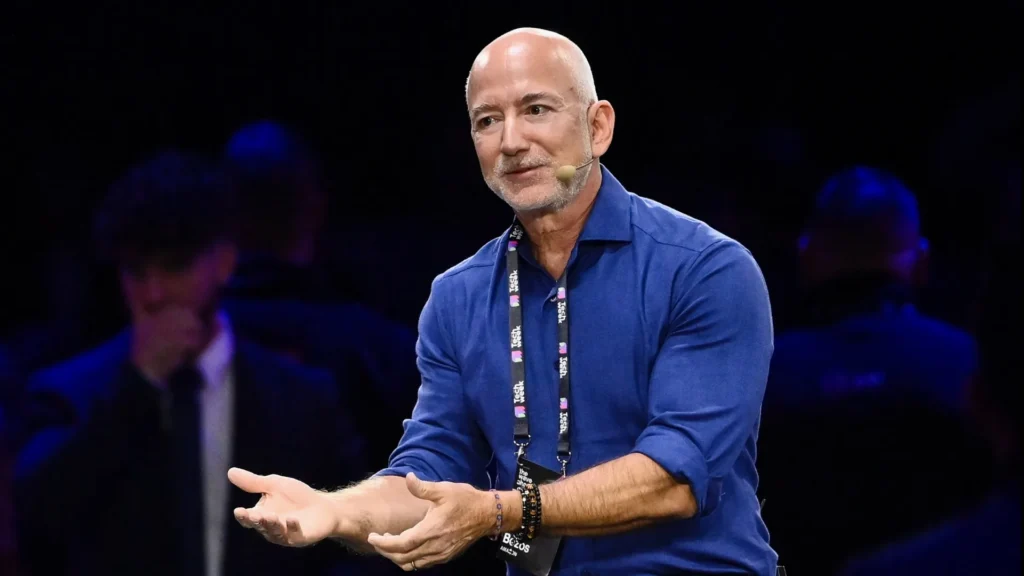
At the recent Italian Tech Week in Turin, Amazon founder Jeff Bezos made a rare public appearance and delivered a set of audacious predictions about humanity’s future. He believes that within a few decades, millions of people will live in space by choice. Robots will handle heavy labor while humans focus on creativity and innovation.
Bezos also envisions a future where massive AI data centers will operate in orbit — powered by endless solar energy, free from weather constraints, and with minimal cooling needs. He called the current AI investment surge a “good industrial bubble,” suggesting it’s driving genuine progress rather than speculative hype.
Why Bezos’s Vision Is More Than Just Science Fiction
Unlike earlier dreams of colonizing Mars or building moon bases, Bezos’s plan centers on orbital living — massive space habitats rotating to provide artificial gravity and livable conditions.
The idea is that space won’t just be a destination for explorers but a permanent home for everyday people. His concept rests on three key pillars:
- Space Habitats at Scale
Future generations might choose to live in orbit for better views, reduced gravity, or simply for lifestyle appeal. - Automation and Robotics
Robots will become the core workforce for construction, maintenance, and logistics in space, freeing humans for higher-level creative and strategic work. - Orbital AI Infrastructure
AI data centers in space could outperform those on Earth, with limitless solar power, no cooling challenges, and constant operation. Bezos predicts these could become economically viable within a few decades.
The Challenges Ahead
While Bezos’s optimism is inspiring, the path to this future is filled with massive engineering, financial, and social challenges.
| Challenge | Why It’s Difficult | Possible Solutions |
|---|---|---|
| Launch Costs | Sending materials to orbit is extremely expensive. | Reusable rockets, in-space manufacturing, lightweight materials. |
| Life Support | Space radiation and closed-loop ecosystems are complex. | Better shielding, bio-regenerative systems, artificial gravity. |
| Energy & Cooling | Space still has extreme temperature fluctuations. | Smart radiators, advanced thermal systems, improved energy storage. |
| Data Latency | Communication between space and Earth has lag. | Laser communication, hybrid Earth-space computing. |
| Regulations | No clear governance for orbital habitats. | New space treaties and international partnerships. |
Bezos’s timeline — within decades — is bold but not impossible. Incremental steps, like smaller space stations or orbital test platforms, will likely come first.
The Opportunities This Future Unlocks
For Tech Companies and Startups
- Develop robotic systems for in-orbit construction and maintenance.
- Innovate in hybrid computing models that blend Earth-based and space-based AI.
- Create materials and 3D printing technologies suited for zero gravity.
- Shape global standards for orbital operations and safety.
For Governments and Policy Makers
- Prepare for competition over orbital zones, resources, and energy platforms.
- Build alliances for shared space infrastructure and governance.
- Incentivize private sector collaboration for cost-sharing and innovation.
For Content Creators and SEO Professionals
The fascination with “space living” and “AI in orbit” will become major search and storytelling themes. Creating educational content, visuals, and blogs on these topics can position you ahead in the SEO curve.
From a marketing and digital strategy perspective, early adopters who build niche authority around “space tech” or “future AI infrastructure” could dominate future search traffic as public curiosity skyrockets.
A Realistic Timeline
- By 2035: First operational small-scale orbital data center.
- By 2050: Thousands living in space for research or tourism.
- By 2080: Potentially millions living in orbital habitats or lunar colonies.
Bezos’s statements are less about predicting a fantasy and more about challenging humanity to think bigger. Space will not just be a destination — it could become our next economy, our next cityscape, and our next home.
Final Thoughts
Jeff Bezos’s bold declaration represents more than just a billionaire’s dream — it’s a vision of evolution. From e-commerce to space commerce, he’s pushing humanity to think beyond Earth as the only frontier.
The road will be long, expensive, and uncertain, but if even a fraction of this future materializes, it could redefine how we live, work, and connect across the solar system.