|
Getting your Trinity Audio player ready...
|
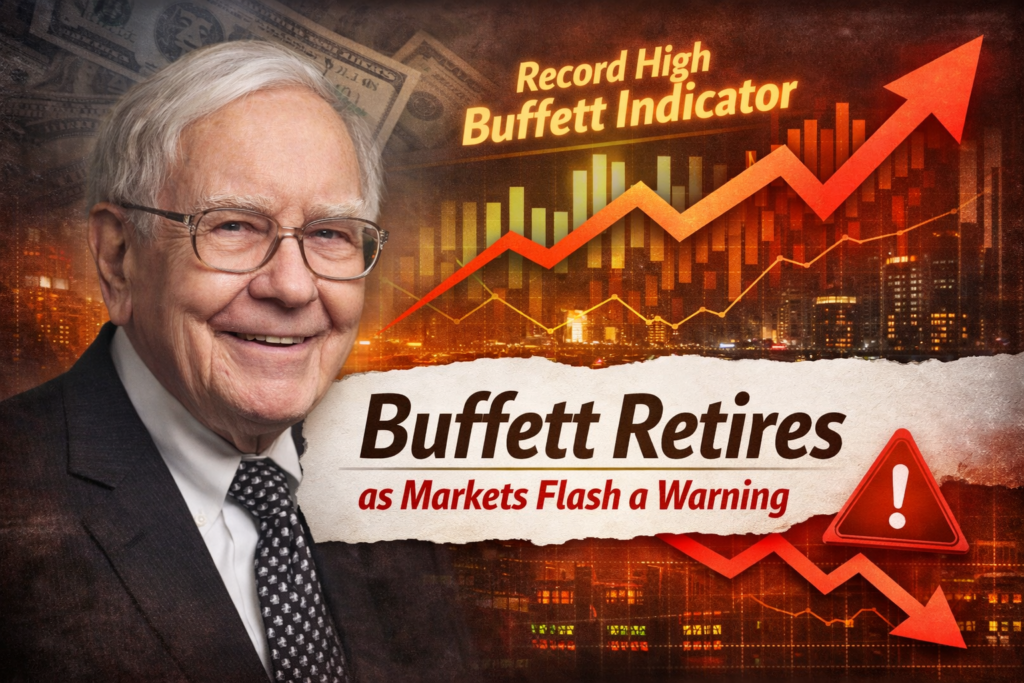
The global investment world witnessed a historic moment as Warren Buffett officially retired, bringing an extraordinary six-decade journey to a close. His exit is not just about a legendary investor stepping aside; instead, it coincides with a powerful market signal. At the very moment Buffett retires, the Buffett Indicator has climbed to its highest level ever, sending a clear message to investors worldwide.
This rare alignment has sparked intense debate. On one side, markets remain confident and optimistic. On the other, valuation indicators suggest caution. Therefore, understanding this moment is critical for anyone tracking global markets in 2026 and beyond.
The End of a Legendary Era
Warren Buffett transformed Berkshire Hathaway from a struggling textile company into one of the most respected conglomerates in the world. Over the years, he proved that patience, discipline, and long-term thinking can outperform hype-driven investing.
Moreover, Buffett consistently avoided speculation. He focused on businesses with strong fundamentals, stable cash flows, and honest leadership. As a result, his investment philosophy shaped generations of investors and became a benchmark for financial wisdom.
Now, as Buffett steps down, leadership transitions to Greg Abel. Although this succession has been planned for years, the emotional and symbolic impact of Buffett’s retirement remains massive. Investors are not just losing a CEO; they are losing a guiding voice of restraint in overheated markets.
Understanding the Buffett Indicator
To grasp why this moment matters, one must understand the Buffett Indicator. Simply put, this indicator compares the total value of the stock market to the overall size of the economy.
When the ratio stays low, markets appear reasonably valued. However, when it rises sharply, it suggests stocks may be priced far above real economic output. Over time, Buffett himself described this metric as one of the best ways to measure long-term market valuation.
Currently, the indicator sits at a record high. This does not automatically predict a crash. Nevertheless, it clearly signals that optimism has outpaced fundamentals.
Why the Record High Matters Now
Historically, extremely high readings of the Buffett Indicator have appeared before periods of lower market returns. Therefore, today’s levels raise serious questions.
First, stock prices have surged faster than economic growth. Meanwhile, liquidity, global capital flows, and enthusiasm around technology and artificial intelligence have pushed valuations even higher.
Second, investors increasingly rely on future growth assumptions rather than present earnings. While innovation supports long-term expansion, excessive optimism leaves markets vulnerable to shocks.
Finally, when valuation gaps grow this wide, even small disappointments can trigger volatility. Hence, the indicator serves as a warning—not a prediction, but a reality check.
Warren Buffett: Key Career Timeline
Warren Buffett began his legendary investing journey long before he became a global icon. Below are the most important milestones that defined his career and legacy:
Early Life & Education
- Born: August 30, 1930 – Omaha, Nebraska
- First stock purchase: 1942 (at age 11)
- Graduated from University of Nebraska: 1950
- Completed MBA at Columbia Business School: 1951
(Studied under Benjamin Graham, the father of value investing)
Career & Berkshire Hathaway Milestones
- 1956: Founded Buffett Partnership Ltd.
- 1965: Took control of Berkshire Hathaway
(This marks his official joining and leadership start) - 1970: Became Chairman and CEO of Berkshire Hathaway
- 1980s–1990s: Built Berkshire into a diversified global conglomerate
- 2010: Berkshire Hathaway crossed $100 billion market value
- 2020: Berkshire market cap crossed $500 billion
- 2023–2024: Reduced exposure to overvalued equities, increased cash holdings
Retirement & Succession
- Retirement announced: 2025
- Official retirement date: December 31, 2025
- Successor: Greg Abel takes over as CEO from January 1, 2026
Legacy Highlights
- Tenure as CEO: ~60 years
- Average annual return at Berkshire: ~20%
- Known for: Long-term value investing, discipline, patience, and capital preservation
- Famous metric: The Buffett Indicator (Total Market Cap vs GDP)
Buffett’s Philosophy vs. Today’s Market
Buffett’s investing style sharply contrasts with current market behavior. He believed in buying strong businesses at fair prices, not average businesses at inflated prices. Yet today, markets reward speed, narratives, and short-term momentum.
Additionally, retail participation and algorithmic trading amplify trends. This environment pushes prices upward faster than fundamentals can follow. Consequently, valuations stretch further with each rally.
Buffett often reminded investors that markets transfer money from the impatient to the patient. Ironically, his retirement comes at a time when patience seems increasingly rare.
What This Means for Investors
For investors, this moment demands clarity. While markets may continue rising in the short term, history suggests future returns may moderate when valuations remain extreme.
Therefore, investors should reassess risk exposure. Diversification, quality focus, and disciplined allocation matter more now than during easy bull runs. Instead of chasing hype, focusing on durable businesses and sustainable earnings becomes essential.
Furthermore, long-term investors must reset expectations. Markets may still deliver gains, but they may arrive with higher volatility and lower average returns.
The Psychological Shift After Buffett
Beyond numbers, Buffett’s retirement represents a psychological shift. For decades, his annual letters and calm insights provided reassurance during crises. Without his presence, market sentiment may swing more sharply between fear and greed.
However, his principles remain relevant. Margin of safety, rational decision-making, and long-term conviction still outperform emotional investing. Investors who internalize these lessons may navigate future cycles more successfully.
Looking Ahead to 2026 and Beyond
As markets enter 2026, uncertainty dominates. Economic growth continues, yet geopolitical risks, interest rate dynamics, and valuation pressures remain unresolved.
The record-high Buffett Indicator does not demand panic. Instead, it calls for preparedness. Smart investors adapt rather than react. They recognize cycles, respect valuations, and remain flexible.
At the same time, leadership change at Berkshire Hathaway symbolizes continuity rather than disruption. The company remains strong, diversified, and disciplined. Yet Buffett’s absence highlights the importance of independent judgment in modern investing.
Conclusion
Warren Buffett’s retirement marks the end of an era, but it also arrives with a powerful signal. With the Buffett Indicator at unprecedented levels, markets are clearly priced for perfection.
Therefore, investors must act thoughtfully. Blind optimism can be costly, while informed patience can be rewarding. Buffett may have stepped away from daily leadership, but his greatest lesson still stands strong:
When valuations stretch too far, wisdom lies not in excitement—but in discipline.