|
Getting your Trinity Audio player ready...
|
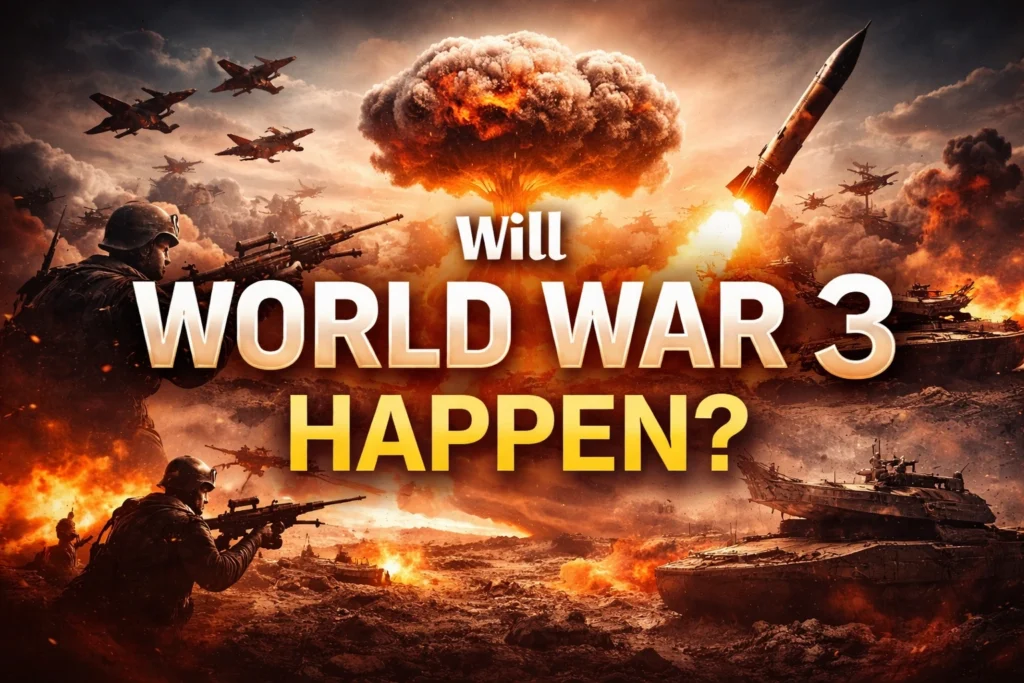
The question “Will World War 3 happen?” keeps resurfacing whenever global tensions spike — whether due to regional wars, military alliances, nuclear threats, or geopolitical rivalries. With ongoing conflicts, military buildups, and rising nationalism across several regions, many people feel the world is drifting toward a larger confrontation.
But the reality is more complex. A global war is not impossible, yet it is also not inevitable. Understanding the likelihood of World War 3 requires a clear look at power politics, military deterrence, economic interdependence, and the evolving nature of modern warfare.
Let’s break this down honestly and strategically.
- The Current Global Climate: Why WW3 Is Being Discussed Again
The Current Global Climate: Why WW3 Is Being Discussed Again
Several factors are fueling renewed fears of a global war:
- Rising tensions between major powers
- Regional conflicts involving global alliances
- Expanding military budgets worldwide
- Cyber warfare and technological arms races
- Increasing geopolitical polarization
Unlike past eras, today’s conflicts are not isolated. A regional clash can quickly pull in multiple nations due to defense treaties, economic ties, and strategic interests. This interconnected environment makes the risk of escalation more serious than before.
However, fear alone doesn’t equal inevitability.
The Biggest Deterrent: Nuclear Weapons
The strongest reason why World War 3 has not happened — and may still not happen — is nuclear deterrence.
Major powers possess nuclear arsenals capable of catastrophic destruction. Any direct large-scale war between nuclear states would risk mutually assured destruction, meaning no side would truly “win.” This harsh reality forces even hostile nations to act cautiously.
In simple terms:
Countries may threaten, compete, and confront — but they also know the cost of full-scale war is unimaginable.
This deterrence has kept global wars from erupting since 1945, despite numerous crises and confrontations.
Modern Wars Are No Longer Traditional Wars
Another major shift is the nature of warfare itself. A future global conflict is unlikely to look like World War I or World War II. Instead, modern wars are fought through:
- Cyber attacks on infrastructure
- Economic sanctions and trade restrictions
- Proxy wars through allied groups
- Intelligence and surveillance battles
- Information and psychological warfare
These “grey-zone conflicts” allow nations to weaken rivals without triggering a full global war. In many ways, elements of global competition are already happening — just not through traditional battlefield invasions between major powers.
So the world may already be in a form of indirect global rivalry, not a declared world war.
Flashpoints That Could Trigger Escalation
While a direct world war remains unlikely, certain flashpoints could escalate tensions if mismanaged:
1. Regional Wars Expanding
A localized conflict involving allied nations could spiral if multiple global powers intervene simultaneously.
2. Miscalculation Between Major Powers
History shows wars often start not by intention but by miscalculation, miscommunication, or accidental escalation.
3. Cyber Warfare Turning Physical
A major cyber attack on critical infrastructure could provoke military retaliation, pushing conflicts into physical confrontation.
4. Strategic Rivalry Between Superpowers
Competition for technological dominance, military influence, and global leadership is intensifying, creating long-term friction.
These risks are real — and ignoring them would be naive.
Why a Full World War Is Still Unlikely (For Now)
Despite rising tensions, several stabilizing factors reduce the chances of World War 3:
Economic Interdependence
Global economies are deeply connected. A large-scale war would devastate trade, supply chains, and financial markets worldwide. Even rival nations rely on each other economically, making total war self-destructive.
Diplomatic Frameworks and Alliances
International institutions, treaties, and diplomatic channels still play a key role in crisis management. Even during tense moments, negotiations often continue behind the scenes.
War Fatigue and Public Pressure
Modern societies are far less tolerant of prolonged global wars compared to the early 20th century. Public opinion, media scrutiny, and humanitarian concerns create pressure on governments to avoid catastrophic escalation.
The Harsh Reality: The Risk Is Low, But Not Zero
Let’s be clear and honest:
World War 3 is not inevitable — but it is not impossible either.
History proves that large wars often begin when leaders underestimate consequences or believe escalation will remain limited. The danger lies not in deliberate global war planning, but in unintended escalation from regional conflicts or strategic misjudgments.
That is the real risk in the modern world.
If WW3 Happens, It Won’t Look Like Past Wars
If a global conflict were to occur, it would likely be:
- Multi-domain (cyber, space, economic, and military)
- Technology-driven (AI, drones, cyber weapons)
- Rapid and highly destructive
- Less about territorial conquest, more about strategic dominance
This means the next world war, if it ever occurs, would be shorter in duration but far more intense in impact than previous global conflicts.
Conclusion
So, will World War 3 happen?
The honest answer is: not likely in the near future — but the possibility can never be fully dismissed. The world today operates on a fragile balance where competition, conflict, and cooperation coexist simultaneously.
Major powers are cautious because they understand the catastrophic consequences of direct global war. Yet rising geopolitical rivalries, technological warfare, and regional conflicts ensure that tensions remain high.
The future will depend not just on military strength, but on diplomacy, strategic restraint, and global cooperation. If those fail, escalation risks increase. If they hold, the world may continue navigating conflicts without crossing the line into a full-scale world war.
The situation is tense, dynamic, and constantly evolving — and that is exactly why the question continues to matter.
Also Read: Trump Deal Will End U.S. Government