|
Getting your Trinity Audio player ready...
|
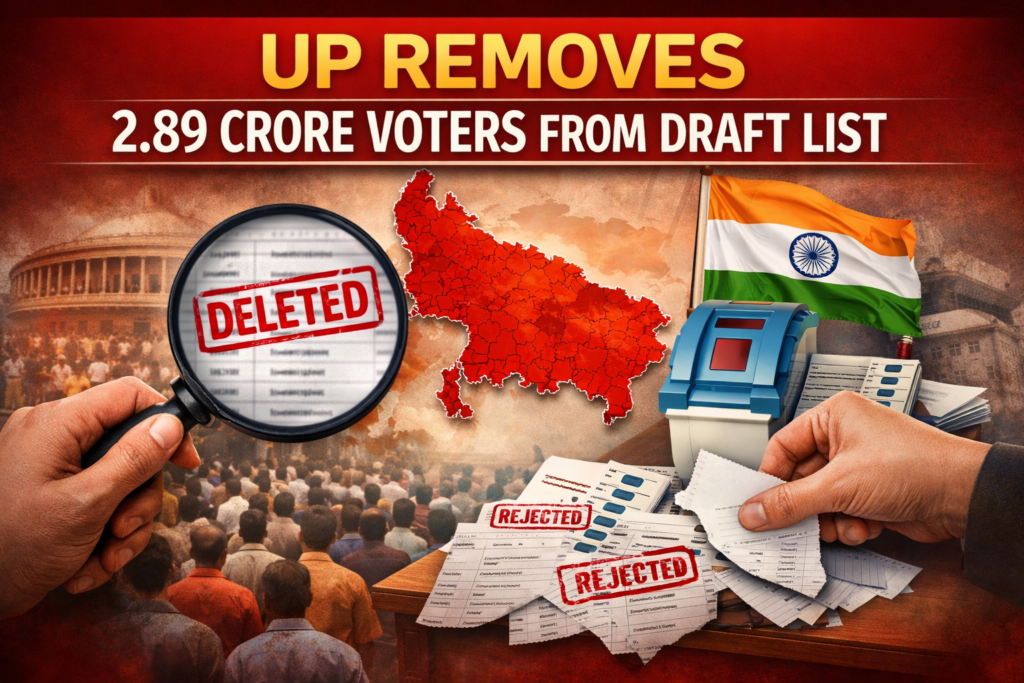
Uttar Pradesh has triggered a nationwide debate after a massive cleanup of its electoral rolls. Following the Special Intensive Revision (SIR) exercise, authorities removed 2.89 crore voter names from the draft electoral list. This move stands as one of the largest voter list revisions ever conducted in the state.
While officials describe the exercise as a routine administrative correction, the scale of deletions has raised serious questions among citizens and political observers. With elections always around the corner in India, voter list accuracy directly impacts democracy itself.
What Is the Special Intensive Revision (SIR)?

The Election Commission conducts Special Intensive Revisions periodically to clean voter databases. The goal is simple but critical:
- Remove deceased voters
- Delete duplicate entries
- Update addresses of migrated citizens
- Eliminate non-traceable or inactive voters
Unlike routine revisions, SIR involves door-to-door verification, physical forms, and detailed cross-checking. In Uttar Pradesh, officials carried out this exercise across urban and rural regions over several months.
Breaking Down the Numbers
The final draft data reveals how massive this exercise truly was:
- 2.89 crore voter names removed from the draft roll
- 46.23 lakh voters marked as deceased
- Over 2 crore voters removed due to migration, duplication, or non-response
- Around 12.55 crore names retained, accounting for more than 80% of the total electorate
This means nearly one out of every five registered voters saw their name removed at the draft stage.
Why Were So Many Names Deleted?
Several factors contributed to this unusually high number:
1. Death Records Catch-Up
Many voter records had not been updated for years. As a result, names of deceased individuals remained on the rolls. The revision finally synchronized electoral data with official death records.
2. Migration at Scale
Uttar Pradesh witnesses large-scale migration for employment and education. Many voters relocate permanently but never update their voter details, leading to removals during verification.
3. Duplicate Registrations
Multiple registrations under the same name or voter ID surfaced during cross-checking. Authorities removed these duplicates to prevent electoral misuse.
4. Non-Traceable Voters
Enumerators marked several voters as untraceable when households remained locked or residents failed to respond despite repeated visits.
Public Reaction and Political Concerns
Although the Election Commission insists the process is neutral and technical, the political response has been intense.
Opposition parties argue that such large deletions could unintentionally disenfranchise eligible voters, especially migrant workers, urban renters, and marginalized communities. Meanwhile, the administration maintains that the draft list is not final and exists precisely to allow corrections.
This tension highlights a long-standing challenge in Indian elections—balancing accuracy with inclusivity.
What Voters Must Do Right Now
If you are a voter in Uttar Pradesh, this phase is crucial.
Check Your Name
Citizens must verify their names in the draft electoral roll immediately.
File Claims or Objections
If your name is missing, wrongly deleted, or incorrectly marked as deceased, you can submit a claim or objection during the designated correction window.
Correction Timeline
- Claims and objections remain open until February 6, 2026
- Authorities will verify submissions before releasing the final roll
Failing to act now could mean losing your voting rights in upcoming elections.
How Corrections Work
Voters can:
- Apply for re-inclusion
- Correct personal details
- Object to wrongful deletion
- Update address or constituency
Supporting documents such as identity proof, address proof, or death certificates (in case of corrections) may be required.
When Will the Final Voter List Be Released?
After reviewing all claims and objections, the Election Commission will publish the final electoral roll on March 6, 2026.
This finalized list will determine who can vote in future state and national elections.
Similar Special Intensive Revision (SIR) efforts in other states have also led to large removals from draft electoral rolls. For example, in Gujarat, authorities removed nearly 74 lakh voter names during the SIR process as part of a comprehensive roll cleanup ahead of elections.
Why This Matters Beyond Uttar Pradesh
Uttar Pradesh has the largest electorate in India. Any large-scale revision here sets a precedent for other states.
This exercise signals three major realities:
- Outdated voter databases are a national problem
- Digital records alone are insufficient without ground verification
- Citizens must actively maintain their voter status
Democracy does not function on autopilot. It demands constant updating, participation, and accountability—from both institutions and voters.
Final Thoughts
The removal of 2.89 crore voters from Uttar Pradesh’s draft electoral roll is not just an administrative headline—it is a democratic stress test.
If managed transparently, this revision can strengthen electoral integrity. However, if genuine voters fail to act in time, the cost could be silent disenfranchisement.
The message is clear:
Your vote exists only if your name exists on the roll.
Check it. Correct it. Protect it.