|
Getting your Trinity Audio player ready...
|
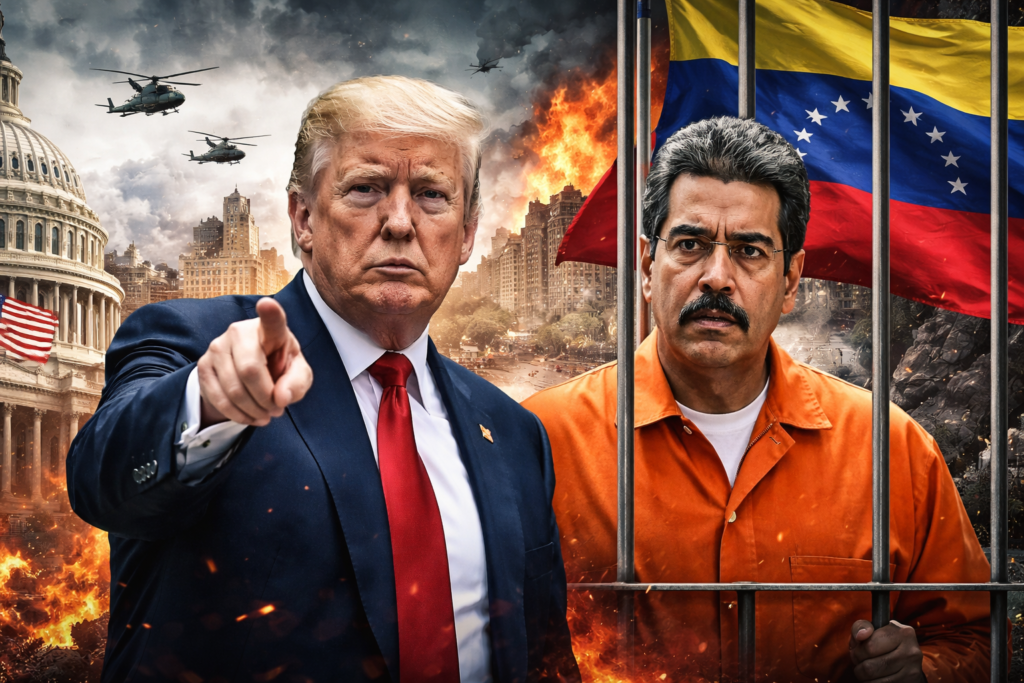
In early January 2026, the global political landscape shifted dramatically after the United States took custody of Venezuelan President Nicolás Maduro, postponed Venezuela’s elections, and initiated a high-profile criminal trial on American soil. These developments are not isolated events. Together, they represent a major recalibration of power, sovereignty, and international law.
This moment has forced governments, legal experts, and global institutions to confront uncomfortable questions about democracy, intervention, and who truly controls political outcomes in fragile states.
Maduro’s Capture and Transfer to the United States
To begin with, U.S. authorities confirmed that American forces detained Nicolás Maduro and transferred him to the United States to face charges related to narco-terrorism and international drug trafficking. The U.S. administration described the operation as a law-enforcement action, not a military intervention.
However, Maduro rejected this claim outright. Instead, he declared himself a political prisoner and accused Washington of violating Venezuela’s sovereignty. Consequently, reactions across Latin America intensified. Some governments condemned the move as unlawful interference, while others quietly supported it, citing years of repression and economic collapse under Maduro’s rule.
Trump’s Decision to Delay Venezuelan Elections
Soon after Maduro’s detention, President Donald Trump announced that Venezuela would not hold immediate elections. According to the U.S. administration, the country currently lacks the security, institutional stability, and political neutrality required for a free and fair vote.
Moreover, Trump argued that rushing elections would worsen instability rather than restore democracy. Supporters of this approach believe stabilization must come first. On the other hand, critics warn that delaying elections risks undermining democratic legitimacy and could entrench foreign influence over Venezuela’s political future.
A Growing Power Vacuum Inside Venezuela
Meanwhile, Venezuela entered a fragile transition phase. With Maduro removed, interim leadership assumed control amid heightened security measures and widespread uncertainty. Reports indicated tighter restrictions on protests and media activity as authorities attempted to prevent unrest.
As a result, public confidence weakened further. While some citizens welcomed the possibility of political change, others feared prolonged instability. At the same time, the absence of a clear election timeline deepened concerns about who truly governs the country and for how long.
The Unprecedented Trial in the United States
At the center of this crisis lies Maduro’s trial in a U.S. federal court. The case itself is historic. Never before has a current or recently removed national leader faced criminal prosecution in the United States on such serious charges.
More importantly, the trial challenges long-standing interpretations of sovereign immunity. If the court proceeds without limitations, it could establish a precedent allowing foreign leaders to be prosecuted abroad for actions taken while in office. Therefore, legal experts worldwide are closely monitoring every development.
International Reaction and Legal Debate
Predictably, the global response has been sharply divided. Several nations condemned the U.S. action as a breach of international law, while others framed it as long-overdue accountability. In response to growing tensions, the United Nations held emergency discussions to assess the legality and consequences of the situation.
At the same time, international law scholars debated whether the operation violated principles of territorial integrity and non-intervention. These debates highlight a deeper issue: existing global rules struggle to keep pace with modern power dynamics.
Political Division Within the United States
Domestically, the episode triggered intense debate in Washington. Critics accused the administration of bypassing congressional authority and stretching executive power beyond constitutional limits. They argued that labeling the operation as law enforcement does not eliminate its military nature.
Conversely, supporters defended the move as a necessary response to transnational crime and regional instability. They insisted that decisive action strengthens global security and deters future authoritarian behavior.
Oil, Strategy, and Economic Interests
Beyond politics and law, economic interests play a crucial role. Venezuela holds one of the world’s largest oil reserves, and restoring its energy sector remains central to any recovery plan. The U.S. administration signaled its intention to stabilize oil production as part of broader reconstruction efforts.
Nevertheless, this stance fueled criticism. Opponents argue that economic motivations overshadow democratic values. Supporters counter that without economic recovery, political reform will fail.
Why This Crisis Matters to the World
Ultimately, this episode marks a turning point in international relations:
- A national leader has been detained and tried abroad
- Elections have been delayed under foreign influence
- Sovereignty and democratic norms face direct challenge
- International law confronts unprecedented stress
Going forward, the outcome in Venezuela will influence how nations interpret accountability, intervention, and democratic restoration. Whether history views this moment as justified action or dangerous overreach depends entirely on what follows.
What remains clear is this: the balance between power and principle has shifted, and the consequences will extend far beyond Venezuela.