
|
Getting your Trinity Audio player ready...
|
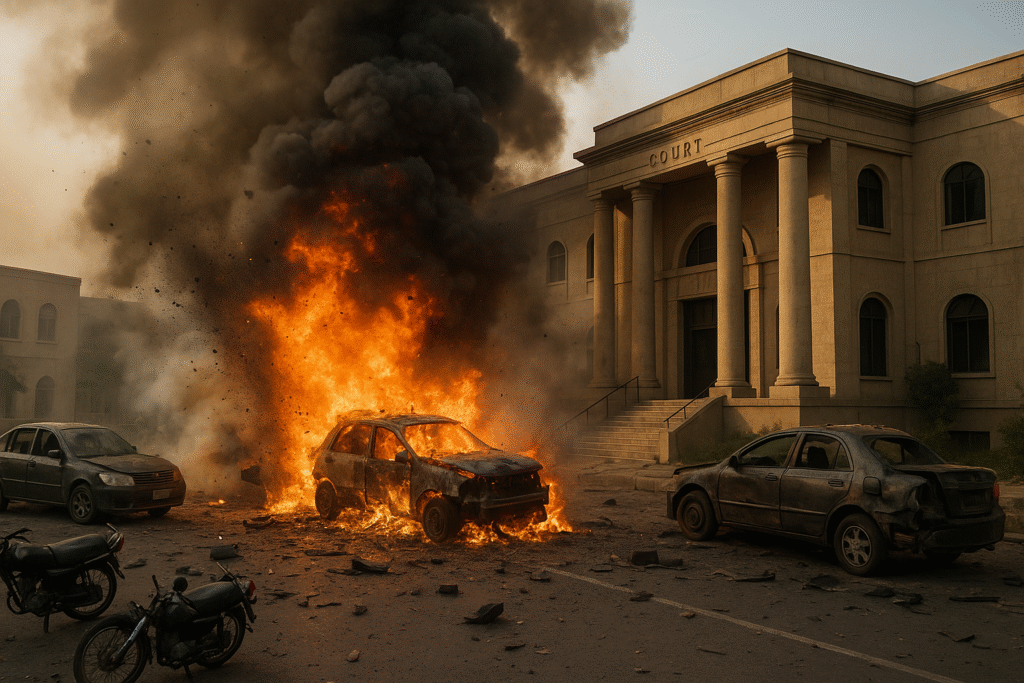
A powerful explosion outside the District and Sessions Court in Islamabad’s G-11 sector has once again dragged Pakistan’s security vulnerabilities into the spotlight. What unfolded was not just another “incident” — it was a calculated strike in the heart of the capital, a few steps away from the country’s legal establishment.
At least a dozen people have lost their lives so far, with over twenty reported injured. The casualty numbers are still shifting because several victims remain in critical condition. The blast was intense enough to engulf vehicles, scatter debris across the court vicinity, and send smoke towering above the city’s skyline. The shockwave was felt in nearby commercial and residential blocks as panic gripped the area.
What Actually Happened?
According to initial investigative details, a vehicle rigged with explosives was positioned near the entrance of the court complex. Eyewitnesses claimed they saw the car standing idle moments before the explosion. Security officials at the site recovered body parts believed to belong to the attacker, leading authorities to treat the case as a suicide bombing.
CCTV footage and preliminary testimony reveal that the attacker may have been trying to infiltrate the court premises. When unable to do so — likely due to layered entry checks — the individual appears to have changed the target on the spot, approaching a nearby police patrol vehicle before detonating.
The explosion instantly triggered chaos — burning cars, shattered windows, dust clouds, screams and frantic evacuations. Emergency responders rushed the injured to Pakistan Institute of Medical Sciences, where several remain under close observation.
Why This Location Matters
This was not an attack in a remote border village or an isolated district — this was Islamabad, the capital. And not just any part of the capital, but near a judicial hub that symbolizes state structure, law and governance.
Targeting a court directly challenges the authority of the judiciary and the state’s enforcement capability. It sends a very deliberate message: “We can reach you anywhere.”
When the capital becomes a theatre of attack, the psychological impact multiplies. Public confidence weakens. The perception of safety collapses. And political pressure on the government explodes.
The Deeper Problem: A Pattern, Not an Exception
Pakistan has seen phases of militant violence over decades, but blasts in Islamabad are comparatively rare in recent years. That is exactly why this attack stands out.
It suggests one of the following:
- Militant networks have regained organizational capability.
- Security surveillance gaps have widened.
- Intelligence warnings were missed or underestimated.
- The attacker’s support pipeline was active inside urban circles.
Any one of these is alarming. Combined, they represent a national threat landscape shifting in the wrong direction.
And this is not happening in isolation. Rising militancy in Khyber Pakhtunkhwa, cross-border infiltration routes, radical ideological recruitment and inconsistent counter-terror strategies all contribute to a system under stress.
Immediate Aftermath and Response
- The blast site has been sealed for forensic analysis.
- Security has been escalated across Islamabad’s critical points, courts, police stations and government offices.
- Investigators are tracing how the vehicle reached the capital and whether it was assembled locally or transported from outside.
- Several agencies are jointly reviewing CCTV networks, phone records and movement logs to identify planner and handlers.
But reactionary security is never enough. Pakistan has already been in this cycle: blast → response → temporary calm → repeat.
This cycle must break — or the next attack will just be a matter of time and place.
Political and Social Implications
This blast will ripple through Pakistan’s political narrative in multiple directions:
- Parliament will be under pressure to defend the government’s national security strategy.
- Opposition voices will weaponize the incident to accuse leadership of incompetence.
- Public trust in law enforcement will suffer, especially in urban centers.
- International observers will re-evaluate travel advisories and diplomatic risk ratings.
If Pakistan does not firmly shift its counter-terror posture, the consequences will not remain domestic — they will spill into regional and diplomatic spheres.
A Critical Weakness: Predictable Security Patterns
One of the most consistent criticisms of Pakistan’s security planning is its predictability.
- Checkpoints remain in the same locations.
- Court entrances have the same routines.
- Arrests often come after attacks, not before.
- Intelligence agencies frequently operate in silos rather than integrated command frames.
Attackers study routines. They exploit repetition. They adapt faster than bureaucratic government structures.
Unless Pakistan modernizes intelligence coordination, predictive threat analysis and rapid action response, incidents like this will continue.
What Needs to Happen Next
1. Unified Counter-Terror Intelligence Network
No more scattered databases and isolated units. Coordination must be real-time, continuous and centralized.
2. Urban Security Reinforcement
Capitals are symbolic. They cannot afford routine-level surveillance.
3. Stop Treating Attacks as Isolated
Every attack connects to pipelines — funders, trainers, safehouses, ideological networks. Break the pipeline, not just arrest the foot soldier.
4. Public Vigilance and Reporting
Security is not just a state responsibility — society plays a role in early detection. Suspicious movement, abandoned vehicles, unusual behavior: these things matter.
Final Word
The Islamabad court blast is a brutal reminder that Pakistan is still in the middle of an unfinished conflict with forces that thrive on chaos and fear. It is not enough to condemn. It is not enough to respond after damage has already happened. The state needs proactive intelligence, unified enforcement and strategic dismantling of the networks that enable attacks like this.
This was not just an explosion.
It was a warning.
Whether Pakistan treats it as one — or allows it to fade like previous tragedies — will decide what comes next for the nation.