|
Getting your Trinity Audio player ready...
|
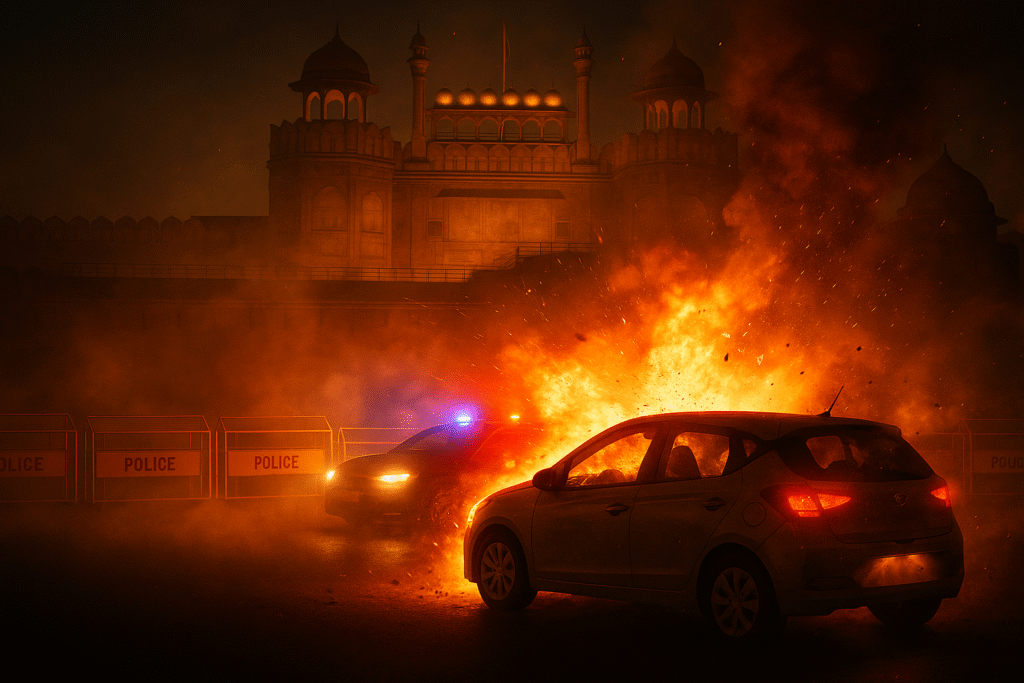
The explosion near the Red Fort was not a random act — it was calculated, deliberate, and executed with chilling precision. New CCTV footage from the area has revealed that the white Hyundai i20 involved in the blast was parked near a mosque for over three hours before the explosion.
This detail has shifted the investigation from simply identifying the vehicle to understanding the exact intent and coordination behind the attack.
The Critical Detail: The Car Waited
The car didn’t just pass through the area. It waited.
- The vehicle entered a nearby parking zone around late afternoon.
- It stayed stationary for more than three hours — the driver did not step out.
- It left just moments before the explosion took place near the Red Fort Metro Gate.
That waiting period is the key: this was not panic, impulse, or improvisation. It was patience. The kind of patience seen in coordinated attacks.
Ownership Trail Raises Bigger Questions
When investigators traced the vehicle’s registration, the story became even more concerning:
- The car was originally registered in Haryana.
- It was later sold to a buyer from Pulwama in Jammu & Kashmir.
- This ownership chain is now central to uncovering whether the blast was part of a larger network.
The connection to Pulwama immediately raises the stakes — and the possibility of involvement from an organized group rather than a lone individual.
Why This Blast Matters
This is not just another security incident. The blast happened:
- Near one of India’s most symbolically powerful heritage sites.
- In a dense public movement zone.
- Adjacent to metro connectivity — meaning high footfall and high vulnerability.
It sends a message — and clearly, someone wanted that message heard.
What Investigators Are Now Focusing On
- Identity of the Driver
Was it the final user of the car, or a planted operative? - Method of Detonation
Was the explosion triggered remotely, manually, or on a timer? - Connection to Recent Explosive Seizures
A massive quantity of explosives was recently recovered in the NCR region. The possibility that these incidents are linked is being examined. - Parking Area Surveillance Patterns
If the car could sit idle for hours without raising suspicion, that’s a failure in the urban security layer itself.
The Bigger Lesson: Urban Heritage Zones Are Soft Targets
Red Fort is not just history. It is symbolism, identity, and visibility.
And it was targeted because the attacker knew:
- Security looks strong from a distance
- But movement zones, parking stretches, and feeder routes are often overlooked
India’s historical and tourist zones need more than checkpoints. They need dynamic surveillance, AI-based vehicle monitoring, and dwell-time alerts — immediately.
In Summary:
The Red Fort Blast was not a spontaneous act — it was a planned strike executed with discipline. The car’s three-hour presence before the explosion is the clearest indicator of intent. The coming days will reveal not just who was behind this, but how they slipped through one of the most watched zones in the capital.
This incident is a warning. And ignoring it would be a mistake.